Almal van ons wonder oor iets… miskien die lewe, oor onsself of dalk oor God. Wat is dit wat jy oor wonder? En hoe kan jy sekere wonder van jou lewe uitskakel?
1.Gee Aanlyn (Kruik Gemeente, ABSA, Tjek, Rek nr: 1510140016) 2.Gee deur Zapper – vind ons QR code in die diens aankondigings. Kontak ons gerus op Kruik Gemeente se Facebook Messenger en Whatsapp lyn (072 133 6130) of besoek ons webtuiste by: https://www.kruik.co.za
ACCUSED SENTENCED TO TEN YEARS IMPRISONMENT FOR R2.4MILLION DRUGS
MPUMALANGA –Andwele Solomon Mwabangwe (45), a foreign national was found guilty and sentenced by the Barberton Magistrate’s Court on Wednesday, 23 November 2021 for dealing in drugs.
The accused was arrested on 19 May 2018 while he was driving Nissan X-trail along R40 road from Swaziland to Gauteng Province. The vehicle was searched and 16 kilograms of heroin to the estimated street value of R2.4 Million was recovered and seized.
Photo for illustration purposes
The accused was arrested resulting in the subsequent conviction. The accused was sentenced to 10 years of direct imprisonment.
The investigation by the Asset Forfeiture Unit into the seized vehicle which was used in the commission of a crime is continuing. An exhibit is also dealt with.
Die derde Kersliggie Fees volg op 2 vorige suksesvolle feeste en is weereens dankbaar vir Midnight Engen Vulstasie in Bethal se betrokkenheid.
Die Fees vir Bethal se kinders word beplan vir die 11de Desember by Marietjie van Niekerk Laerskool se saal. Hierdie baie gewilde fees is oop vir alle kinders in die gemeenskap.
“Ons nooi graag alle kinders onder 13 jaar,” Het Michelle Rademeyer gesê, “Indien jy n kind het tussen 14 en 18 wat saamkom, laat weet asb vroegtydig.”
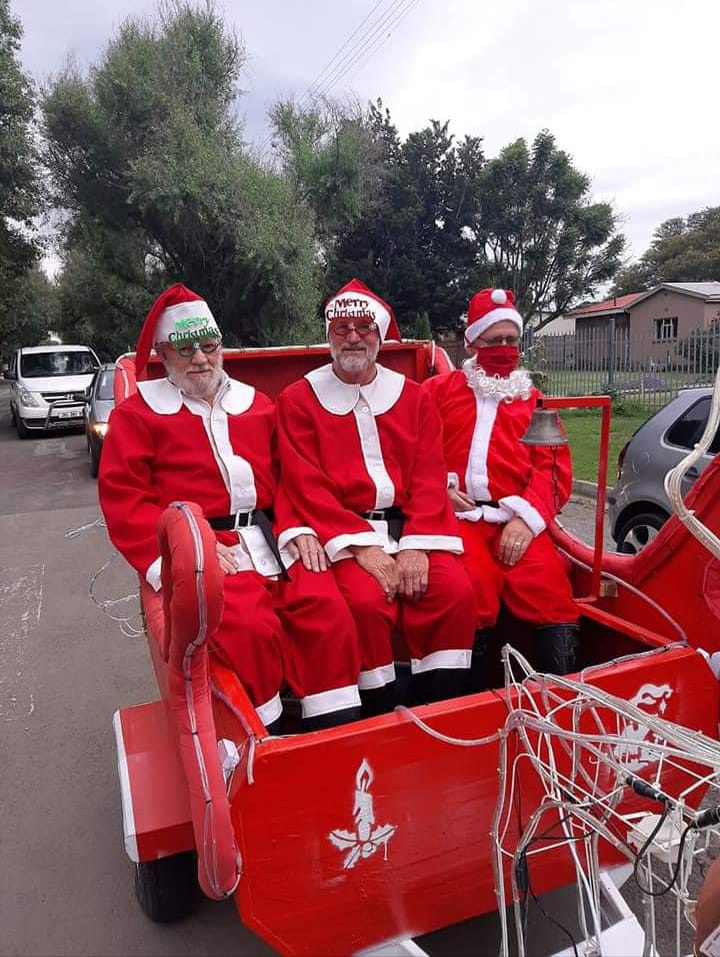
“Baie kinders het nog nooit n Kersboom in hul eie huise gehad nie,” het sy verder gesê, “Ons gaan weer n Kersvader en Elfies ook he, wat geskenke gaan uitdeel.”
Die Kersliggie Fees begin om 16:00 die middag en dit beloof om ‘n onvergeetlike dag te wees.
Daar sal ook n ete bedien word tydens die uitdeel van die geskenke.
“Alles is GRATIS,” het Micelle gesê, “Almal is welkom.”
Natuurlik is so ‘n fees nie moontlik sonder die hulp van die gemeenskap nie en hulp met die volgende word benodig:
Kersversierings/Liggies
Klein geskenkies vir seuns en dogters (Ter waarde van R50)
Geskenkpapier en kleefband sodat ek die persente kan toedraai.
“Ons vra dan dat die wat kan help ons kontak,” sê Michelle, “so ook die wat hul kinders gaan bring en bywoon. Ons sal graag wil beplan en moet weet hoeveel mense en hulle kinders daar gaan wees.”
Michelle kan by 0604917038 gekontak word of Hennie kan by 0765313587 geskakel word.
“Dis gratis vir Bethal, deur Bethal,” het Hennie Rademeyer aan die Bulletin gesê, “Dan het ons ook gaskuntenaars wat gaan optree en gaan sorg vir lekker vermaak dus het ons borge nodig om die optree kostes asook verblyf in gastehuis vir die Kunstenaar te betaal.”
Hoof borg van die Kersliggiefees
Hierdie jaar se gaskunstenaar is die allom bekende Manie Jackson
Finansiele bydraes kan direk inbetaal word by”
Kersliggie Projek
Capitec Bank
Spaar rekening
Rekening nr: 1672179333
Takkode: 470010
Vir alle navrae en bydraes kontak Michelle Rademeyer by 0604917038 of Hennie Rademeyer 0765313587
ANIMALS 101 – HOW TO HANDLE THEM CORRECTLY AND WITH CARE.
Many of us grew up with the tale of the rabbit and the tortoise, with a good life lesson in it, however this lesson didn’t include how to care for them or how to handle these creatures physically. That is what we will look at today.
We do not support keeping tortoises or rabbits as pets and especially not for kids. One of the biggest reasons for this is because there are very specific ways in which they should be handled and doing it wrong can be fatal! If you do decide to get any one of these species, then you NEED TO DO PROPER RESEARCH to meet all their needs! This includes, but is not limited to; food, enclosure, enrichment, social needs, behaviour and more.
ABOUT RABBITS
Rabbits have fragile skeletons and a powerful kick. This means they can easily break their backs, especially if not held correctly.
Their dietary requirements are not so straight forward and many do not understand this! One example: Carrots are to rabbits like sweets are to a child.
The protocols (pre & post) with sterilization are different from other pets. Most antibiotics can kill them, so you need an exotic pet vet!
They do not vocalize discomfort as much as a chinchilla or a dog, which means if they are screaming, it is already very sore/stressful and they can easily die from this.
Picture from The Paw Company Facebook page
TIPS ON HANDLING RABBITS
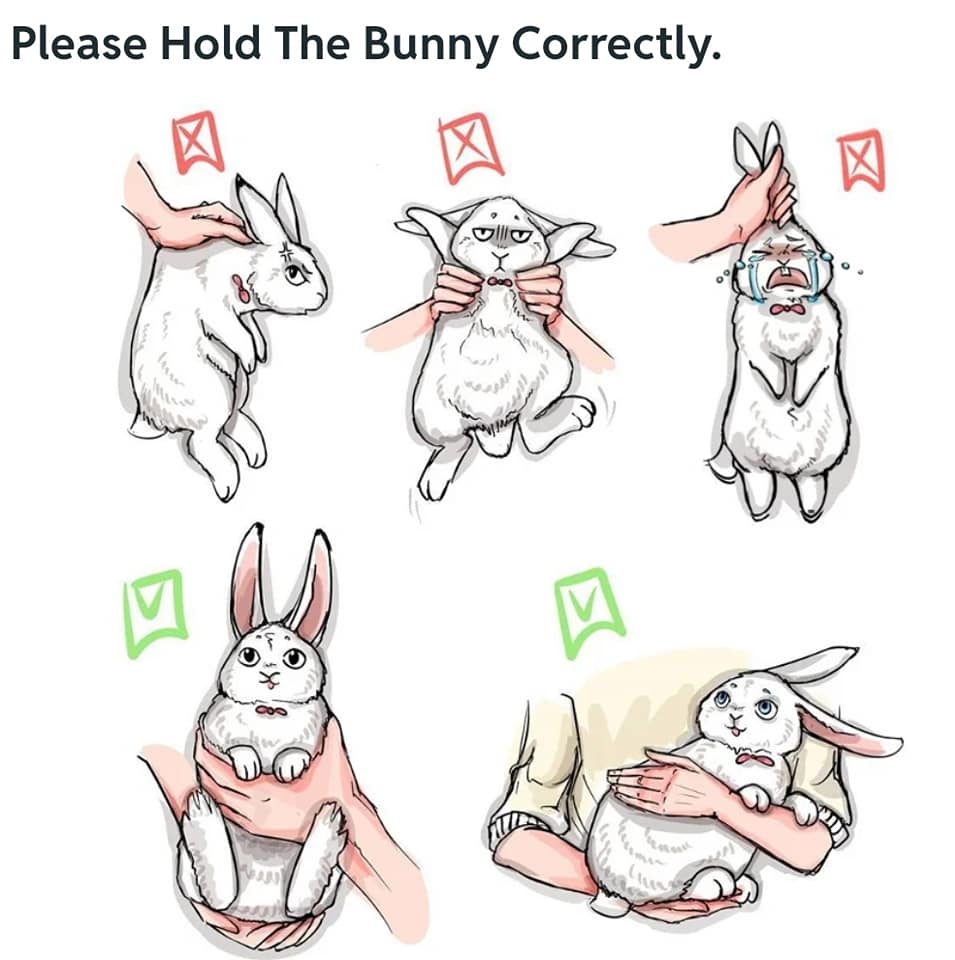
NEVER PICK THEM UP BY the ears, scruff, tail or legs. It would be extremely stressful, will hurt and is highly likely to injure them badly!
START EARLY
Get your rabbits used to human touch by socializing them early. Rabbits who aren’t handled regularly from a young age, or roughly handled at any age, may find human contact distressing.
BE GENTLE
Move slowly and talk quietly around rabbits so not to startle them. They’re more likely to be relaxed in a quiet and calm handling environment.
PICK UP FROM THE GROUND
Picking rabbits up when you’re close to ground level is less likely to scare them, and is also safer as it helps prevent them being dropped by accident from a height. We advise all interaction to take place on ground level when possible.
COVER EYES
This can help them feel more relaxed whilst being held, but you should ensure the nares (nostrils) aren’t obstructed. You can cover their eyes with a towel or in the crook of your arm.
ALWAYS SUPERVISE CHILDREN
Supervise children at all times, and only adults or responsible older children should be allowed to pick up rabbits.
BE SAFE
Safety is paramount when handling rabbits as their fragile spines can be seriously, or even fatally damaged if they feel insecure or struggle when held.
Hold rabbits gently, but firmly and ensure one hand supports their back and hindquarters at all times.
Help them feel secure by holding all four feet against your body.
Avoid placing rabbits on slippery surfaces. Placing a towel down can help make rabbits feel more secure.
Watch this video on how to handle a rabbit or look at the Wikihow pictures.
Photo from The Paw Company Facebook page
ABOUT TORTOISES
REMEMBER THEY ARE NOT “IN” THEIR SHELLS, THEY “ARE” THEIR SHELLS. They are born with one and will keep only that one.
Pyramiding is a shell deformity sometimes found in captive tortoises, in which the shell grows unevenly resulting in a pyramid shape underlying each scute.
If you move a tortoise out of the road then it should be in the same direction that they were going.
When picked up in nature they are usually dinner, so this might stress them out, even if you do not plan to eat them!
Mid-Atlantic Turtle & Tortoise Society advises as follow:
Hold them firm enough to not let them drop (watch back legs), but not too hard to hurt them.
Don’t lift them high of the ground. This will be very scary for them!
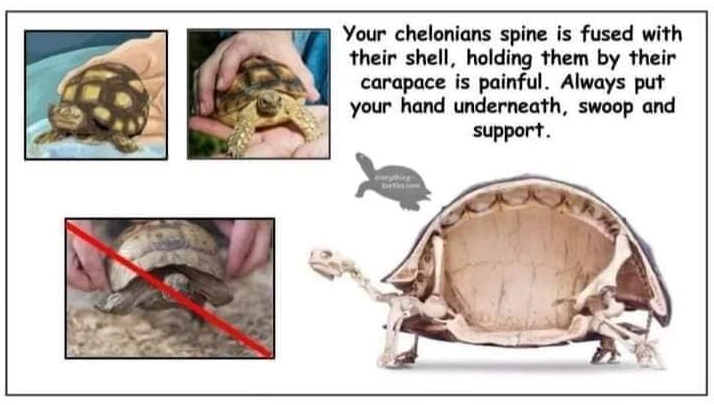
REMEMBER the shell of a turtle/tortoise is sensitive to touch, can be injured and can break. It is a living and growing part of the tortoise/turtle.
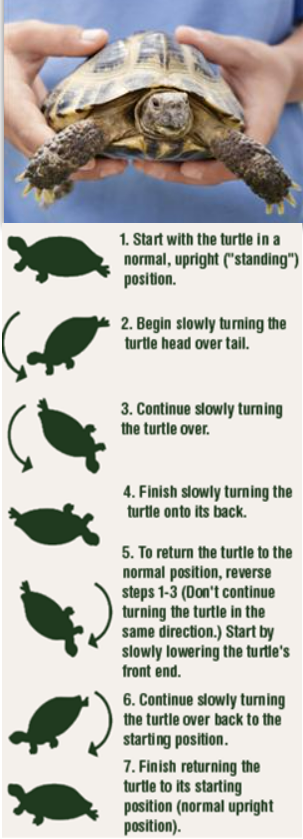
See picture below on holding them. Those with calcium deficiency, some diseases, young ones or certain tortoises/turtles have softer shells and you can hurt them when picked up incorrectly.
BOTH HANDS need to be used for SUPPORT.
Never complete a 360⁰ circle when you turn them. Only 180⁰.
Rotate them SLOWLY and never side to side. It has to be tail over head or head over tail. See picture attached.
Do not hold them on their back for any longer than absolutely necessary!
Never pick them up by the legs or tail, it can dislocate and will be very painful.
Put them down slowly and gently to not cause damage to their legs, organs or shell. Visit their website for more info.
Photo by Mid-Atlantic Turtle & Tortoise Society
REMEMBER!
Never release a captive animal into the wild! They will not be able to care for themselves. Surrender them to your nearest SPCA, the NSPCA wildlife unit, your nearest reputable rescue organisation or a near-by wildlife rehabilitation centre.
If you see neglected rabbits or tortoises/turtles (any animal) please REPORT it to your local SPCA or the NSPCA.
Check your local BYLAWS on whether you need a PERMIT for keeping them in your province as well as possible travel permit when you move them.
If you’re concerned about your rabbits or tortoises’s behaviour, seek veterinary advice, from an exotic vet, to rule out any form of illness or injury that could be causing problems. Read more below on choosing the right veterinarian as all vets are not qualified to treat exotic pets!
Read more on rabbit sterilization and questions to ask your veterinarian.
PLEASE STERILIZE YOUR RABBITS and other pets! Rabbits can have a litter almost every month. Hundreds of rabbits are surrendered daily, because there are just not enough homes.
Want a rabbit? Then please ADOPT, DON’T SHOP. Contact Critter Rescue SA for free care sheets for rabbits or to adopt. Another great rabbit resource is The House Rabbit Society.
Thanks for tuning in! Next week we will look at safety tips when it comes to hot weather and your pets.
ACCUSED REMANDED IN CUSTODY FOR ENTICING TRAFFIC OFFICIALS
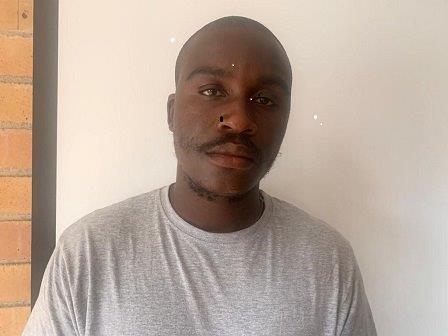
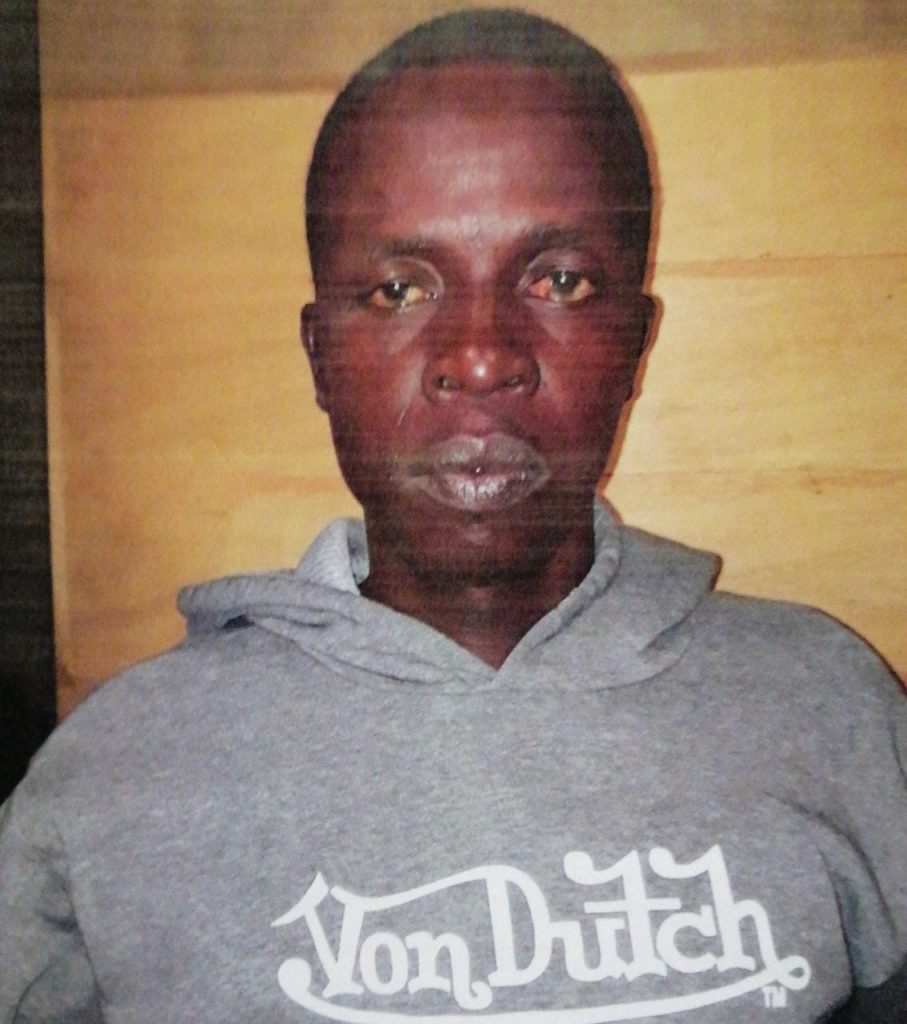
MPUMALANGA – Accused Moshayi Tonderai (31) and Patrick Ncube (31) were remanded in custody by the Komatipoort Magistrates Court on Friday, 19 November 2021 after he was arrested for enticing traffic officials. The case was postponed to 23 November 2021 for a formal bail application.
Moshayi Tonderai (31)
It is alleged that on 17 November 2021, Tonderai from Zimbabwe who is a truck driver was at Lebombo Port of Entry when he bypassed other truck drivers who had queued for their turn to cross the border. He was stopped by the traffic police for a routine inspection of the truck. When the routine check was done, it was discovered that the truck had an expired disc. The truck driver was asked about the documents of the truck, he then became violent and drove away nearly running over the traffic officer.
Patrick Ncube(31)
When pursued, he stopped the truck and locked himself inside the truck, refusing to talk to the traffic police officers until his boss from Limpopo was contacted to speak to him that he should hand himself over to the police officers. He has been arrested and charged with attempted murder and operating an un-roadworthy vehicle.
The following day, other truck drivers from Zimbabwe contributed an amount of R4 000 and allegedly went to approach the traffic officer, Mr Baloyi that he should squash or withdraw the case against their homeboy. It is further alleged that they initially promised to give R10 000.
The traffic officer then decided to report the matter to the Hawks’ Serious Corruption Investigation team based in Nelspruit, that he is being offered a bribe by the truck drivers. The team arranged for a sting operation which led to the arrest of Ncube who then joined Tonderai in custody.
South African National Parks (SANParks) in partnership with TotalEnergies Marketing South Africa and First National Bank (FNB) has opened the 16th annual South African National Parks Week in Addo Elephant National Park, in the Eastern Cape. The week, opened by the SANParks Chairperson of the Board Pamela Yako begins tomorrow, 22 November 2021 and ends on 28 November 2021.
SANParks Acting Chief Executive Officer, Dumisani Dlamini says that under the established theme ‘Know Your National Parks’, the weeklong campaign encourages citizens through the #LiveYourWild campaign to visit a national park for free and be part of a worldwide campaign. “SANParks is striving to provide all South Africans with equal opportunities and in line with our vision of an ‘A world-class system of sustainable national parks reconnecting and inspiring society’, we want to inspire people to take pride in and to enjoy their national parks while spending time in nature.”
Dlamini said that free access will be granted to South African day visitors. “This is also an effort to reach out and allow all citizens a chance to freely access something they might not have been exposed to and to start to understand the importance of conservation.” The free access to the parks does not include accommodation or any commercial activities in the park. Kruger, Addo Elephant, Augrabies, Agulhas, Table Mountain and the Tsitsikamma section of Garden Route National Park will only have free access until Friday 26 November.
“This week is also an opportunity to showcase all the national parks as key and affordable local holiday destinations which offer unique experiences that families and individuals from all backgrounds, cultures, lifestyles and communities can enjoy.”
Dlamini said that due to the country still being on Alert Level 1 of the lockdown in November… “we would like to remind the public that a quota system will apply in most of our national parks throughout the focus week. We have to remain responsible and alert and therefore would like to request the public to continue to observe the COVID 19 protocols, which are sanitising, wearing of our face masks and observing social distancing.”
TotalEnergies Marketing South Africa’s CEO & Executive VP Southern Africa, Mariam KANE-GARCIA said, “With our ambition to be a major player in the energy transition and being a partner of SANParks for more than 62 years, we remain committed to the conservation of wildlife and the collective heritage of South Africans which are fundamentally associated with sustainable development. TotalEnergies Marketing South Africa is honoured to be part of meaningful programmes geared towards nature conservation in South Africa. We are particularly proud of the annual SANParks Week which allows free entry to SA citizens and gives everyone the opportunity to experience the parks first-hand.”
Sipho Silinda, CEO, FNB Public Sector Banking says “The 16th annual SANParks week is a notable milestone in our commitment to continue enabling South African citizens to explore our country’s natural heritage. While not forgetting that the tourism industry is still one of the most affected sectors by the Covid-19 pandemic, it, therefore, remains vital for our communities and individuals to support our national heritage and culture.”
SANParks started this campaign in 2006 to encourage all South Africans, especially those from the communities around the parks, to share in what SANParks believes to be the pride and joy of all South Africans and the world. “The survival of the South African national parks system and our natural and cultural heritage lies in the people of South Africa and we are focused on involving young people and communities, to cultivate knowledge of the importance of conservation and an appreciation for the country’s natural heritage,” concluded Dlamini.
Visit our website www.sanparks.org/about/events/parks_week for more information and follow #SANationalParksWeek and #LiveYourWild on social media, to join in the fun and discover all there is to do and see in our national parks
TWO FOREIGN NATIONALS IMPRISONED FOR POSSESSION OF RHINO HORNS
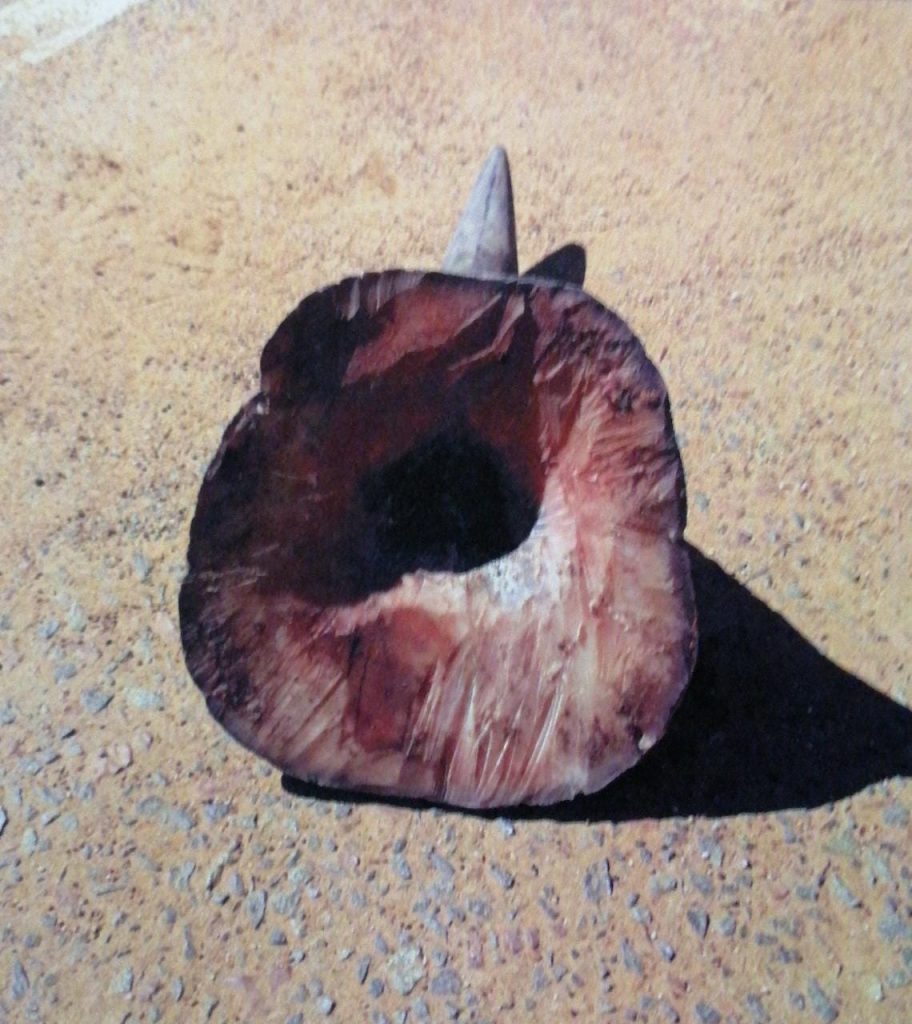
MPUMALANGA – The Middelburg Regional Court sentenced a father (48) and his son (27) to a total of 14-year imprisonment for National Environmental Management Biodiversity Act (NEMBA)-related charges on 19 November 2021.
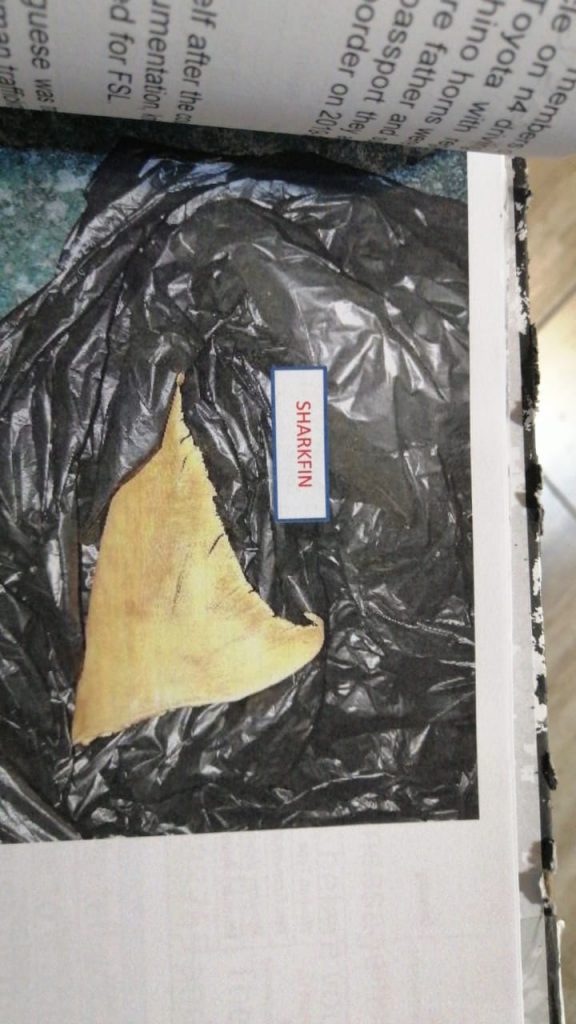
On 20 April 2019, two Mozambicans both named Alberto Ernesto Nharreluga were travelling on the N4 in Nelspruit when they were stopped by the Middelburg Flying Squad members. Police searched their vehicle and recovered two rhino horns as well as shark fin. They were immediately arrested and they offered police officers R20 000 to turn a blind eye to a criminal act.
They were charged and the docket was assigned to the Middelburg based Hawks team for investigation. The accused were kept in custody throughout the trial.
They were sentenced to six years for possession of rhino horns, five years for corruption and three years for possession of a shark fin.
Welkom by Kruik se oggenddiens van 21 November 2021
Vanoggend se tema: “Wonder”
Almal van ons wonder oor iets… miskien die lewe, oor onsself of dalk oor God. Wat is dit wat jy oor wonder? En hoe kan jy sekere wonder van jou lewe uitskakel?
A man was shot and killed early this morning in Thistlegrove
A man was shot and killed this morning at his home in Thistlegrove, Kinross.
4 Armed men stormed the house of one of the Co-Taxi Owners from Vukanini Taxi Association. The man, whose name is known to the Bulletin, was doing his chores with two of his Taxi drivers. They were starting the Taxi’s when the 4 armed men opened fire.
It is alleged that at least 5 AK-47 shell casings and three 12guage casings were found on the scene. It is also alleged that his body was hit more than once in the attack.
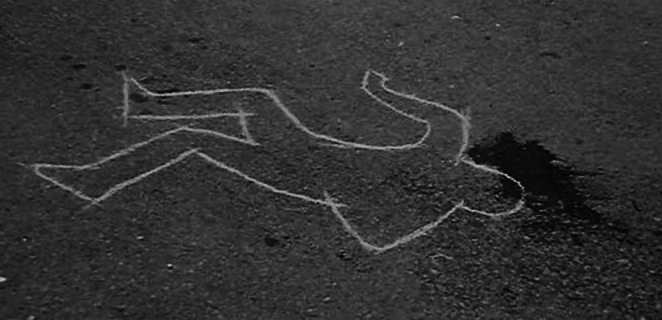
image for illustration purposes
While the first impression would be that this is Taxi related it is believed not to be the case. Nothing was taken during the attack.
The motive remains a mystery as the investigation is still in very early stages. Anyone with information can contact Kinross Police station.
Emergency personnel was summoned to the scene as well as SAPS but the man, unfortunately, succumbed to the gunshot wounds and was declared deceased by the EMS.
This shocking incident left his colleagues in the taxi business in disbelief and shocked.
The family of the deceased asked for privacy to come to grips with the tragedy and to mourn his death.
ANIMALS 101 – WHO LET THE DOGS OUT? WOOF WOOF WOOF WOOF!
One of the 5 FREEDOMS OF ANIMAL WELFARE includes the FREEDOM TO EXPRESS NATURAL BEHAVIOUR and barking is natural behaviour! Barking is a way to communicate, so it will never be the goal to stop barking entirely. Obviously, we don’t want constant or excessive barking, but then we need to find out what is being constantly communicated through the barking. Barking is a way your dog is telling you something is not right, which might include that their needs are not met, so listen up!
REASONS WHY DOGS BARK
Dogs bark for different reasons and understanding what triggers the behaviour can provide insights into what, if anything, you should do about it. Barking can simply be a form of greeting, but two of the top reasons probably are that IT FEELS GOOD & IT WORKS! When you pat them after a bark, it worked! When a person or pet backs off after a bark, it worked! When you give them a treat (maybe to silence them), it worked!
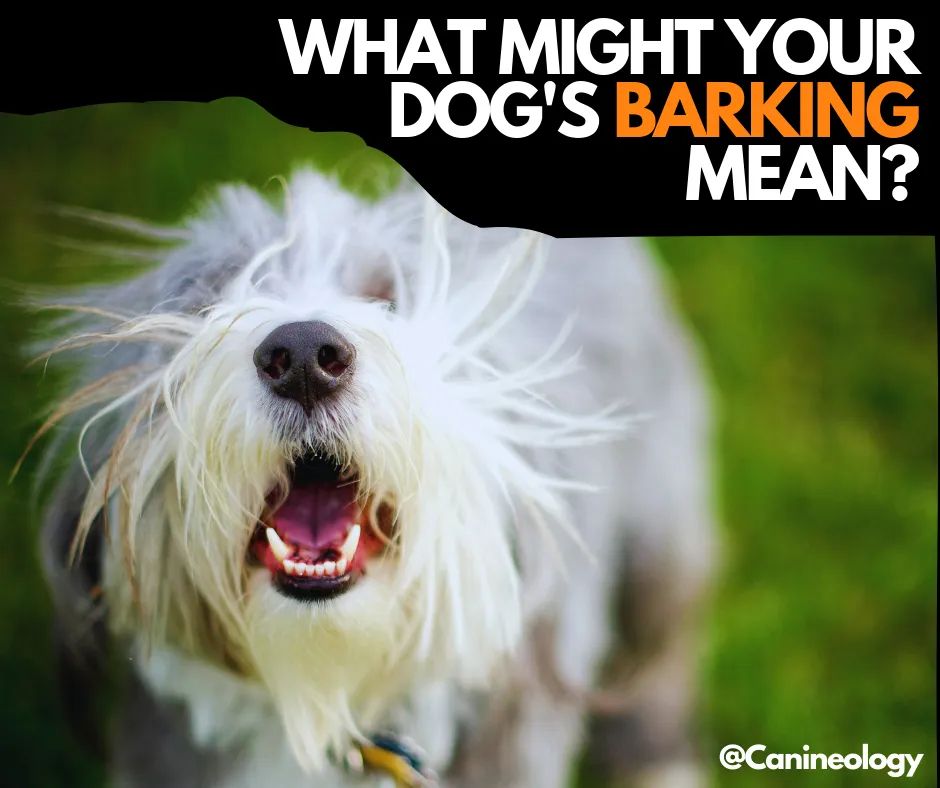
Photo by Canineology
OTHER REASONS
Genetics – some breeds are more prone to barking (e.g., Terriers), even though any breed can bark excessively.
Physical needs – The dog is hot, cold, hungry, thirsty, want to go potty or is in pain. This is the dog’s way of requesting that you help them with one of their needs. Insufficient exercise, means build-up energy, which is easily released through barking.
Emotional needs – This may include boredom, excitement, surprise, fear, being anxious or it can be compulsive behaviour due to a frustration and need for social and/or mental stimulation and attention.
Environment – Improper confinement (locked up, restrictive tethering, alone for long periods of time etc.). It can also be a territorial bark or in response to other dogs barking. It can also be triggered by cars or people passing by, sirens, storms or other changes in their environment.
Just like a mom might know what her baby needs by the way they cry, so can this apply to your dog’s bark. Listen carefully and learn the type of bark and what they are telling you specifically through that bark.
Two key indicators might be what they are looking at when they bark and what happens after the bark.
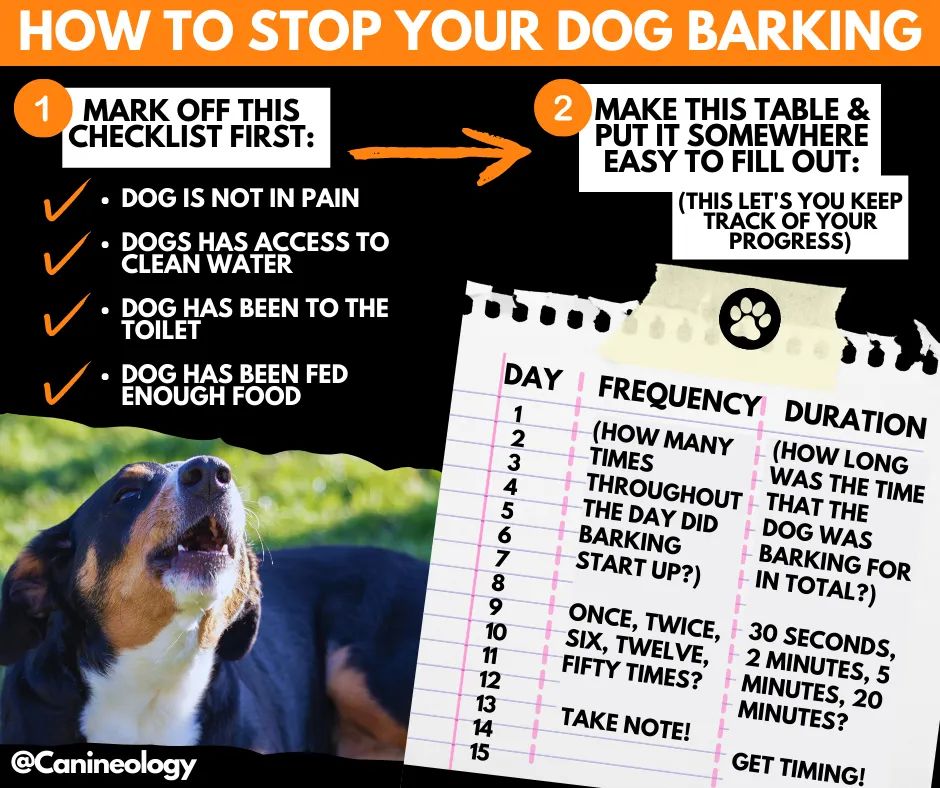
Photo by Canineology
READ MORE on what the specific type of bark might mean.
ADDRESSING THE PROBLEM OF EXCESSIVE BARKING
Some reasons for excessive barking resolve with appropriate environmental or lifestyle adjustments, while others may benefit from positive reinforcement behaviour training.
First, attempt to understand what he’s trying to tell you, rather than trying to prevent your dog’s barking. You can also focus instead, on rewarding his silence. As you interact with your dog, you can encourage barking by rewarding the behaviour (more playtime or treats, for instance, when she barks) or encourage silence using the same principle.
New behaviour? Consider a vet visit or PROFESSIONAL HELP from a qualified behaviourist.
Photo by Canineology
IMPORTANT NOTES!
Never punish communication! It’s important not to punish your dog for barking; if you do, you’ll both miss out on this rewarding form of communication. However, for times when you need your dog to be quiet, encourage silence by offering praise and a treat or attention reward when she stops barking on command.
As barking is a way of communication, so is a growl. NEVER PUNISH A GROWL! It is the way the dog is telling you that they are not comfortable. When you punish the growl, the next time, they might skip the growl and go straight to bite.
Devocalization, or DEBARKING, which involves cutting or removing an animal’s vocal cords, is a CRUEL PROCEDURE that should not be considered to stop a dog from barking, as it removes a natural method of communication, can cause permanent health problems and it never addresses the root cause of the behaviour. It involves lots of postoperative pain and it is unnecessary. Most Vets will condemn it, but never support a vet that supports it, unless there was a critical medical reason for it. The same goes for anti-bark collars which is fear-based training and cruel.
If a dog barks excessively it can be very frustrating to neighbours, but it is important to always remember that those animals were and are being failed by humans, it is not their fault! Don’t blame them!
DON’T IGNORE A CHANGE IN A BARK (OR MEOW)!
Your pet’s vocalizations are important, as they can clue you in to how they feel physically and emotionally. Dr. Karen Becker explains that if you notice any changes with their voice, that you shouldn’t ignore it. Unlike most transient voice changes or laryngitis in people, a change in or loss of voice in dogs and cats should trigger a visit to the veterinarian.
She further explains that there are mainly two types of voice changes in pets: mechanical interference with vocal cord vibration, or loss of nerve signals to the vocal cords.
Mechanical interference with vocal cord vibration is often caused by trauma, an abscess, tumours or cancer.
Loss of nerve signals to the vocal cords can have many causes, including an autoimmune condition, infection, hypothyroidism, and laryngeal paralysis.