The Electoral Commission will urgently approach the Electoral Court to
postpone all scheduled by-elections as part of its response to the COVID-19
pandemic.
The decision follows the announcement by the President of the Republic
of a National Disaster in terms of the Disaster Management Act (Act 57 of 2002)
and the introduction of a range of measures to help curb the spread of the
coronavirus. The measures announced include urging people to limit physical
contact and prohibiting gatherings of more than 100 people.
The election process involves relative close physical contact between election officials and voters including the exchange of ballot papers and inking of thumbs. At the end of the voting process, ballot papers must also be counted. Where an infected voter has handled a ballot, indications are that active viruses will last for at least 10 hours. This will be yet another opportunity for cross-infection of officials conducting the counting process.
Given heightened awareness and concerns over the COVID-19 pandemic, there is also a real possibility that significant numbers of voters may stay away from voting stations in upcoming by-elections.
This will result in low participation levels which will undermine the
freeness and fairness of elections.
The Commission is of the view that in the circumstances, the measures
announced as part of the national response to the pandemic; the possibility of
free and fair elections is incontrovertibly vitiated.
The Commission has written to the Minister and provincial MEC’s for
Cooperative Governance and Traditional Affairs to advise them of the intended
application to the Electoral Court.
All associated election events including voter registration weekends and
code of conduct signing ceremonies have also been postponed.
Scheduled by-elections affected are as per the schedule below:
BY-ELECTION DATE
PROVINCE
MUNICIPALITY
WARD NUMBER
DATE OF PROCLAMATION
18 March 2020
Gauteng
Emfuleni
16
14 Feb 2020
18 March 2020
Gauteng
City of Johannesburg
68
14 Feb 2020
18 March 2020
Gauteng
City of Johannesburg
120
14 Feb 2020
18 March 2020
Gauteng
City of Johannesburg
130
14 Feb 2020
18 March 2020
KwaZulu-Natal
Msunduzi
25
14 Feb 2020
18 March 2020
KwaZulu-Natal
Mtubatuba
10
14 Feb 2020
18 March 2020
Limpopo
Polokwane
14
14 Feb 2020
18 March 2020
Mpumalanga
Emalahleni
18
14 Feb 2020
18 March 2020
Mpumalanga
Bushbuckridge
31
14 Feb 2020
18 March 2020
Northern Cape
Khai-Ma
4
14 Feb 2020
8 April 2020
Free State
Matjhabeng
3
6 March 2020
8 April 2020
Gauteng
Ekurhuleni
60
6 March 2020
8 April 2020
Gauteng
Ekurhuleni
103
6 March 2020
8 April 2020
Gauteng
Tshwane Metro
3
6 March 2020
8 April 2020
KwaZulu-Natal
eThekwini
32
6 March 2020
8 April 2020
KwaZulu-Natal
uMvoti
7
6 March 2020
29 April 2020
Gauteng
Ekurhuleni
89
27 March 2020
29 April 2020
Limpopo
Ba-Phalaborwa
19
27 March 2020
29 April 2020
Mpumalanga
Govan Mbeki
30
27 March 2020
13 May 2020
Eastern Cape
Makana
14
9 April 2020
13 May 2020
Eastern Cape
Amahlathi
1
9 April 2020
13 May 2020
Eastern Cape
Mbizana
24
9 April 2020
13 May 2020
Northern Cape
Dawid Kruiper
10
9 April 2020
13 May 2020
Western Cape
George
8
9 April 2020
13 May 2020
Western Cape
George
14
9 April 2020
13 May 2020
Western Cape
George
27
9 April 2020
All associated election events including voter
registration weekends and code of conduct signing ceremonies have also been
postponed.
MPUMALANGA HAWKS SEARCHING FOR SAM
“MSHENGU’ TSHABALALA FOR FAILING TO APPEAR IN COURT
MPUMALANGA – The Directorate for Priority
Crime Investigation (DPCI) is asking for the public’s assistance in locating
the whereabouts of Sambulo Bruce Tshabalala (26) who failed to appear in court
on two occasions for fraud, two counts of corruption and possession of an
unlicensed firearm.
Tshabalala, who goes by the name Mshengu,
is out on bail of R200 000 and R500 000 respectively for two cases. He failed to appear for his two cases on 06
March 2020 at the Witbank Magistrate Court and last week Friday in the
Middelburg Magistrate Court. The combined amount of the bail posted for the two
separate cases has since been forfeited to the state.
Tshabalala was first arrested in September
last year following an investigation initiated by the Department of Home
Affairs about his status in the country.
Tshabalala allegedly tried to derail the investigations after he tried
to corrupt an official from the department to drop the probe. He paid R50 000 to the official and was
nabbed by the Mpumalanga Hawks immediately after paying the inducement. His car at the time was also impounded. He was granted R200 000 bail pending further
investigations.
Whilst on bail Tshabalala attempted to
corrupt a senior police official in Middelburg in February this year to release
his car which had been impounded and also to make his previous case disappear.
He paid R120 000 bribe money, R50 000 down payment and later R70 000 which led
to his arrest. He was released on R500 000 bail by the Middelburg Magistrate
Court for corruption pending his appearance on 13 March 2020. He decided not to turn up and two warrant of
arrests have been issued against him.
The Hawks has seen a suicidal note that was sent to his wife claiming that he is going to commit suicide. Despite the note, anyone with information which can lead to the arrest of Tshabalala is urged to contact the investigating officers Colonel Daniel Hall on 071 481 3281 or Captain Dietlof Meyer on 071481 2977. All information will be kept confidential.
South African President, Cyril Ramaphosa, addressed the nation after an urgent cabinet meeting on Sunday, March 15.
One of the measures taken by the Government is to close all schools from March 18 until after the Easter weekend.
The President apologised for the late
start and explained that consultations needed to be finalised. Here are some quotes
from his address:
“The world is facing a medical emergency, far graver than any that we have experienced in over a century. The World Health Organisation (WHO) has declared the Coronavirus outbreak as a global pandemic. There are now more than 162000 people that tested positive for the Coronavirus across the globe.
Given the scale and the speed that the
virus is spreading is clear that no country is immune from the disease or will
be spared its severe impact.
Never before in the history of our
democracy has our country been confronted with such a severe situation.
As of now, South Africa has 61 confirmed
cases of people infected with the virus and this number is expected to rise in
the coming days and weeks.
Initially, it was people that travelled out of the country especially Italy that tested positive for the virus. It is concerning that we are now dealing with the internal transmission of the virus.”
Serious measures were announced to reduce the impact of the virus on the nation as a whole.
A national state of disaster has been declared by the President! This will enable the government to set up and implement rapid and emergency responses to situations as necessary.
Cabinet decided on the following measures
to try and contain the disease.
Limit contact with persons who may be infected.
A travel ban imposed on foreign nationals from high-risk countries such as Italy, Iran, South Korea, Spain, Germany, The United States, The United Kingdom and China as from 18 March 2020.
Cancelled Visas from those countries from today and previously granted visas are revoked.
South African citizens are advised to refrain from travelling especially through the European Union, The United States, The United Kingdom and other identified high-risk countries. This is effective immediately.
Any foreign national who visited high-risk countries in the past 20 days will be denied a visa.
South African citizens returning from visits to high-risk countries will be subjected to testing and self-isolation or quarantine on return to South Africa.
Al travellers from medium-risk countries such as Portugal, Singapore and Hong Kong will be subjected to high-intensity screening.
All travellers that have entered South Africa from high-risk countries since mid-February are required to present themselves for testing.
South Africa has 72 points of entry into the country. Of the 53 land ports, 35 will be shut down from Monday 16 March.
2 of the 8 seaports will be closed for passengers and crew changes.
Effective immediately, all non-essential travel for government
Non-essential domestic travel has been discouraged. Especially by air, rail, busses and taxis.
Group gathering of more than 100 has been prohibited.
This will affect every single person in
South Africa. The world economy has already shown the effects of the outbreak.
Here are some tips on preventing the disease.
(From the WHO)
Wash your hands frequently
Regularly and thoroughly clean your hands with an alcohol-based hand rub
or wash them with soap and water.
Why? Washing your hands with soap and water or using alcohol-based hand
rub kills viruses that may be on your hands.
Maintain social distancing
Maintain at least 1 metre (3 feet) distance between yourself and anyone
who is coughing or sneezing.
Why? When someone coughs or sneezes, they spray small liquid droplets from their nose or mouth which may contain the virus. If you are too close, you can breathe in the droplets, including the COVID-19 virus if the person coughing has the disease.
Avoid touching eyes, nose and mouth
Why? Hands touch many surfaces and can pick up viruses. Once
contaminated, hands can transfer the virus to your eyes, nose or mouth. From
there, the virus can enter your body and can make you sick.
Practice respiratory hygiene
Make sure you, and the people around you, follow good respiratory
hygiene. This means covering your mouth and nose with your bent elbow or tissue
when you cough or sneeze. Then dispose of the used tissue immediately.
Why? Droplets spread the virus. By following good respiratory hygiene, you protect the people around you from viruses such as cold, flu and COVID-19.
If you have fever, cough and difficulty breathing, seek medical care
early
Stay home if you feel unwell. If you have a fever, cough and difficulty
breathing, seek medical attention and call in advance. Follow the directions of
your local health authority.
Why? National and local authorities will have the most up to date information on the situation in your area. Calling in advance will allow your health care provider to quickly direct you to the right health facility. This will also protect you and help prevent the spread of viruses and other infections.
Stay informed and follow the advice given by your healthcare provider
Stay informed on the latest developments about COVID-19. Follow the advice given by your healthcare provider, your national and local public health authority or your employer on how to protect yourself and others from COVID-19.
Why? National and local authorities will have the most up to date information on whether COVID-19 is spreading in your area. They are best placed to advise on what people in your area should be doing to protect themselves.
Here is the full statement by the President (as received):
STATEMENT BY PRESIDENT CYRIL RAMAPHOSA ON MEASURES TO COMBAT COVID-19 EPIDEMIC 15 MARCH 2020 Fellow South Africans, I am addressing you this evening on a matter of great national importance. The world is facing a medical emergency far graver than what we have experi-enced in over a century. The World Health Organisation has declared the coronavirus outbreak as a global pandemic. There are now more than 162 000 people who have tested positive for the coronavirus across the globe. Given the scale and the speed at which the virus is spreading, it is now clear that no country is immune from the disease or will be spared its severe impact. Never before in the history of our democracy has our country been confronted with such a severe situation. From the start of the outbreak in China earlier this year, the South African gov-ernment has put in place measures to screen visitors entering the country, to contain its spread and to treat those infected. As of now, South Africa has 61 confirmed cases of people infected with the virus, and this number is expected to rise in the coming days and weeks. Initially, it was people who had travelled out of the country, especially from Italy, who had positively tested for the virus. It is concerning that we are now dealing with internal transmission of the virus. This situation calls for an extraordinary response; there can be no halfmeasures. Cabinet held a special meeting earlier today. After which, due to the serious measures we are going to announce, I have consulted the premiers. We have decided to take urgent and drastic measures to manage the disease, protect the people of our country and reduce the impact of the virus on our society and on our economy. We have now declared a national state of disaster in terms of the Disaster Management Act. This will enable us to have an integrated and coordinated disaster management mechanism that will focus on preventing and reducing the outbreak of this virus. We will also be able to set up emergency, rapid and effective response systems to mitigate the severity of its impact. Following an extensive analysis of the progression of the disease worldwide and in South Africa, Cabinet has decided on the following measures: Firstly, to limit contact between persons who may be infected and South African citizens We are imposing a travel ban on foreign nationals from high-risk countries such as Italy, Iran, South Korea, Spain, Germany, the United States, the United Kingdom and China as from 18 March 2020. We have cancelled visas to visitors from those countries from today and previously granted visas are hereby revoked. South African citizens are advised to refrain from all forms of travel to or through the European Union, United States, United Kingdom and other identified high-risk countries such as China, Iran and South Korea. This is effective immediately. Government will continue to regularly issue travel alerts referring to specific cities, countries or regions as the situation evolves based on the risk level. Any foreign national who has visited high-risk countries in the past 20 days will be denied a visa. South African citizens returning from high-risk countries will be subjected to testing and self-isolation or quarantine on return to South Africa. Travellers from medium-risk countries – such as Portugal, Hong Kong and Singapore – will be required to undergo high intensity screening. All travellers who have entered South Africa from high-risk countries since mid-February will be required to present themselves for testing. We will strengthen surveillance, screening and testing measures at OR Tambo, Cape Town and King Shaka International Airports South Africa has 72 ports of entry in the country which are land, sea and air ports. Of the 53 land ports, 35 will be shut down with effect from Monday 16 March. 2 of the 8 sea ports will be closed for passengers and crew changes. Effective immediately, all non-essential travel for all spheres of government outside of the Republic is prohibited We further discourage all non-essential domestic travel, particularly by air, rail, taxis and bus. Secondly, it is essential therefore that we minimize the risk of the spread of this virus by limiting contact amongst groups of people. While we appreciate the economic, religious, and cultural significance of social and community gatherings, the coronavirus is spread through contact between persons. As we have said before, the current circumstances require extraordinary measures to curb the spread of infections. Countries that have heeded the call to implement these radical measures, have fared much better than those than do not. Therefore to encourage social distancing Cabinet has decided on these additional measures: Gatherings of more than 100 people will be prohibited. Mass celebrations of upcoming national days such as Human Rights Day and other large government events will be cancelled. Where small gatherings are unavoidable, organisers will need to put in place stringent measures of prevention and control. Schools will be closed from Wednesday, 18 March, and will remain closed until after the Easter Weekend. To compensate, the mid-year school holidays will be shortened by a week. Government is working closely with colleges, universities and other public facilities such as Parliament, prisons, police stations and military installations to intensify hygiene control. Visits to all correctional centres are suspend for 30 days with immediate effect. Government is aware of the confirmed case of a student who has tested positive for the coronavirus at Wits University. Those who have been in contact with the student will be quarantined. The Minister of Higher Education, Science and Innovation is consulting with vice chancellors of universities and colleges across the country and will soon be announcing measures in this regard. We call on all businesses including mining, retail, banking, farming to ensure that they take all necessary measures to intensify hygiene control. We also call on the management of malls, entertainment centres and other places frequented by large numbers of people to bolster their hygiene control. Thirdly, to further strengthen our health response: Government is strengthening its surveillance and testing systems. We are in process of identifying isolation and quarantine sites in each district and metro. Capacity is being increased at designated hospitals in all provinces. We are also increasing the capacity of existing contact tracing processes. We are partnering with the private sector to set up a national tracking, tracing and monitoring system of all people infected with the coronavirus and those they have been in contact with We are undertaking a mass communication campaign on good hygiene and effective prevention behaviour. Therefore, we are calling on everyone to: • Wash their hands frequently with soap and water or hand sanitisers for at least 20 seconds; • • over their nose and mouth when coughing and sneezing with tissue or flexed elbow; • • Avoid close contact with anyone with cold or flu-like symptoms. In essence, we are calling for a change of behavior amongst all South Africans. We must minimise physical contact with other people, and, encourage the elbow greeting rather than shaking hands. Because of the severity of this virus and its rapid spreading, government will make funding available to capacitate the sectors dealing with the national response to the Coronavirus outbreak. Since the outbreak of this pandemic, our government’s response has been led by an Inter-Ministerial Committee, chaired by the Minister of Health, Dr Zweli Mkhize. We congratulate them on the outstanding work they have done – together with their able support teams – to steer our country through this challenging and un-certain period. As part of the intensification of this effort, we have decided to establish a National Command Council chaired by the President. This Command Council will include, amongst others, members of the InterMinisterial Committee and will meet three times a week, to coordinate all aspects of our extraordinary emergency response. My fellow South Africans, In addition to the impact that this pandemic will have on health and wellbeing of our people, and the impact it will have on the day-to-day life of our society, COVID-19 will also have a significant and potentially lasting impact on our economy. In the last few weeks, we have seen a dramatic decline in economic activity in our major trading partners, a sudden drop in international tourism and severe instability across all global markets. The anticipated effects of the decline in exports and tourist arrivals will be ex-acerbated by both an increase in infections and the measures we are required to take to contain the spread of the disease. This will have a potentially severe impact on production, the viability of businesses, job retention and job creation. Cabinet is therefore in the process of finalising a comprehensive package of interventions to mitigate the expected impact of COVID-19 on our economy. This package, which will consist of various fiscal and other measures, will be concluded following consultation with business, labour and other relevant institutions. It is clear that this disease will be extremely disruptive. Our priority must be to safeguard the health and well-being of all South Africans, to minimise the number of infections and to ensure all those infected get proper treatment. While we are battling a contagious virus, perhaps the greatest dangers to our country at this time are fear and ignorance. We must appreciate the extent of the threat that this disease presents, we must accept the anxiety that it causes, but we cannot allow ourselves to be overwhelmed by fear and panic. We should stop spreading fake and unverified news and create further apprehension and alarm. While we are facing a medical emergency far graver than we have experienced in recent times, we are not helpless. We have the knowledge, the means and the resources to fight this disease. If we act swiftly, with purpose and collectively we can limit the effects of the coronavirus on our people and our country. Although we may be limiting physical contact, this epidemic has the potential to bring us closer together. We are responding as a united nation to a common threat. This national emergency demands cooperation, collaboration and common action. More than that, it requires solidarity, understanding and compassion. Those who have resources, those who are healthy, need to assist those who are in need and who are vulnerable. All the institutions of the state will be mobilised to lead this effort, but, if we are to succeed, every company, trade union, NGO, university, college, school, religious group and taxi association will need to play its part. We thank those people who suspected they may have been exposed to the virus for coming forward to be tested and for taking measures – such as self-isolation – to prevent further transmission. We thank the medical teams around the country who are leading our response and are putting the well-being of others ahead of the risks they face themselves. On Saturday we welcomed 104 of our compatriots who were in Wuhan City, China. We thank the repatriation team for the task they performed with pride and efficiency to return them to the country and ultimately to their families. The repatriation has been successful and those who have returned have settled in the quarantine area. We thank the military health officials, pilots, cabin crew and all those who participated in this exercise. We thank the leadership and the people of Polokwane and Limpopo for warmly welcoming our fellow South Africans. We also extend our gratitude to the staff and management of the Ranch Hotel who have accommodated our compatriots and also subjected themselves to quarantine. We extend our appreciation too to the companies, organisations and individuals who have taken it upon themselves to disseminate information about this virus and to raise awareness. We thank those businesses that have taken steps to protect their employees, and those unions that have taken steps to protect their members. Ministers who are at the frontline of coordinating our response to this crisis will be briefing the nation tomorrow, where they will unpack details in relation to the measures we announced tonight. Fellow South Africans, this is the most definitive Thuma Mina moment for our country. I have great trust that our people will respond positively to this call to common action. Fellow South Africans, This epidemic will pass. But it is up to us to determine how long it will last, how damaging it will be, and how long it will take our economy and our country to recover. It is true that we are facing a grave emergency. But if we act together, if we act now, and if we act decisively, we will overcome it. I thank you.
The president of South Africa, Cyril Ramaphosa, will address the country at 18H00 on the COVID-19 outbreak.
Some people feel that this should have
been done long ago as the South African positive count rises above the 50 mark.
“The National Institute for
Communicable Diseases (NICD), a division of the National Health Laboratory
Service, has tested 1476 for SARS-CoV-2 – the causative pathogen for
COVID-19. As of 15 March 2020, there have been 13 newly imported COVID-19
cases, taking the total number of positive COVID-19 cases to 51.” States
the NCID on their website.
The NCID also
plays down the possibility that the virus is circulating in the general public.
“While we continue to see an increase in COVID-19 positive cases in South
Africa, there is currently no evidence to suggest that COVID-19 is circulating
in South Africa’s population; however, the status of COVID-19 transmission is
increasingly likely to shift based on trends found in other parts of the world.
We call on all South Africans to continue to follow COVID-19 preventive
measures such as meticulous hand hygiene and cough etiquette.”
This is despite
the fact that the infected people could have been in contact with a number of
people before being diagnosed with the disease.
This should
however not spark widespread panic as people are constantly reminded of the
preventative measures that can be taken to minimise the risk of infection.
On the 13th
of March, NCID wrote “There has been an increase in the number of imported
COVID-19 cases in South Africa since the first confirmed case. The
identification of additional imported cases of COVID-19 is not unexpected and
is likely related to increasing numbers of cases in other parts of the world,
leading to increased importation risks.”
The National
Institute for Communicable Diseases (NICD) continues to receive samples of
COVID-19 suspected cases and has been following up on all possible leads to
track down COVID-19 cases reported in the country.
VLNR: Stacha Pretorius, Chrizanè Venter, Giani Smith, Andr- San Venter
Mev. Stacha Pretorius, Me. Chrizanè Venter, Mev. Giani Smith en Andri -San Venter van Hoërskool Secunda het onlangs die Toneelspel en Teater werkswinkel aaangebied deur The Speech and Drama College (SA) te Sandton Primary School, bygewoon.
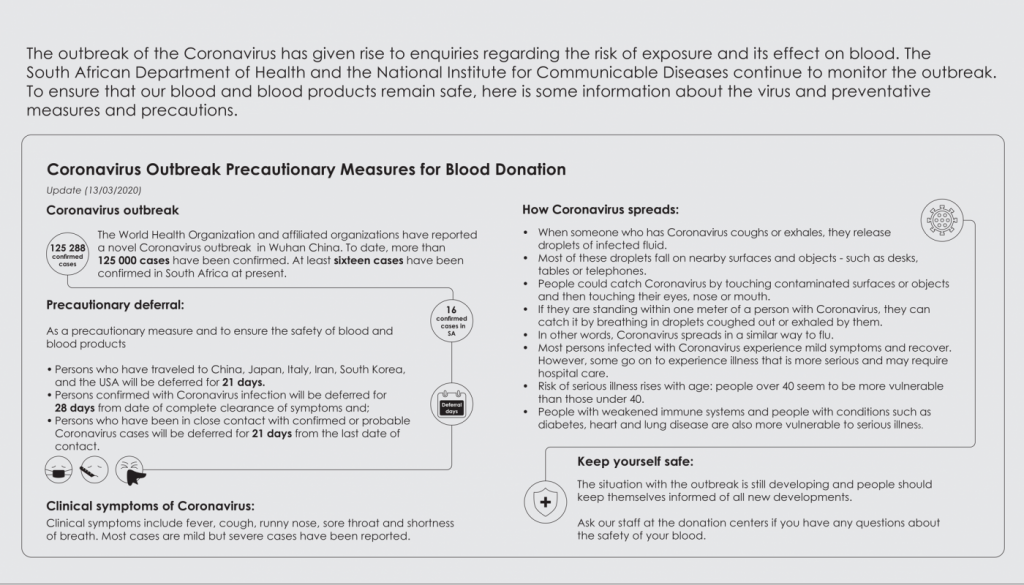
The South African National Blood Service (SANBS) would like to appeal to all their healthy donors to continue to donate blood. “The SANBS would like to assure donors that donating blood is safe. The Coronavirus (COVID-19) cannot be transmitted through blood transfusion as respiratory viruses are generally not known to be transmittable by donation or transfusion. Blood donor screening, which includes travel self-deferrals, are already in place to prevent individuals who may be at risk of clinical respiratory infections from donating blood.” As per a statement released today.
The SANBS would also like to urge healthy
donors who belong to all blood groups to continue to donate blood to ensure
that the blood stock levels are adequate at all times in the country. “We
anticipate added pressure on the blood supply during Easter, Ramadan and the
winter months and the added effects of the COVID-19 could see the number of eligible
donors decrease in the following few months,” says Silungile Mlambo,
spokesperson for the SANBS.
the number of infected persons has now risen to 24
There had been an influx of visitors to
the donor centres after the outbreak of the Coronavirus.
SANBS released the following statement in
this regard:
“We have noted an influx of visits to
our donor centres and several claims on social media about the South African
National Blood Service (SANBS) providing testing for the Coronavirus
(COVID-19).
We wish to state unequivocally that the
SANBS does not conduct testing for Coronavirus at our donor centres.
“Diagnostic tests for COVID-19 are not
done on blood, but on throat swabs and sputum samples,” asserted Dr Jackie
Thomson, Medical Director of SANBS.
Testing is currently available at the
National Institute for Communicable Diseases (NICD) for free. You can also get
tested at Lancet Laboratories and at some National Health Laboratories Services
(NHLS).
The SANBS urges donors to take the necessary
precautions to ensure the safety of their fellow citizens. If you are feeling
unwell or exhibiting any clinical symptoms of infection (fever, cough, runny
nose, sore throat and shortness of breath), you are encouraged to delay
donation until you are in good health.
If you feel you are at risk, have come
into contact with someone who has been infected or fear that you may have been
infected with COVID-19, speak to your physician for advice. Alternatively,
contact the toll-free NICD hotline on 0800 029 999.”
The National
Institute for Communicable Diseases (NICD), a division of the National Health
Laboratory Service, as from 13 March 2020, can confirm eight (8) additional new
imported COVID-19 cases that have tested positive for SARS-CoV-2 – the
causative pathogen for COVID-19. This brings the total number of COVID-19
cases to 24 in four provinces across the country, KwaZulu-Natal, Gauteng,
Western Cape and Mpumalanga.
Gister middag, 11 Maart, het Laerskool
Kruinpark se senior Landsdiens leerlinge ‘n verrassing ontvang. Hulle het meer
geleer oor Spekbome.
Laerskool Kruinpark het laas jaar hulle #spekboomchallenge begin. Die skool het 600 Spekbome verkoop. Juffrou Yolinda, hoof van die Landsdiens, het besluit dat die #spekboomchallenge weer aangepak moet word.
Landsdiens is
’n omgewingsgerigte jeugbeweging. Dit streef daarna om die jeug vaardig te maak
in die hantering en bewaring van die omgewing in sy totaliteit. Om dié doel te bereik
word van opvoedkundige omgewingsgerigte aktiwiteite en tegnieke gebruik gemaak.
By
gister se landsdiensbyeenkoms het Ina Klopper, van Garden Terrace Kwekery, kom
praat met die kinders oor die voordele van die Spekboom.
Sy het begin deur die kinders te vertel van die wonderplant se voordele. Die kinders se hande het opgeskiet en hulle kon self dié tannie vertel hoekom die spekboom ‘n wonderplant is. “Tannie die Spekboom haal die koolstof uit die lug uit sodat ons skoon suurstof kan in asem,” het een seun geantwoord.
Tannie Ina het verder die verskillende name van die Spekboom genoem vir die kinders en ook watter voordele die plant inhou vir diere in die natuur. Die kinders het aandagtig geluister en relevante vrae gevra.
Die
dag was volmaak met nog ‘n verrassing… Oom Douw, van die GMM Brandweer en sy
span het kom kuier!
Die
kinders het aan oom Douw se lippe gehang toe hy verduidelik hoekom die brandweer
kom kuier het by hulle. Die kuier van die brandweer was ook met ‘n doel beplan.
Die Gr 7 leerders het sopas geleer oor die Kake van die Lewe (Jaws of life) in
Tegnologie.
“Hallo maats! Vandag gaan ons julle wys en meer leer oor die Jaws of Life, Kake van die Lewe in Afrikaans. Die Jaws of Life bestaan uit ‘n hidroliese pomp met ‘n kabel en dan ons toerusting stukke wat ons gebruik. Wanneer ons by ‘n ongelukstoneel kom en daar sit mense vas, haal ons die pomp van die voertuig af, konnekteer die kabel en ons konnekteer die “jaws” sodat ons die mense kan uit sny uit die voertuig uit,” het oom Douw verduidelik.
Die kinders was gewys hoe die Kake van die Lewe werk op ‘n ou motor deur. Die ooooooeeeeee’s en aaaaa’s het deur die pawiljoen ge-eggo.
Die kinders het ook ‘n kans gehad om al die veiligheidskleding van ‘n brandweerman/vrou aan te pas en om te voel hoe ‘n regte brandslang water spuit!
Die
dag was geniet deur almal en baie dankie aan die Laerskool Kruinpark Landsdiens
onderwysers wat die dag moontlik gemaak het.
Daar was 550 Spekbome onder die hele Landsdiensgroep van Laerskool Kruinpark uitgedeel. Die doel van dié #spekboomchallenge is die graad groep wat meer as 100 Spekbome verkoop kry ‘n dag by Aqua Zone geborg deur Mnr Johan Rosslee.
Daar is ‘n Laerskool Kruinpark Landsdiens boek by Garden Terrace om boek te kan hou van die #spekboomchallenge. Gaan maak gerus ‘n draai, koop jou Spekboom vir R20 en merk die graad groep af vir wie jy ondersteun!
Juffrou Nicole en Franzelle Nortje met hulle Spekbome
The 5th
of March may be a Rubicon for Sasol investors as Moody downgraded Sasol to junk
status.
The press release from Moody’s states that Moody’s “has today downgraded Sasol Limited’s (Sasol) long-term rating to Ba1 from Baa3 and its short-term rating to Not Prime from P-3. The long-term national scale rating has been downgraded to Aa2.za from Aa1.za while the short-term national scale rating has been affirmed at P-1.za. The rating outlook has been changed to stable from negative.” As well as “Moody’s has withdrawn the Baa3 issuer rating and assigned a Ba1 corporate family rating (CFR) to Sasol, in line with the rating agency’s policy for non-financial corporates with non-investment grade ratings downgraded from investment-grade ratings.”
However, the rating
outlook has improved from negative to stable.
The root cause of
Sasol’s problems is the overruns on the budget for its Lake Charles Chemical
Project (LCCP) which is expected to cost $12.8bn compared to an original budget
of $8.9bn.
Governance
failures and inadequate project oversight led to escalated costs not being
identified and reported in a timely manner on LCCP. The cost overruns at LCCP
has burdened Sasol with high financial leverage and has weighed on the company’s
credit profile over the years.
Moody’s
further said in their statement that, “The decision to downgrade the ratings to
Ba1 reflects Moody’s view that Sasol’s financial leverage will remain elevated
over the next two years and that the pace of deleveraging is vulnerable to
event risks and challenging market conditions globally and domestically, as
demonstrated over time by the company’s downward revisions of EBITDA forecast
on the Lake Charles Chemicals Project (LCCP). The rating agency estimates that
free cash flows over the same period will not materially reduce the ZAR138
billion debt stock, majority of which was accumulated as a result of the LCCP.”
“Sasol’s
liquidity is adequate with available group cash balance of ZAR10.4 billion as
at 31 December 2019 along with forecasted FFO generation of ZAR32 billion in
calendar year 2020 being sufficient to fund working capital needs and
sustaining capex of approximately ZAR24 billion,” Moody’s statement continued,
“ An additional ZAR4 billion is needed to complete LCCP while of the ZAR18.4
billion of short term debt, ZAR14 billion is related to the unsecured
syndicated loan facility which has a final maturity in April 2021.”
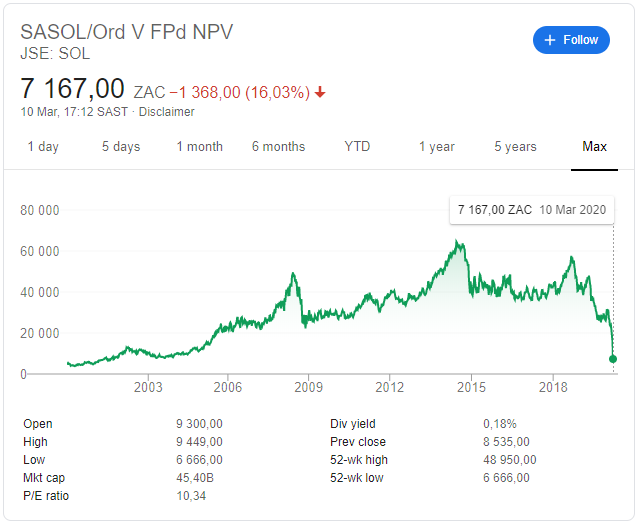
Fin24 reported on the drop in Sasol share prices.
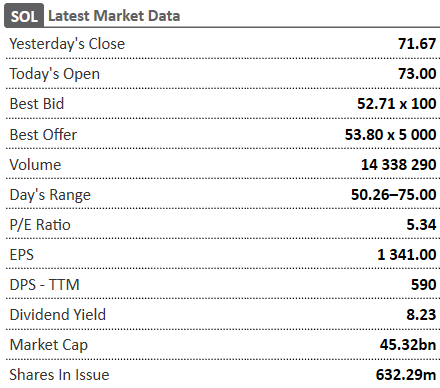
“Sasol’s share price reached R68 earlier on Tuesday,
after trading at around R480 as recently as in April last year. After falling
47% on Monday in reaction to an oil price crash, its share price was down
another 8% by late Tuesday afternoon. It was last trading at around R53.85. Less
than a year ago it was trading above R470.The market now values Sasol at around
R47 billion. The company has a debt burden of more than R120 billion, and
investors are worried that it may be forced to issue more shares to raise
cash.”
Sasol has now lost more than 65% since the week
started, the most among the 1,401 members of the MSCI Emerging Markets Index,
which is down 5.6%. The latest slump has dragged the stock to levels last seen
in early 2001.
Source: sashares.co.za 08H00 11/3/2020
Brent crude oil prices
crashed 31 percent to $36.30 a barrel this week, the lowest level since 1991,
amid an oil bloodbath prompted by Saudi Arabia’s decision to slash its oil
prices over the weekend by about 10 percent after Russia walked away from the
negotiating table.
Russia on Friday refused to
join Opec’s production cut as the coronavirus continues to ravage the global
economy and, with it, demand for oil, pitting Russia against Saudi Arabia.
“This further compounds Sasol’s problem as Sasol assumed that oil prices will be staying a $50 to $70 a barrel. This was used to calculate their outlook projections, Brent, unfortunately, dropped to as low as $31.02 on Monday,” Reported Bloomberg.
This
does not spell anything good for Sasol nor does it for investors. The Lake
Charles Chemicals Project (LCCP) will haunt the company for a very long time
still. Or so it appears.
It has been a week of steep drops for some
emerging-market stocks, but Sasol has out-plunged its peers, battered by the crash
in oil prices and concern among investors of a potential looming rights offer
as it grapples with a debt burden of about $8 billion.
After a 47% crash on Monday, Sasol lost more on Tuesday and then fell another 25% on Wednesday afternoon. It was last trading at R53.85 – less than a year ago it was above R470.
Sasol has now lost more than 65% since the week
started, the most among the 1,401 members of the MSCI Emerging Markets Index,
which is down 5.6%. The latest slump has dragged the stock to levels last seen
in early 2001.
Saturday morning (7 March 2020) started with a chill in the air. Typical for the PwC Kosmos 3in1. The area around the Makoro at Lake Umuzi was abuzz with activity. When the final countdown started it became clear that this race has become one of the most popular races in Mpumalanga.
This popular race runs through the streets of Secunda and this was the 28th time that it was run. Runners from all over the country swarmed the Lake Umuzi area in March every year to run the race. Over 9000 entries were received for the day’s races. The 42km had 3075 entries the 21 km race had 3045 and the 10 km race received 3365 entries. It is a gruelling race with a full marathon being run in the morning (06H00), a half marathon at noon (13H00) and finally a 10km race at 17H00.
Every year Mediclinic Highveld erects a huge tent to help runners with cramps and other muscle problems. This also proves very popular.
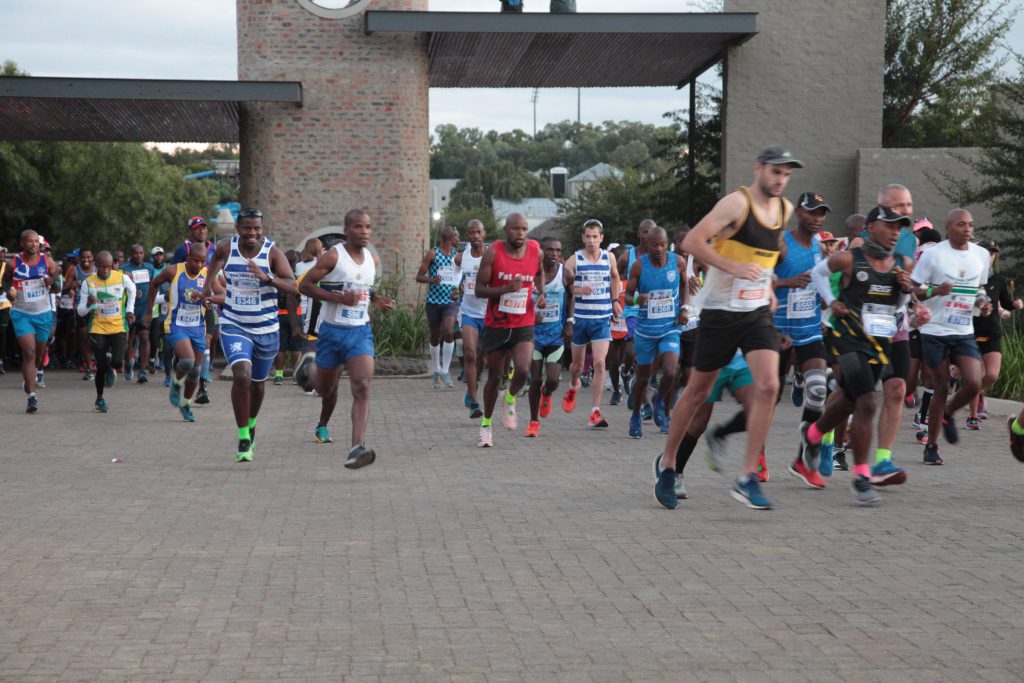
Start of the first race of the day
The day heated up and so did the competition. The runners braced the heat of the midday race and continued with relatively fast times. The last race was run in slightly cooler conditions.
The runners praised the organisation of the PwC Kosmos 3in1 for organising such an event. Even when the Friday night entries swelled to near uncontrollable numbers, the organisers stayed calm and just continued to work through the numbers.
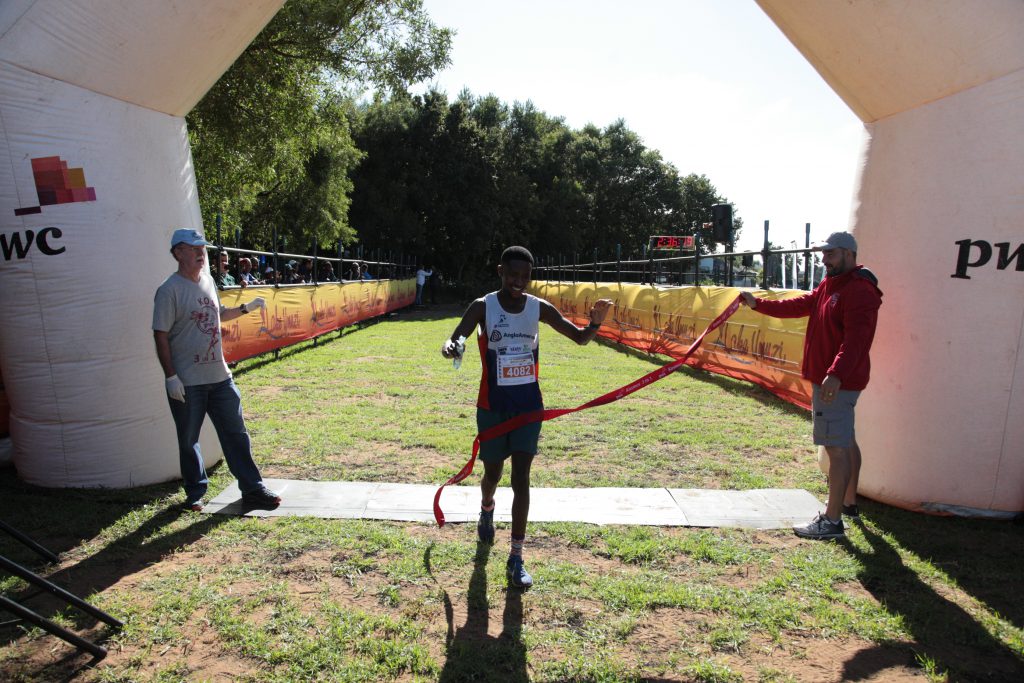
Koketjo Gumbo was the winner of the men’s race with a time of 04:33:28 and Dineo Manamelo (women’s race) with a time of 05:51:12
Winner of the first race of the day
What is remarkable is that in the top three of the men’s race the second-place winner, Clement Modisha was 38 and the third-place winner, Kori Seshoene is 39 and a few days away from his 40th birthday.
The women’s race winner, Dinea is 34 years old and the second-place winner, Anja Heenop is 27 years old with third place winner Bheku Sithole only 30 years old.
The waterpoints bring huge excitement every year when they compete for the coveted winners’ position. Waterpoints are usually a bus of activity with music blaring and excited supporters enticing runners to take water from them. The winner for the day was AES Seals. Congratulations on winning. The success of the PwC Kosmos 3in1 also stems from the contribution that the waterpoint has made.
The PwC Kosmos 3in1 was a clear success for all and everyone is looking forward to next year’s races with some of the accommodation already booked for next year. The accommodation at Umuzi Lodge and The Merchant hotel are already fully booked while Inn Green has only 8 rooms left.
Saturday morning (7 March 2020) started with a chill in the air. Typical for the PwC Kosmos 3in1. The area around the Makoro at Lake Umuzi was abuzz with activity. When the final countdown started it became clear that this race has become one of the most popular races in Mpumalanga.
This popular race runs through the streets of Secunda and this was the 28th time that it was run. Runners from all over the country swarmed the Lake Umuzi area in March every year to run the race. Over 9000 entries were received for the day’s races. The 42km had 3075 entries the 21 km race had 3045 and the 10 km race received 3365 entries. It is a gruelling race with a full marathon being run in the morning (06H00), a half marathon at noon (13H00) and finally a 10km race at 17H00.
Every year Mediclinic Highveld erects a huge tent to help runners with cramps and other muscle problems. This also proves very popular.
Start of the first race of the day
The day heated up and so did the competition. The runners braced the heat of the midday race and continued with relatively fast times. The last race was run in slightly cooler conditions.
The runners praised the organisation of the PwC Kosmos 3in1 for organising such an event. Even when the Friday night entries swelled to near uncontrollable numbers, the organisers stayed calm and just continued to work through the numbers.
Koketjo Gumbo was the winner of the men’s race with a time of 04:33:28 and Dineo Manamelo (women’s race) with a time of 05:51:12
Winner of the first race of the day
What is remarkable is that in the top three of the men’s race the second-place winner, Clement Modisha was 38 and the third-place winner, Kori Seshoene is 39 and a few days away from his 40th birthday.
The women’s race winner, Dinea is 34 years old and the second-place winner, Anja Heenop is 27 years old with third place winner Bheku Sithole only 30 years old.
The waterpoints bring huge excitement every year when they compete for the coveted winners’ position. Waterpoints are usually a bus of activity with music blaring and excited supporters enticing runners to take water from them. The winner for the day was AES Seals. Congratulations on winning. The success of the PwC Kosmos 3in1 also stems from the contribution that the waterpoint has made.
The PwC Kosmos 3in1 was a clear success for all and everyone is looking forward to next year’s races with some of the accommodation already booked for next year. The accommodation at Umuzi Lodge and The Merchant hotel are already fully booked while Inn Green has only 8 rooms left.