Vier van Laerskool Kruinpark se kekkelkouse het by die ATKV-Landsfinaal deelgeneem.
Amelia Shaw, Imke van der Lith, Kamo Maile en Busisa Mashego (Laerskool Kruinpark verteenwoordig, hy is nou in Laerskool Bosveld, Lephalale), het deurgedring het na die ATKV se Nasionale finale Redenaarskompetisie, wat in 16 Augustus by Buffelspoort plaasgevind het.
Dit was strawwe voorbereiding om teen die land se beste redenaars te kompeteer en het al die kekkelkouse hulle goed van hul taak gekwyt.
Al 4 Kruinpark kekkelkouse eindig by die ATKV Landsfinaal op die TOP 10!
LAERSKOOL KRUINPARK KEKKELKOUSE by die ATKV-Landsfinaal (van links na regs): Busisa Mashego, Kamo Maile, Imke van der Lith, Amelia Shaw, juffrou Marianna Victor.
Busisa Mashego, het tydens die ATKV Nasionale redenaarskompetisie die prys gewen het vir beste taalgebruik en beste spreker, graad 4 en 5 addissionele taal.
ATKV-Landsfinaal: Busisa Mashego wen beste taalgebruik en beste spreker, graad 4 en 5 addissionele taal. Busisa ontvang sy sertifikate en prys saam met sy ma en juffrou Marianna Victor.
Kamo Maile het ‘n 5de plek, Amelia Shaw eindig 6de en Imke van der Lith kry 9de plek.
KRUINPARKERS EINDIG ALMAL OP DIE TOP 10 (van links na regs): Imke van der Lith, Kamo Maile en Amelia Shaw.
Kruinpark se kekkelkouse kook sowaar!
Lees hier om te lees hoe hierdie leerders hulle pad oopgepraat het deur die jaar met ATKV Redenaars.
Laerskool Kruinpark se Trompoppies is provinsiale wenners!
Laerskool Kruinpark se Trompoppies het hierdie jaar vir die eerste keer ingeskryf om deel te neem aan SAMCA Liga. SAMCA staan vir “The South African Majorette and Cheerleading Association”
Die skool het Trompoppies as ‘n kultuur aktiwiteit al vir 5 jaar. Dit verg baie dissipline, tyd en toewyding. By Laerskool Kruinpark kan graad 1 tot graad 7 meisies deel word van die Trompoppiespan.
Die kinders begin vroeg in die jaar om te oefen, en begin die kompetisies reeds in die tweede kwartaal. Omdat die kompetisie so streng is en baie hoë standaarde verwag word, oefen die meisies elke week getrou, selfs vakansies word opgeoffer.
Hierdie jaar spog Laerskool Kruinpark se Trompoppiespan ook met ‘n splinternuwe, enig in sy soort, kleurvolle kleredrag, wat die meisies net nog meer laat skitter!
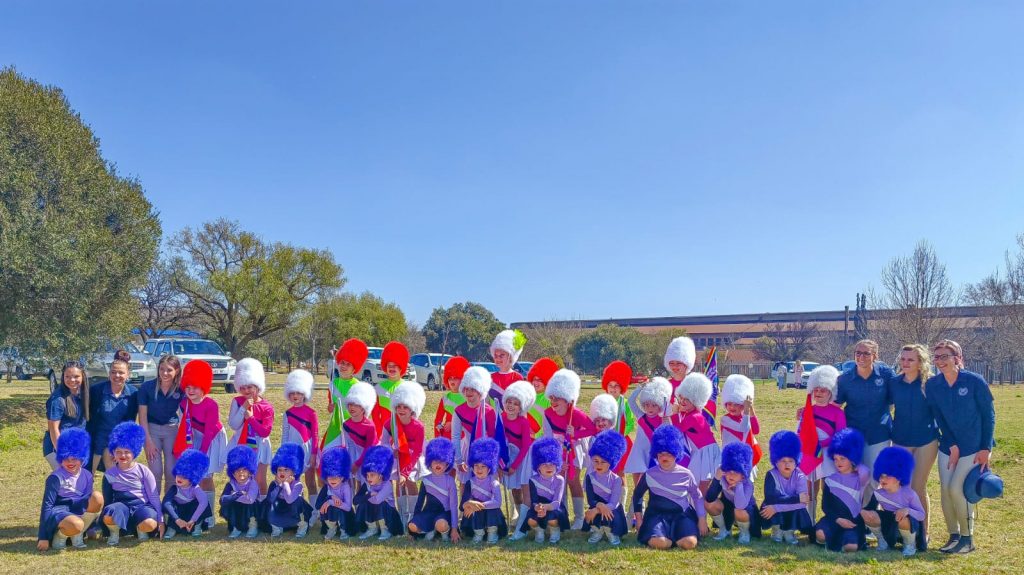
Laerskool Kruinpark Trompoppies tydens 23 Julie 2022 se kompetisie. (Foto deur Trompoppie ouer geneem)
Met Hoërskool Oosterland se 2022 Wieleskou, het die meisies die geleentheid gekry om in hulle splinternuwe klere te kon optree. Tydens Laerskool Kruinpark se Opedag, kon voornemende Kruinparkers ook sien presies wat hierdie unieke kultuur aktiwiteit behels.
Gedurende 2022, het die span reeds aan 2 vorige kompetisies deelgeneem. Die eerste kompetisie het plaasgevind op Laerskool Kruinpark se gronde op die 23ste Julie 2022. Tydens hierdie kompetisie het hulle 2de plek ontvang.
6 Augustus 2022 het die span aan hulle tweede kompetisie deelgeneem wat in Middelburg plaasgevind het en daar het die meisies 1ste plek gekry!
Laerskool Kruinpark Trompoppies tydens 6 Augustus se kompetisie waar hulle 1ste plek ontvang het. (Foto deur Trompoppie ouer geneem)
Saterdag, 27 Augustus 2022 het die span aan die Provinsiale kompetisie deelgeneem en het hulle 1ste plek gekry. Die kompetisie het in Middelburg plaasgevind en Hoërskool Middelburg het as gasheer opgetree. Dit is die eerste van vele vir Laerskool Kruinpark se Trompoppies!
Laerskool Kruinpark se Trompoppie span tydens die Provinsiale Kompetisie wat 27 Augustus 2022 plaasgevind het in Middelburg. Afrigters is: 1ste ry links na regs: Duné Kruger (Organiseerder en hoof afrigter), Bianca Botes. 2de ry links na regs: Melanie Greeff, Charnél van der Walt. 3de ry regs: Wilmarie Greyventstein. 4de ry links na regs: Ninette Booysen, Alecia van Blerk. (Foto deur Trompoppie ouer geneem)
Hierdie is nie die enigste prestasie vir Laerskool Kruinpark se leerders nie, die skool het ook 4 skaakspanne wat die naweek, 3 September 2022 deelneem aan die Mpumalanga uitspele in Nelspruit. Lees meer hier.
Vir meer nuus oor Laerskool Kruinpark se aktiwiteite, volg hulle Facebookblad hier.
SPAYING AND NEUTERING HAVE MANY BENEFITS, INCLUDING HEALTH, BEHAVIOUR & COMMUNITY BENEFITS.
There are two big reasons why you should spay and neuter your pets. We have a massive pet overpopulation crisis worldwide, with not nearly enough homes, never mind good homes. This means that millions of healthy animals are being euthanized (killed humanely) annually. Another reason is it is good for their health!
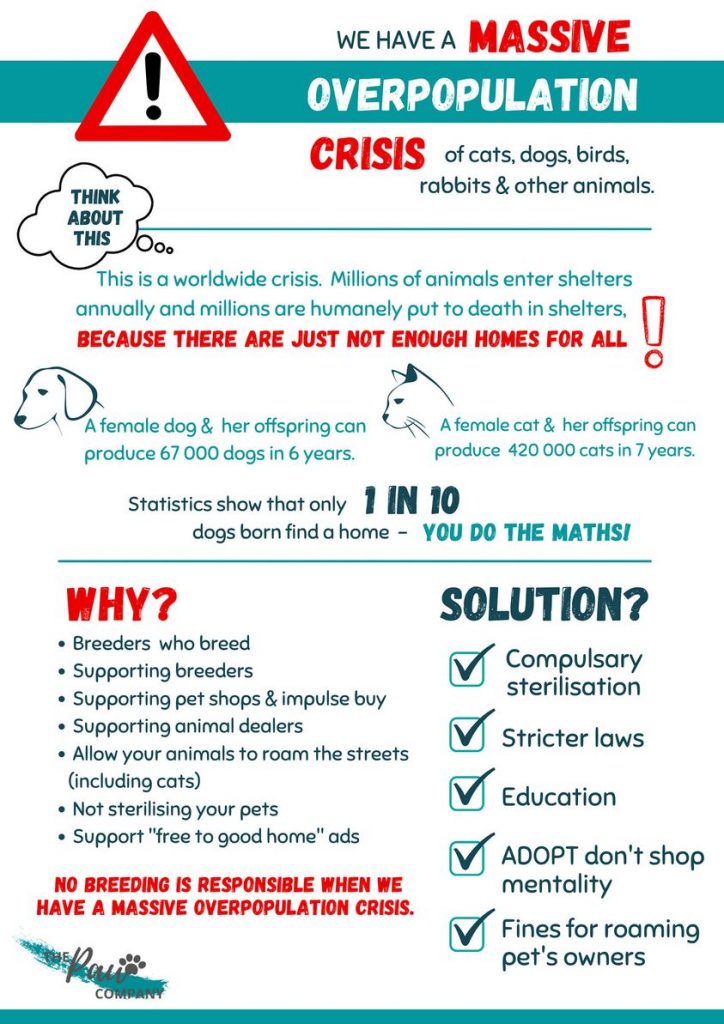
THE PET OVERPOPULATION CRISIS
You need to understand the magnitude of this overpopulation crisis and then, hopefully, you will understand why many of us advocate so hard for it.
One female cat and her offspring can exponentially produce 370 000 cats in just seven years.
One female dog and her offspring can exponentially produce 67 000 dogs in six years.
Only 1 out of every 10 dogs born, find a home.
According to Rescue Rehab SA, approximately 1 million dogs and cats are euthanized in South Africa every year, that is 2740 a day!
According to the Humane Society of the USA, a cat or dog is euthanized at shelters every 10s.
A report by Mars Petcare showed 224 million animals are homeless in the USA, UK, SA, Mexico, Greece, Russia, China, India & Germany and about 30% of animals in SA are homeless.
At least one in four pets brought to shelters are purebred and this number is climbing.
Although we promote adoption, we can’t adopt our way out of this problem, so we need to fix (pardon the pun) it. We have heard all the bad excuses, debunked the mythsand I educate about it daily on the SPAY & NEUTER SApage.
One of the worst excuses I have heard is that preventing pets from having litters is unnatural and that if God thought it was a problem he would make them sterile. The fact is that we have already interfered with nature by domesticating dogs, cats and other animals. We domesticated the dog 15 000 years ago and the cat 8 000 years ago. In doing so, we helped create this problem. Now it’s our responsibility to solve it. It’s also unnatural to be killing so many of them in our pounds and shelters each year. You can’t blame the shelters, but you should blame breeders and dealers of any kind.
Image by The Paw Company
IT IS GOOD FOR THEIR HEALTH
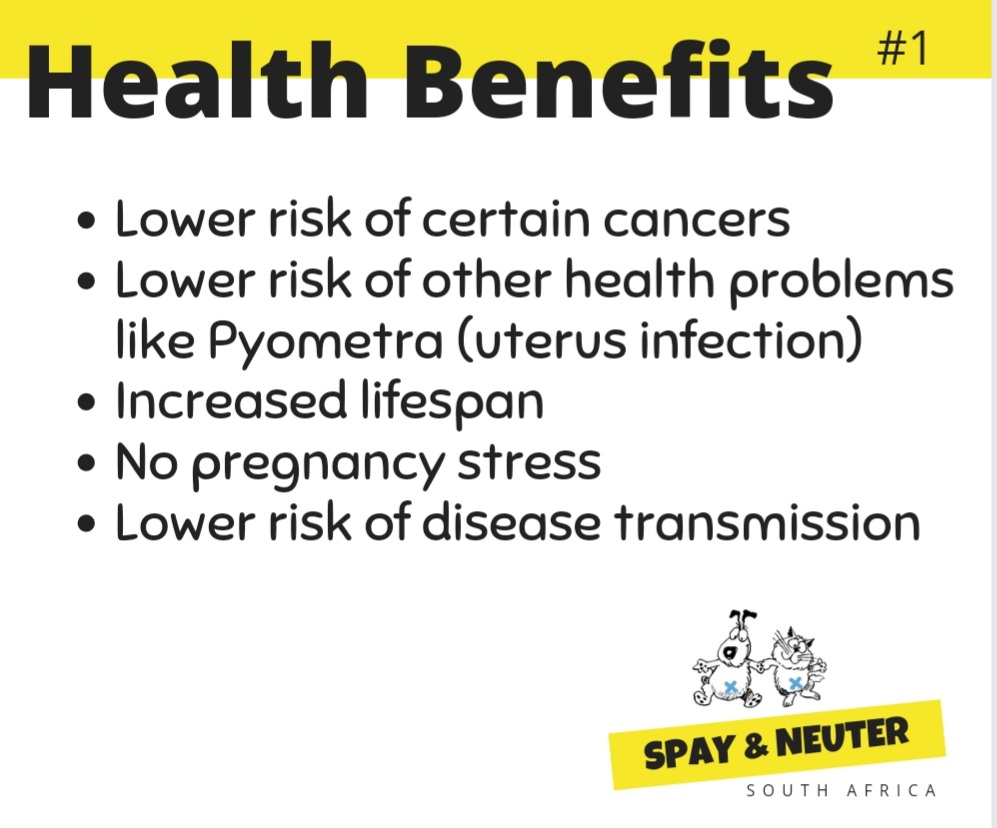
When you spay and neuter your pets it can lead to longer and happier lives. There are many benefits of spay and neuter for their health which include a lower risk for certain diseases like cancers and pyometra. It certainly eliminates the stress associated with pregnancy. It improves behaviour, especially when dealing with females in heat and males marking or spraying and wandering out of the yard in search of these females which they can smell from far away.
Image by Spay and Neuter SA
FREQUENTLY ASKED QUESTIONS ABOUT SPAYING & NEUTERING
WHAT DOES SPAY & NEUTER MEAN?
It’s important to recognize the difference between sterilization and desexing (traditional spay and neuter). Whereas the former procedure eliminates a dog’s ability to procreate, desexing sterilizes but also eliminates the dog’s ability to produce sex hormones for the remainder of their life.
Vetcare.com defines it as follows:
The word “spay” refers to the sterilization of female pets. During the ovariohysterectomy, or the typical “spay”, the ovaries, fallopian tubes and uterus are removed from a female dog or cat.
The term “neuter” refers to the castration of male pets. During orchiectomy, or the typical “neuter”, the testes are removed from a male dog or cat.
Both the spay and neuter procedure makes them unable to reproduce and reduces or eliminates breeding-related behaviours. In females it eliminates her heat cycle.
WHAT AGE SHOULD I SPAY/NEUTER MY PET?
An experienced vet can spay and neuter at an age as young as 6-8 weeks old, however, the risks involved with anesthesia may be slightly greater at this age. Older females that are not spayed are at risk too. There is generally no other age limit for the procedure as long as your pet is healthy.
We support spay and neuter at around 6 months of age. We have done so with our pets who all reach ripe old ages and are rarely sick.
SHOULD I LET MY PET HAVE BABIES BEFORE I SPAY THEM?
Most veterinarians and the most recent research recommends that animals are spayed before their first heat cycle (before the age of 7 months or so). This drastically reduces the risk of mammary tumors later in life, prevents uterine infections and unwanted pregnancy. Pregnancy can put unnecessary stress on your pet’s body.
MY PET JUST GAVE BIRTH, HOW LONG SHOULD I WAIT TO SPAY?
Please prevent this, but if it did happen, the suggested time for animals that have recently given birth is about 2 weeks after the young have been weaned and the mother’s milk has dried up.
WHAT ARE SIGNS THAT MY CAT/DOG IS IN HEAT? (Vetcare.com)
Dogs have outward signs of being in heat. The vulva swells, and there is bleeding present for 1-1 ½ weeks. Just after the bleeding stops, most dogs will be receptive to mating for 1-2 weeks. Most dogs will go into heat twice a year, in the spring and fall. Some dogs may skip the fall cycle.
Cats go into heat for the first time typically when they are 5-7 months old. A cat will be in heat (receptive to mating and able to become pregnant) for up to two weeks and then go out of heat. If she has not been mated, two weeks later, she will go back into heat again. This cycling in and out of heat will continue for several months.
Cats can have their first heat cylce at around 4 months of age.
WHAT ARE THE RISKS?
Even though spay and neuter are major surgical procedures, they are some of the most common procedures done by vets. As with any surgery, there are risks associated with anesthesia and potential surgical complications. The overall occurrence of these risks is very rare.
WILL MY PET GAIN WEIGHT?
Probably not. Just like people, pets become overweight when they eat too much or exercise too little. Choosing a diet that is species-appropriate and suited to the health and lifestyle of your pet is important to prevent weight gain.
WILL THEIR BEHAVIOUR CHANGE AFTER THE SURGERY?
The spay and neuter will most likely not alter your pet’s basic personality which is mainly determined by the breed and a few other factors. It can result in some behavioural changes, but usually for the better!
WILL MY MALE CAT STOP SPRAYING IF I GET HIM NEUTERED?
Spraying is common in unneutered male cats. They want to mark their territory and it would be best to neuter your cat before they develop this behaviour. Males may still engage in full-testosterone male behaviors while their male sex hormone levels diminish after surgery. This can take 6-8 weeks. Remember that male rabbits can still be fertile for a few weeks after neutering, as there may be sperm left in the reproductive tract!
DOES SPAYING & NEUTERING HURT?
During a spay or neuter surgery, the animal is fully anesthetized, so they feel no pain. Afterward, some animals seem to experience some discomfort temporarily, but with pain medication, discomfort may not be experienced at all.
HOW LONG DOES IT TAKE TO HEAL?
According to vetcare.com, most spay and neuter skin incisions are fully healed within about 10–14 days, which coincides with the time that stitches or staples, if any, will need to be removed.
WHICH VET TO CHOOSE?
Even though this procedure is a common procedure for vets, not all vets are good at it, so do your homework on the vet! Cats & dogs are common patients, but please use an exotic qualified vet for other animals!
SHOULD ALL ANIMALS BE SPAYED & NEUTERED?
The massive overpopulation crisis includes more than just cats and dogs, so the answer is mostly yes. There might be exceptions due to safety or medical reasons and those animals need highly responsible owners to prevent litters. Spaying or neutering a bird is not a routine surgery like it is with many mammals and can be riskier. There are many other ways to prevent your birds from reproducing offspring. Removing eggs of egg-laying animals (the right way) is another method.
CAN YOU SPAY A FEMALE IN HEAT?
Although possible, most vets will probably advise against it due to more swelling and a higher risk of bleeding. This surgery may take longer and be more expensive.
CAN’T WE JUST SPAY THE FEMALES AS THEY HAVE THE LITTERS?
No darling, it takes two to tango if you missed biology class. The female can only have so many puppies/kittens at once, but the male can impregnate many females around the same time.
IF I KEEP THEM SAFE IN MY YARD, DO I STILL NEED TO SPAY & NEUTER THEM?
Yes, for sure! Do you know that guy called Murphy? Animals get in and out of yards and saying it was an unexpected litter doesn’t fly. If your pet is not spayed or neutered, you can totally expect it.
ARE THERE SPECIFIC PRECAUTIONS TO TAKE AFTER THE PROCEDURE?
Apart from the usual veterinary advice like keeping your pet still and keeping the wound clean, you also need to phone your vet the moment you think something is not right and keep the freshly-neutered males away from non-spayed females for some time.
When it comes to male neuters for various species, after the testicles are removed, it takes time for all of the residual sperm to clear out of the pipes. Ask your vet how long, but some sources suggest days to weeks. During this time, a freshly-neutered male can still impregnate females.
IS THE PROCEDURE EXPENSIVE?
It probably depends on what you spend money on and whether your pet’s health is a priority to you. The cost of spaying or neutering depends on the sex, size, and age of the pet, your veterinarian’s fees, and a few other factors. Remember that spay or neuter surgery is a one-time cost and the cost far outweighs the cost of health-related issues due to not sterilizing or even for raising litters. There are many opportunities to do this at more affordable rates and adoption fees include it!
In general, spaying tends to be more expensive than neutering. Spaying involves opening your dog or cat’s stomach to access the animal’s reproductive organs where neutering is less complex.
The cost may vary from town to town, but according to Pawpawpets.com, the average cost of a spay in South Africa is around R1350 for a female cat and around R1800 to a crazy R4000 for a female dog. Neuters can cost around R750-R1000 for a male cat and around R1200 – R2500 for a male dog.
THE BIGGEST CRITICISM OF EARLY SPAY & NEUTER
There are always two sides to a coin and it is important to look at both.
Some research shows that in desexing spays and neuters – surgical procedures that remove the gonads and associated sex hormones – can have a long-term negative impact on their health.
The research mostly suggest this more in large dog breeds. The advice then is to have them spayed or neutered after they turned one year old, but again then they need a highly responsible owner. You must also remember that the relationship between sex hormones, health and wellness is more complex and can be influenced by many aspects like sex, breed, age, environment and more.
I have not yet seen these negative effects and I think there is more research needed on this as single case studies are not enough. With this massive overpopulation crisis worldwide, the benefits far outweigh the risk for me.
If this does occur, it seems that hormone restoration therapy may be beneficial to symptomatic spayed and neutered dogs.
What are alternatives then?
When a pet is left intact, it requires a highly responsible pet guardian who is fully committed to and capable of preventing mating and litters.
Another option is sterilizing so the testes or ovaries can continue to produce hormones. This can be accomplished through vasectomy and hysterectomy. According to Dr. Karen Becker, traditional spaying and neutering are basically the only techniques vets are currently taught and we need to change that.
Changing the fate of animals and the massive overpopulation crisis resolves around three principles namely sterilization, education, stricter and enforced laws for those who don’t respond to being asked nicely. No breeding can be “responsible” when we have a massive overpopulation crisis and when you support breeders, you are part of the problem.
BE PART OF THE SOLUTION AND JOIN THE SPAY & NEUTER REVOLUTION
Spay & neuter your pets.
Share, educate & advocate for it.
Donate to spay & neuter campaigns.
Support petitions on the topic.
Don’t support animal dealers, breeders, or pet shops that fuel the overpopulation crisis.
Adopt from reputable organizations.
Can you see now why reputable animal welfare organizations are all up-in-your-business about spay and neuter? Next week we will look at another big problem……… “free to good home” animals.
Laerskool Kruinpark seuns is die Jukskei Mpumalanga Liga wenners vir 2022!
Laerskool Kruinpark se O/13 A-span seuns is die Mpumalanga skole ligawenners vir die seuns afdeling en het algeheel 2de plek in die O/13 liga geëindig.
Die seuns dring deur na die Noordvaal Kampioenskappe wat die 17de September 2022 in Middelburg plaasvind.
Jukskei seisoen het vroeg in die derde kwartaal afgeskop, met ‘n eerste liga wedstryd wat in Middelburg plaasgevind het die 30ste Julie 2022.
Daarna was daar weer 13 Augustus 2022 in Morgenzon ‘n liga wedstryd waarna die die 27ste Augustus 2022 die finale liga wedstryd was.
Die seuns het baie hard hierdie kwartaal geoefen en met elke liga hulle alles ingesit om as ligawenners aangewys te word.
Laerskool Kruinpark O/13 A Jukskei span (van links na regs): Liam Barkley, Jakes Etchells, Jonathan Phillips (Kaptein), Louwrens Erasmus, Xavier le Roux
Laerskool Kruinpark se sportspanne vaar uitstekend hierdie jaar, met die 1ste Tennisspan seuns wat ook ligawenners van 2022 is, lees meer hier.
Om meer van Laerskool Kruinpark se prestasies te lees, of te sien wat die skool behels, volg gerus die skool se FB BLAD.
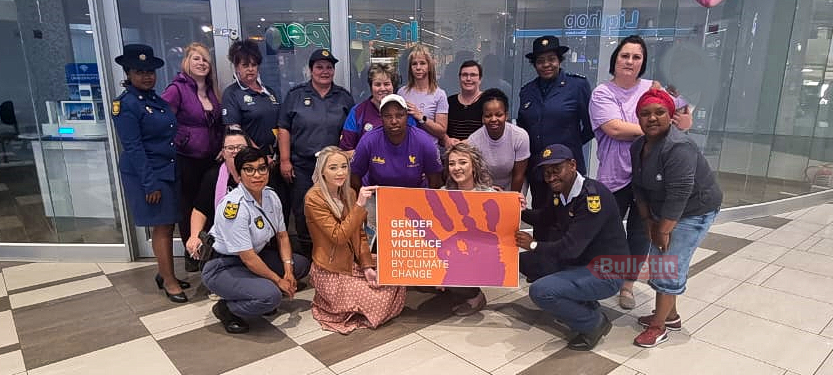
SAPS and Several entities joined hands in bringing a Gender Based Violence (GBV) awareness campaign to Secunda
The short awareness campaign was held at Secunda Mall on Saturday 17 August 2022.
The campaign was spearheaded by the Fire Licence Office at Secunda Saps. Firearms are increasingly used in GBV. The Bulletin reported on a few such cases in the past.
GBV knows now sacred grounds, and even some police members are victims of GBV. This is true for Females as well as Males.
The awareness campaign focused on letting people know that there is help. There are several groups that will help should the need arise. It is important to know that there are a lot of people that are willing to help, you just need to ask.
Everybody is telling victims to get out of the situation, it is extremely difficult at times. But there is help and you will be able to get out of the abusive situation.
The organisations that helped on Saturday are:
Thuthuzela centre
Women’s network
Men for change
Kuramus
National Prosecuting Authority (NPA)
FCS
Anyone that needs any information or help can go to the Thuthuzela care centre at Evander Hospital. The Bulletin had the opportunity to visit the centre a while back and was impressed with the facility and staff. They will provide counselling also if needed.
Constable Busi Mthethwa and Warrant Officer Liesl Horack at the awareness campaign
Thuthuzela Care Centres (TCCs) are one-stop facilities that have been introduced as a critical part of South Africa’s anti-rape strategy, aiming to reduce secondary victimisation and to build a case ready for successful prosecution. Fifty-one centres have been established since 2006.
The Thuthuzela project is led by the NPA’s Sexual Offences and Community Affairs Unit (SOCA), in partnership with various departments and donors as a response to the urgent need for an integrated strategy for prevention, response and support for rape victims. Since its establishment, the SOCA Unit has been working to develop best practices and policies that seek to eradicate the victimisation of women and children, while improving prosecution, particularly in the areas of sexual offences, maintenance, child justice and domestic violence.
Thuthuzela Care Centre operations: How does the TCC work?
Step 1: You can report a rape case directly to a TCC (based at community clinics or hospitals) or to a police station
Step 2: TCC staff will assist to get you immediate medical attention at the Centre
Step 3: TCC staff will arrange counselling services at the Centre
Step 4: TCC staff will assist you to open a police case (if you want to do so immediately or even at a later stage)
Step 5: TCC staff will arrange for on-going counselling and court preparation (if the case goes on trial)
Services offered at the Thuthuzela Care Centres (TCCs)
Welcome and comfort from a site co-coordinator or nurse.
An explanation of how the medical examination will be conducted and what clothing might be taken for evidence.
A consent form to sign that allows the doctor to conduct the medical examination.
A nurse in the examination room.
After the medical examination, there are bath or shower facilities for victim use.
An investigation officer will interview the survivor and take his/her statement.
A social worker or nurse will offer counselling.
A nurse arranges for follow-up visits, treatment and medication for Sexually Transmitted Infections (STIs), HIV and AIDS.
A referral letter or appointment will be made for long-term counselling.
The victim (survivor) is offered transportation home by an ambulance or the investigating officer.
Arrangements for the survivor to go to a place of safety, if necessary.
Consultations with a specialist prosecutor before the case go to court.
Court preparation by a victim assistant officer.
An explanation of the outcome and update of the trial process by a case manager.
Police urge anyone with any information on Crime to call the Crime Stop number at 08600 10111. Alternatively, members of the public can send information via MYSAPSAPP. All received information will be treated as confidential and callers may opt to remain anonymous
OTHER ACCUSED ON BETHAL TRAFFICKING IN PERSON CASE REMANDED IN CUSTODY
MPUMALANGA – Nonhlanhla Precious Thabetha (49) appeared before the Bethal Magistrates’ Court on Monday, 29 August 2022 after she was arrested from her hiding place in Esikhawini near Richards Bay in the KwaZulu-Natal on Thursday, 25 August 2022 for trafficking in person case. The case was postponed to 6 September 2022 for a formal bail application.
Nonhlanhla Precious Thabetha
Her arrest followed the investigation after the incident which occurred on Saturday, 14 May 2022 in Bethal farm whereby a foreign national, Edjuanida Teixeira (40) was arrested by the Secunda-based Hawks’ Serious Organised Crime Investigation team for trafficking in person after a tip-off about young and undocumented Mozambicans who were kept in a farm around Bethal was received.
The team promptly responded to information and on arrival at the farm, they found six undocumented Mozambicans who complained to the police that they were recruited from Mozambique and were promised that someone in South Africa have a job for them but on arrival what they were promised was never done.
Edjuanida Teixeira was then arrested while Thabethe escaped. Teixeira appeared in court and his case was postponed to 20 September 2022 for further investigation.
Police urge anyone with any information on Crime to call the Crime Stop number at 08600 10111. Alternatively, members of the public can send information via MYSAPSAPP. All received information will be treated as confidential and callers may opt to remain anonymous
FORMER MUNICIPAL OFFICIALS ARRESTED FOR CONTRAVENTION OF PFMA
MPUMALANGA – The former municipal manager, Theron Zwelishe Shongwe (47); former municipal manager, Thusi Hezekiel Kubheka (65) and former community service manager, Masego Mmabatho Matsheka (51) of Msukalikwa Municipality (Ermelo) appeared before the Ermelo Magistrate’s Court on Monday, 29 August 2022 after their arrest by the Nelspruit based Hawks’ Serious Corruption Investigation team for fraud, theft and contravention of the Public Finance Management Act (PFMA).
Theron Zwelishe Shongwe
It is alleged that between 2014 and 2018, the former municipality officials of Msukalikwa local Municipality in Ermelo contravened the PFMA by selling and exchanging the property belonging to the municipality which included the reservoir and the water pump which are meant to serve the basic needs of the community. They also exchanged the municipality properties with a higher value for the property of lower value to benefit the private person without considering the essential benefits to the community.
Masego Mmabatho Matsheka
The matter was reported to the Hawks in March 2020 for further probe. During the investigation, it was established that the correct procurement processes were not followed and that the properties which were sold belonged to the municipality for the benefit of the community.
Thusi Hezekiel Kubheka
The trio were granted R5000 bail each and the case was postponed to 6 October 2022 for further investigation. More arrests are imminent.
Police urge anyone with any information on Crime to call the Crime Stop number at 08600 10111. Alternatively, members of the public can send information via MYSAPSAPP. All received information will be treated as confidential and callers may opt to remain anonymous
POLICE ARREST TWO FOR ILLEGAL MINING FROM NEIGHBOURING COUNTRIES
Nelspruit: 30 August 2022 -The challenge of illegal mining in the country has been in the public eye recently, receiving strong condemnation from all angles. However, members of the SAPS in the province of Mpumalanga have been working tirelessly to address the challenge. The arrest of two suspects aged 21 and 26 is a typical example of such efforts by the police to stabilize the situation. The two were arrested yesterday, 29 August 2022 at a certain farm in Greylingstad.
According to the report, members of the Police at Greylingstad conducted a sting operation after gathering some information about activities of illegal mining in the area. They then cornered one suspect and the second one later. The two were charged with illegal mining as well as contravention of the Immigration Act after police discovered that the two are foreign nationals without valid documentation to be in the country.
It is said that one of the suspects is from Mozambique whilst the other is from Zimbabwe. On the scene Police also discovered some equipment suspected to have been used by the suspects for illegal mining. Police cannot rule out the possibility of adding more charges against the suspects as the investigation continues.
The two male suspects are expected to appear before the Balfour Magistrate’s Court tomorrow, Wednesday 31 August 2022 facing the said charges.
Meanwhile the Provincial Commissioner of the SAPS in Mpumalanga, Lieutenant General Semakaleng Daphney Manamela reassured the public that police are doing all in their power to mitigate the challenge of illegal mining in the province hence the arrest. “We are making some good progress in dealing with illegal mining and the arrest of the two is a sign of so many achievements that we have made thus far. We will continue to monitor the situation to ensure that we do not leave any stone unturned” said the General.
Police urge anyone with any information on Crime to call the Crime Stop number at 08600 10111. Alternatively, members of the public can send information via MYSAPSAPP. All received information will be treated as confidential and callers may opt to remain anonymous
BUSINESS WOMAN WANTS TO BLOW RENEWED LIFE IN 68-YEAR-OLD TESTING LAB BY PARTICIPATING IN THE SERITI WOMEN IN MINING ESD PROGRAMME
“I don’t want to be somebody’s shadow.”
Evander based Silver Solutions 1445 cc, now trading as Colliery Environmental Control Services, has a soft but firm hand holding the reigns. Business owner Shamilla Rampersad is trying to have her “space recognised in the competitive world of mining” and hopes the recently launched Women in Mining programme, sponsored by Seriti, will provide her with the necessary tools and skills to succeed. The programme is designed and managed by Collective Value Creation (CVC) on behalf of Seriti.
Born and bred in Dannhauser in KZN, Shamilla eventually made her way to Mpumalanga in 1999 and into the world of mining as a personal assistant at Sasol mining in Secunda. In 2007 she ventured into the personal protective equipment environment by starting a small supplies company. After many years of trying to break into the market, she finally got a break in 2016 to do stone dust sampling for a mining house.
In 2020, the struggling laboratory assisting Shamilla’s company with sample analysis came on the market and, yet again, this driven businesswoman with a quest for innovative ideas and continuous improvement, grabbed the opportunity to extend the scope of her business. Today she is very proud of the expert talent and dedication of her twenty employees.
Collieries Dust and Ventilation Laboratory established in 1954, had its name changed in March 1981 to Collieries Environmental Control Services (CECS) and formed part of Colliery Training College (CTC).
Nowadays CECS, a SANAS accredited laboratory, does a number of tests such as respirable airborne particulates based on NIOSH 0600 for personal dust monitoring and continuous miner dust monitoring; total airborne particulates based on NIOSH 0500; Crystalline Silica Analysis based on NIOSH 7203 and Stonedust colourimetric standard preparation and analysis, to name a few.
Shamilla explains that her business tests for basically everything “that can cause harm to humans and in order for mining houses to take corrective action to create a safe and healthy work environment for miners”. Fortunately, the business was still regarded as an ‘essential service’ during the Coronavirus pandemic and, even though only a limited number of staff were employed, all were paid their salaries.
With the Women in Mining programme, Shamilla is hopeful that she can share and also learn best practises within the group and mentors of the programme. She believes that by sharing expertise, participants will add value to each other’s experiences. Her husband is part of the company and a valuable contributor towards the technical side of the business for which she is grateful. However, it is important to her that she is not just seen as a shadow but recognised as an equal. “I need people to believe in me and my abilities.”
With her focussed approach to life and business, Shamilla is an avid believer in ensuring her tasks and life are balanced and rightly prioritised. To relax, she loves reading, especially motivational books by Deepak Chopra and spends time on creative art such as embroidery and painting.
This mother of three adult children hopes to leave a legacy, especially for her daughters, that it is important to be a confident woman and take up your rightful space in society and in business.
Nyaniso Rapiya, Preferential Procurement & ESD Lead said: “Seriti continues to introduce initiatives aimed at developing communities surrounding our operations and the Women in Mining ESD programme is one such initiative. This WIM programme is structured to provide different types of support based on the stage or level of business maturity of the SMMEs, as well as existing operating gaps. In this way, we are able to equip the women entrepreneurs with the much-needed skills and support to ensure that they are successful and sustainable, way into the future.”
Sasol faces environmental charges relating to pollution by DFFE
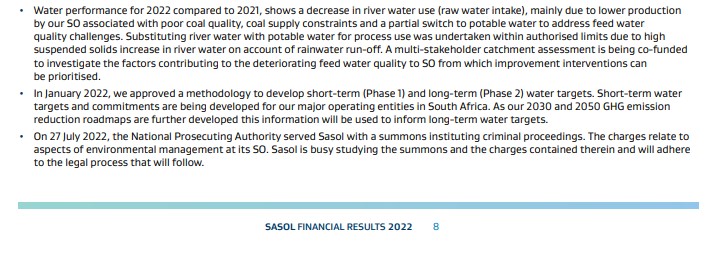
“On 27 July 2022, the National Prosecuting Authority served Sasol with a summons instituting criminal proceedings. The charges relate to aspects of environmental management at its SO. Sasol is busy studying the summons and the charges contained therein and will adhere to the legal process that will follow.”
A small note at the bottom of page 8 of the “Annual financial results for the year ended 30 June 2022” was Sasol’s way of informing its shareholders and investors about the pending court case regarding possible pollution of our water systems.
Notes in finacial results regarding charges against them
The Bulletin wrote to Sasol in March enquiring about the “Spillage into and subsequent contamination of the Klipspruit”
In their response, Sasol mentioned that they observed raw sewage seeping into the Klipspruit. Our investigations showed that the sewage spillage had been ongoing for several days and could not result in a spike of dead fish as observed by Sasol.
The Bulletin wrote to Sasol again about the spillage. We also enquired about charges that were laid at Secunda SAPS. “To date, no charges have been brought against Sasol” were their response.
The case number is Secunda CAS 19/06/2021. This clearly indicates that the charges were made in June 2021.
The National Prosecuting Authority (NPA) has now served Sasol with a summons to appear in the Secunda magistrate’s court on 20 September to face criminal proceedings. This was done in July.
“The summons was issued on the 27 July 2022 by the Secunda Magistrates court under instruction of Advocate Bekwa, the prosecutor in the matter,” said Albi Modise, spokesperson for the Department of Forestry, Fishery and the Environment. “ This summons was issued to Sasol South Africa Limited as well as Ms Nomia Machebe (in her capacity as a representative of SASOL South Africa Limited).”
The Bulletin asked the Department of Forestry, Fishery and the Environment for more details. Albi Modise confirmed that The charges relate to the following alleged misconduct:
The unauthorised disposal of waste;
Dismissing information which may have disclosed evidence of potential environmental risk;
Disposal of waste in a manner which is likely to cause pollution;
Commencing activities in the absence of an environmental authorisation;
Unlawful, negligent disposition/discharge of contaminated water into a water resource
It was also confirmed that this case related to the complaint made by Mr Ian Erasmus, a former employee of Sasol and now turned whistleblower.
Mr Ian Erasmus, a former employee of Sasol and now turned whistleblower.
In March last year, the Mail & Guardian reported how Erasmus, who worked as a senior process controller at Sasol from 2005 until he was allegedly forced to resign in 2020, had endured “years of hell” after blowing the whistle on the company’s alleged unlawful disposal of the hazardous chemicals, vanadium, diethanolamine and potassium carbonate, into the river. The California Office of Environmental Health Hazard Assessment has listeddiethanolamine as cancer-causing.
But Sasol is not only in the proverbial “dogbox” in South Africa. The company also encountered some problems with its Lake Charles project.
A group called VICE released a video about a small community called Mossberg and their dealings with Sasol. The community is only about two minutes drive away from the Lake Charles project.
Here is a quick description of VICE taken from their Facebook page: VICE is a global media channel focusing on investigative journalism and enlightening videos about everything from world news, travel, art, drugs, politics, sports, fashion, sex, and super cute animals.
Watch the video below
There is also the story of the Meyer family living in Lake Charles. Sasol tried to buy the property, allegedly far below market value. When this did not succeed, they approached the district for help.
The Meyers were successful in fighting off the land grab for the time being.
Here are a few excerpts from that court document granting a preliminary injunction against the district:
“Mr Rase confirmed that were it not for Sasol’s Megaproject, the District would not have looked at acquiring the Meyers’ property.”
“Instead, the Meyers submit that the sole purpose of the Resolution is to deprive them of their private property for the sole benefit of another private, for-profit, foreign-controlled company.”
The Bulletin asked Sasol for a response but did not receive anything from them at the time of placing this article.