The speaker of Emalahleni Municipality in Mpumalanga Mduduzi Mswati Nkosi resigned suddenly from his position on 29 April 2025
There were growing calls over the recent months for the Speaker to resign or be removed. These included marches by the community as well as a formal complaint by the Democratic alliance.
Growing calls for the removal of Emalahleni Speaker by Newzroom Afrika
The DA has also asked for a special council sitting where a motion of no confidence could be made and discussed against the Speaker
There are allegations that the Speaker has been involved in (according to a statement by the DA dated 15 April 2025);
Disrupting rightfully constituted community meetings;
Interfering with community projects and money laundering;
Failure to address public grievances in the form of a memorandum that was submitted to him.
To date, Nkosi has failed to act without bias when presiding over council sittings as he failed to allow adequate deliberation on matters that affect the residents. In this regard, he conducted proceedings in such a way that excluded the DA’s objections to the 2025/26 budget which was unfunded by R1 billion.
He also failed to uphold the legislative duties that are ascribed to him by the Municipal Finance Management Act when he allowed the council to adopt this unfunded budget.
Emalahleni Speaker, Mduduzi Nkosi
“The DA in eMalahleni welcomes the resignation of the Speaker of Council, Mduduzi Nkosi. This is a significant victory for the Council and the municipality in general,” said Maureen Scheepers, DA Councillor Emalahleni Local Municipality, “The speaker’s resignation comes in the wake of a Motion of No Confidence that was submitted by the DA on the 15th of April 2025. Our motion outlined serious allegations of misconduct, abuse of power, and the Speaker’s ongoing failure to execute his duties impartially and act in the best interest of the municipality and its residents.”
Maureen Scheepers DA Councillor Emalahleni Local Municipality
The Speaker’s resignation is a desperate move to cling to power and avoid a humiliating defeat that was on the horizon.
“Therefore, on the basis of accountability, transparency, and proper governance, the DA is content with this resignation,” continued Scheepers, “In this regard, our end goal has always been to remove an incompetent Speaker who has persistently undermined council processes, ignored legitimate complaints, and presided over sittings with a culture of impunity.”
However, despite the above, the DA is dismayed at the prospect of having an ANC councillor from Nkangala District Municipality being redeployed to eMalahleni. It is understood that the ANC leadership in the province is allegedly in the process of swapping Nkosi with a councillor from the district municipality.
The people of eMalahleni deserve leadership that is ethical, fair, and committed to service delivery. The DA remains resolute in our mission to hold this ANC-led municipality accountable and to restore integrity to council proceedings.
“We will continue to push for clean governance and will monitor the process of appointing a new Speaker closely. The DA remains the true champion of accountability in eMalahleni,” concluded Scheepers.
CRUELTY COMES IN MANY FORMS AND MANY PEOPLE, UNKNOWINGLY, SUPPORT THESE PRACTICES OR INDUSTRIES.
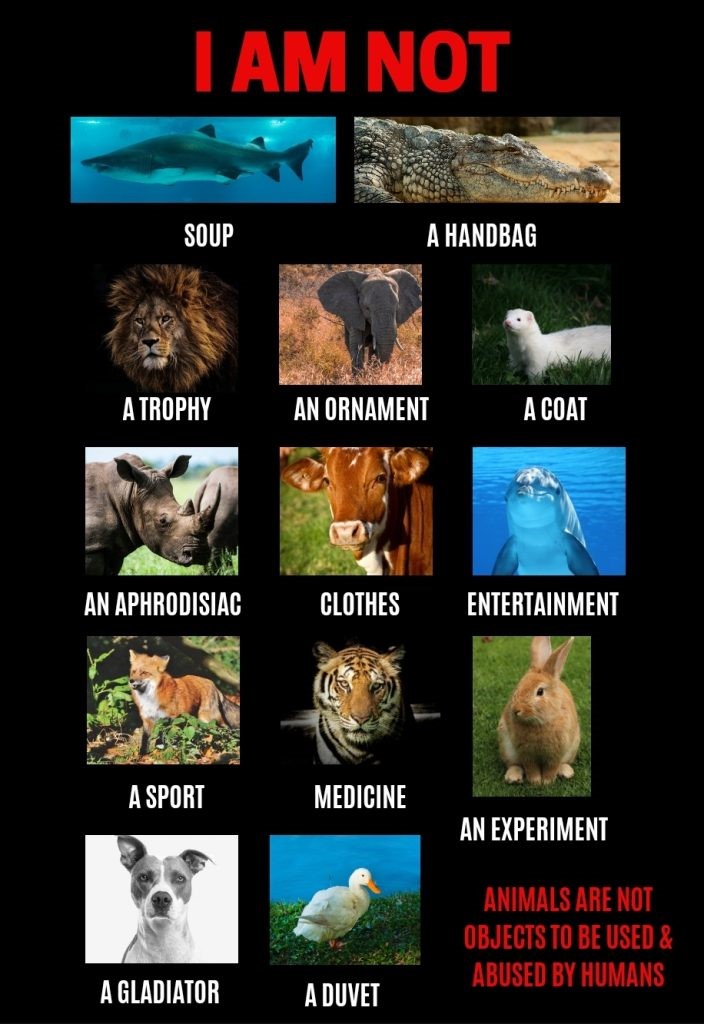
Many of you may speak up when you see a dog chained or a cat neglected. Yet, without realizing it, you might be supporting industries that quietly profit from animal suffering — all under the guise of education, entertainment, or tradition. Have you ever taken your children to a petting zoo, aquarium, pony ride, or circus show? In light of April being the Prevention of Cruelty to Animals Month, we want to shine a light on the industries and practices you might be supporting that contribute to cruelty!
Responsible people and tourists do not interact with captive wild animals! While many elephant-riding operations say that their animals are well-treated, there is no quick, easy, or humane way to train any elephant, Asian or African, purely for the pleasure of people to ride these highly intelligent and majestic creatures. Also, look at the spine structure and think about whether it will hurt or not.
Too many animals living on one property may be a sign of animal hoarding. Thousands of animals are hoarding-victims each year. Animals are kept in overcrowded, deteriorated areas, and unfortunately, most hoarding animal victims will have to be euthanized due to ill health. Even animal welfare organizations resort to hoarding, which is never beneficial for the animals.
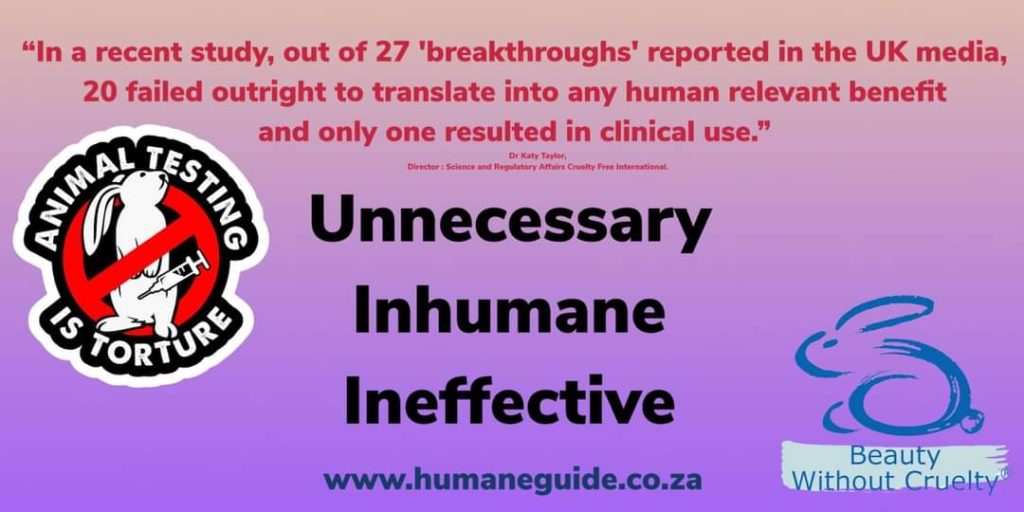
Every year millions of animals suffer and die for nothing – animal-based experiments are misleading and retard medical progress. There are safe, modern, effective, accurate, reliable, and repeatable methods available that require no living beings. Watch this Save Ralph short film. Read more about the cruelty of animal testing and the product you choose to use.
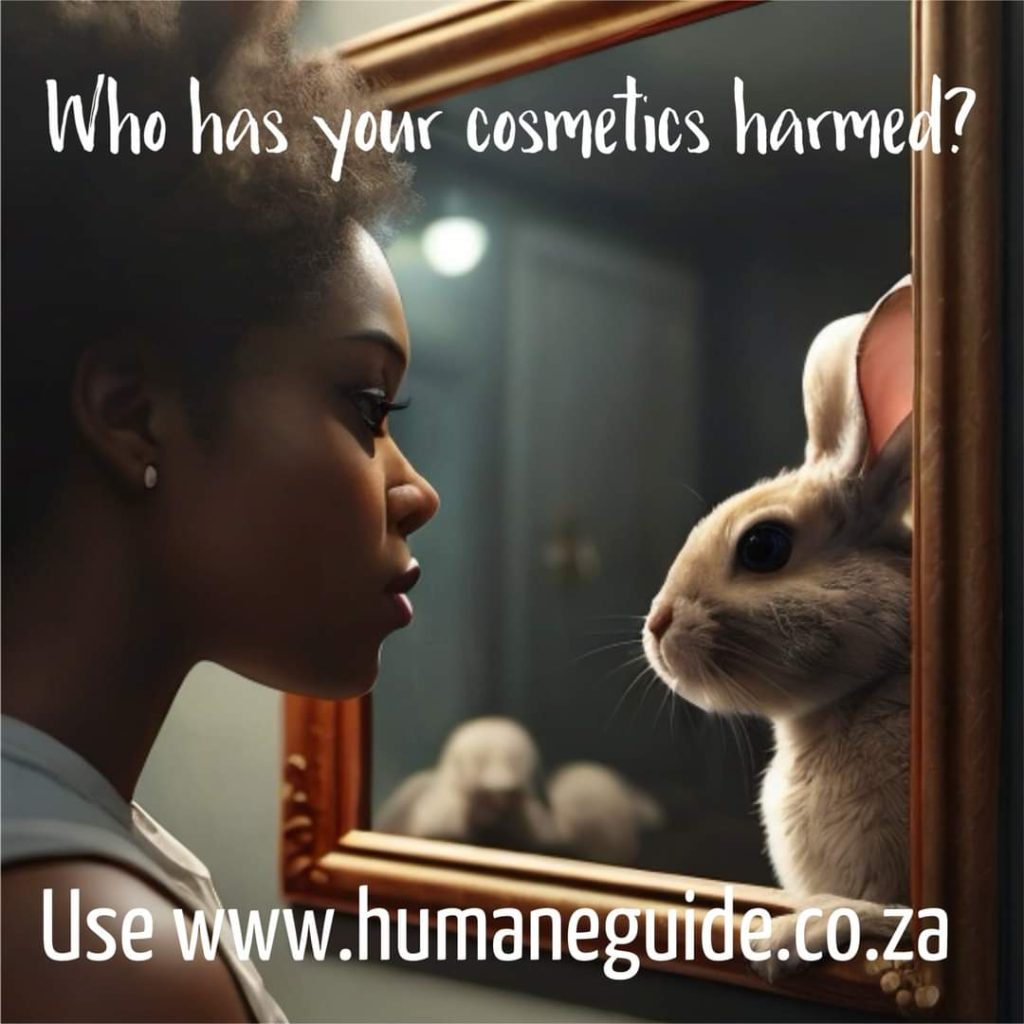
Make a difference where you can, by using kind options for household cleaners and grooming needs. It doesn’t matter what a brand says, it is what it can prove, and remember that all bunny logos mean the same. Find ethical products on www.humaneguide.co.za.
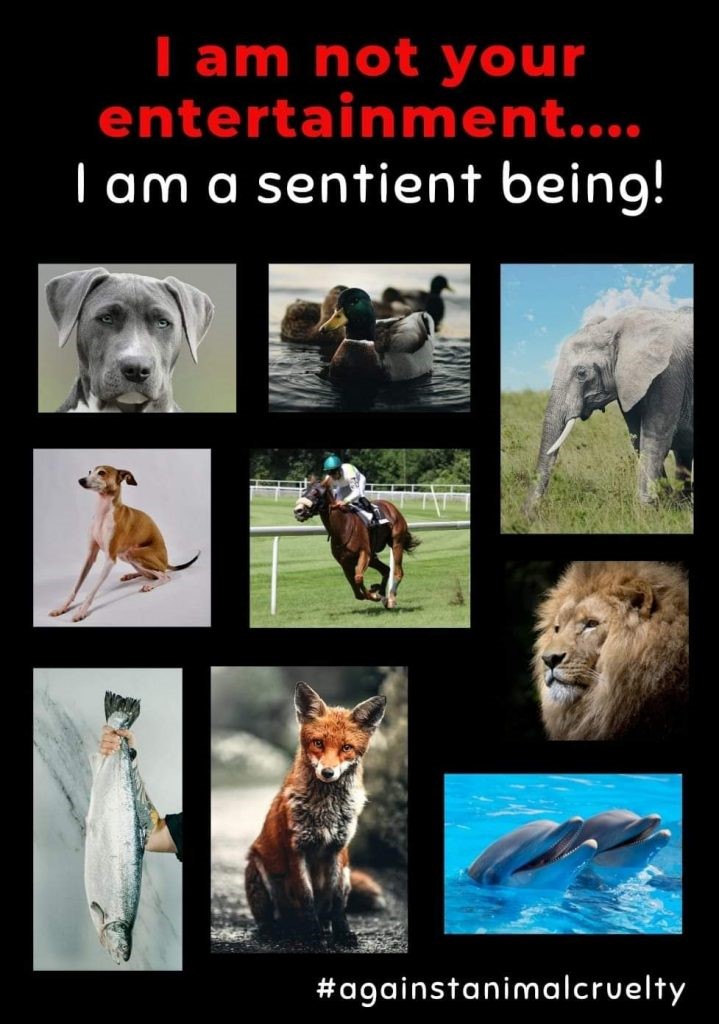
Even though we understand that hunting is deeply entrenched in the SA culture, we strongly object to any hunting or fishing for sport, entertainment, or recreational purposes. The sport does not justify causing suffering to animals.
A canned hunt is a trophy hunt that is not a “fair chase”; it has been made too easy for the hunter. Animals have been kept in a confined area, such as a fenced-in area, increasing the likelihood of the hunter obtaining a kill. A canned hunt is a hunt for animals that have been raised on game ranches until they are mature enough to be killed for trophy collections.
The welfare concerns are crucial here, and both the dog and its prey can get injured and die a terrible death, apart from the living conditions of the hunting dogs.
A line of beaters pushes the animal in the direction of a chain of waiting hunters. This way, you can be relatively certain of getting a chance to shoot the game several times each day.
Fox hunting is a very disturbing form of hunting. There are more humane ways to deal with what you perceive as “pests”.
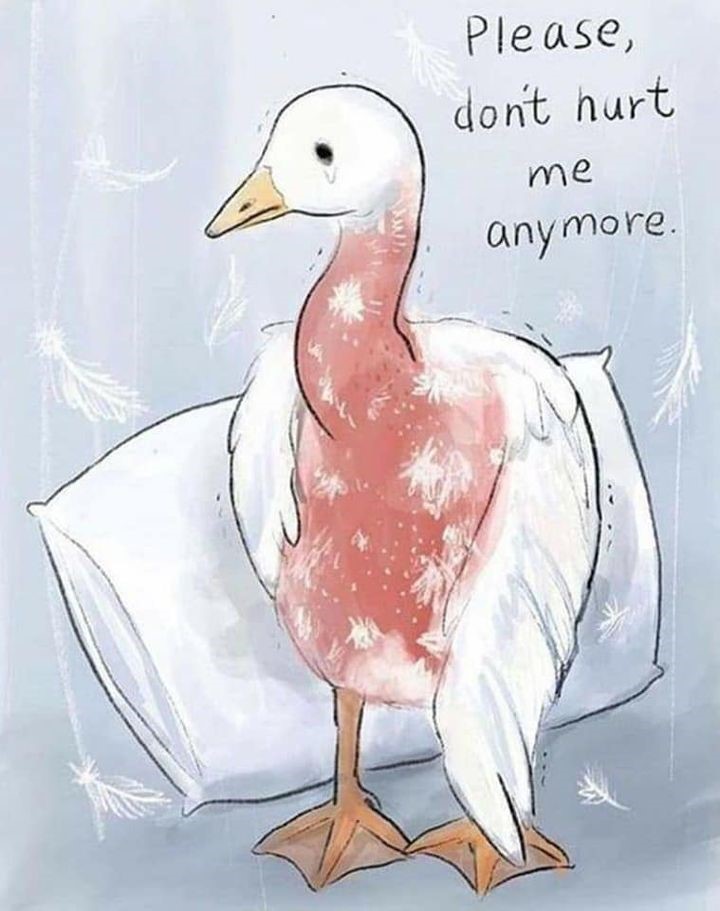
Are you ok with cruel beauty or comfort? If you’re considering buying a product stuffed with down or body feathers, the first thought on your mind probably isn’t: “Where did these feathers come from? One of the ways they collect feathers is live-plucking. Live plucking is exactly what it sounds like a goose or duck is held down by their neck or wings as the “targeted feathers” are torn from their skin. When the skin rips during this process it is sewn up with a straight needle (no analgesic or sterilization used) and the bird is left to recover before the next “harvest of feathers.” This process is repeated every 6-7 weeks before the bird’s eventual slaughter (or death from the trauma of the plucking process itself).
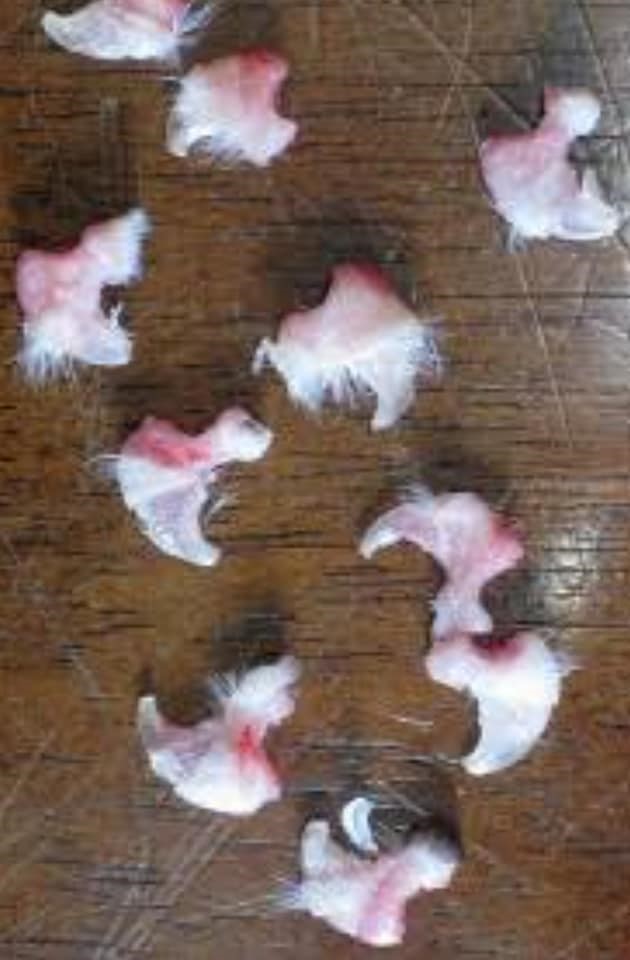
This is an amputation equivalent to the first digit of your fingers. We believe declawing cats is both unethical and inhumane. We also believe that Veterinarians should say no to this procedure unless there is a medical reason for it. There are many alternatives for responsible pet owners who are not lazy. Watch this video about declawing. Any veterinarian who thinks this is acceptable should be questioned!
While docking and bobbing are more commonly used to refer to the removal of the tail, the term cropping is used for the ears. There is no justifiable reason to dock a dog’s tail or ears. Those who do it will be liable for prosecution under the Animal Protection Act no 71 of 1962. This mutilation affects the dog’s body language for humans and other animals. When you buy breeds where this has been done, you are supporting cruelty. Again, if a veterinarian does this without a medical reason, then they are part of the problem and support cruelty.
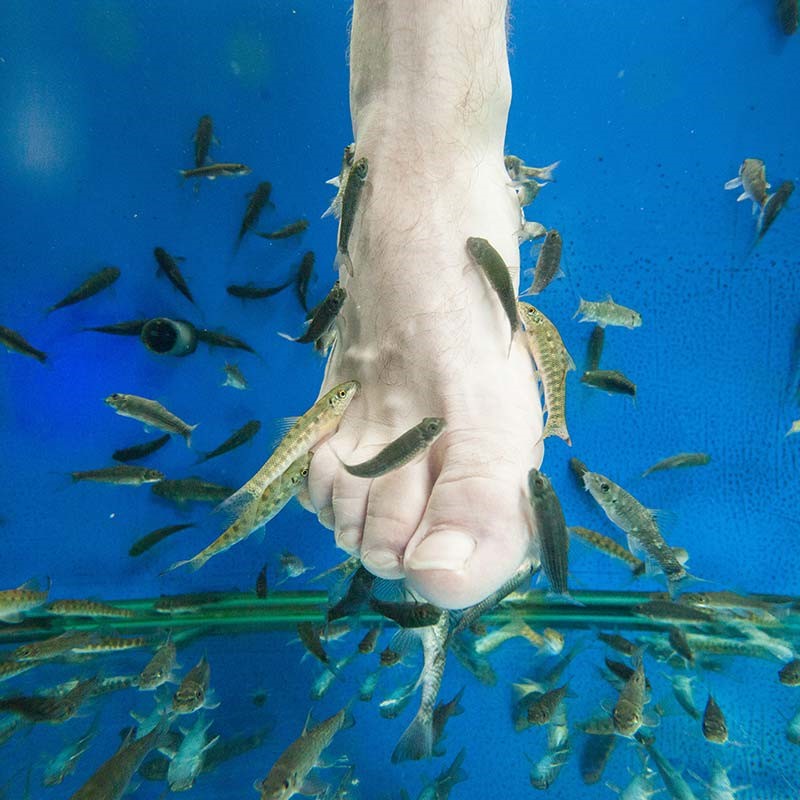
Many factors seriously compromise the welfare of the fish, leading to suffering and may even kill the animals. The water quality is affected, and temperature changes are also a concern. Toxic (to fish) chemicals, such as those from toiletries or nail varnish, may leach into the water. Chemicals used to clean or disinfect tanks or to clean clients’ feet before treatment may also be toxic to the fish. Overcrowding fish in a small volume of water will lead to increased concentrations of ammonia, too. Well-fed fish may show no interest in human skin and may be unlikely to feed on the skin if they have access to appropriate food sources. There is also the question of what happens to the fish once they have become too big to be used for pedicures.
People catch & release for personal fun. Take a photo to boost your low self-esteem, maybe, or for some likes on Facebook? You are not doing this for conservation. Fish can feel the injury, and depending on where you hook them, it can have detrimental effects on their well-being, and that is apart from the fact that many die about a week later, due to infection of the injury site.
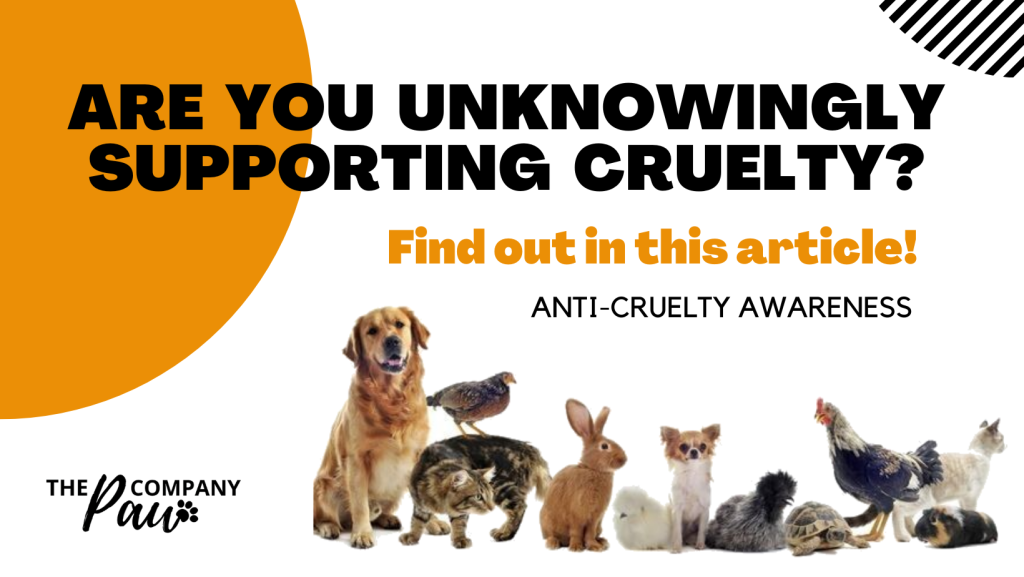
Image by The Paw Company
THE ANIMAL FOOD INDUSTRY, WITH A SPECIAL MENTION OF FOIE GRAS
The ethical questions regarding food sources are a topic on their own, but Foie gras and the methods used are a particular concern. Foie gras is a specialty food made of duck or goose liver. One bird is forced to consume between 160 and 210 kg of corn mush in only three weeks. This is the equivalent of a 68kg human consuming roughly 27 kg of oiled pasta daily, or 54 boxes of pasta a day.
The list goes on……………
There is no way for you to justify these cruel practices or industries. Animals do not deserve to be treated like products. They are sentient beings and deserve respect, care, and most of all freedom.
Join us next week to explore and learn more about the amazing animals that share our world and how we can be responsible guardians.
Strengthening the Family Unit: A Social Work Perspective
The family is the foundation of every society, shaping our values, behaviour, and emotional well-being. In social work, families are seen as key support systems, especially for children’s development. South Africa’s Children’s Act 38 of 2005 as amended, along with the Constitution, recognizes the family as the primary environment for raising children, with the state committed to supporting families in this role.
Families today face many challenges, poverty, unemployment, substance abuse, violence, and family breakdowns. These issues affect not only adults but also the emotional and developmental health of children. Strengthening the family unit promotes resilience, reduces risks, and creates healthier communities.
Social workers assist families by:
Improving communication
Promoting positive parenting
Providing counselling and emotional support
Linking families to services like housing, education, and healthcare
The Children’s Act highlights keeping families together where possible and protecting children when needed. Section 7 outlines the best interests of the child, including the importance of stable, loving relationships and safe environments.
Practical Tips to Strengthen Your Family:
Communicate Daily: Make time to talk without distractions, listen, share, and support.
Set Healthy Boundaries: Children feel safer and thrive when limits are clear and consistent.
Create Routines: Mealtimes, bedtimes, and chores help build structure and reduce stress.
Solve Conflict Peacefully: Teach and model respectful ways to manage disagreements.
Get Support When Needed: Family counselling or parenting workshops can help restore balance during tough times.
Annual Children’s Festival Date: 30 June – 4 July 2025 Fun, learning & engagement for children from 5-18 years! Contact: Jan Badenhorst – 071 378 6805 | ✉️ jan@kids4jesus.co.za
How can you help?
Social workers can’t do it alone. Here’s how you can support:
Volunteer your time or skills
Donate to help provide food, shelter, and support
Raise awareness about social work and child welfare
???? Contact Tutela Family Care Secunda: 079 310 2599 | ✉️ tutela.secunda@gmail.com
Let’s work together to build stronger, healthier families for a better future.
ARE YOU MAKING ETHICAL CHOICES WHEN IT COMES TO ANIMALS AND THE PRODUCTS YOU USE?
Most people don’t give any thought to animals when they buy products for themselves, whether clothes, beauty, or cleaning products, medicines, etc., but when you work in animal welfare, it most likely becomes second nature to make ethical choices, especially when it involves animals. Cruelty is not only physical abuse, but unknowingly, you might also be cruel to animals by supporting certain practices, products, or industries. Today, we will focus on the medical and beauty industry and animal testing.
Tomorrow, 24 April, is World Day for Laboratory Animals, an “international day of commemoration” for animals in laboratories.
Animals used for research include (in decreasing order) mice, rats, birds, rabbits, guinea pigs, hamsters, farm animals (including pigs and sheep), dogs, primates (including monkeys and chimpanzees), and cats. Frogs and fish are also widely used. These are, however, not the only ones, and some are sadly not protected under animal welfare Acts. Animals can’t consent to this, and their lives are given for a “cause” they can’t comprehend. Do you think that is ethical and acceptable?
Charles Magel shares that when you ask the experimenters why they experiment on animals, the answer is, ‘Because the animals are like us.’ Ask the experimenters why it is morally okay to experiment on animals, and the answer is, ‘Because the animals are not like us.”
There are modern, reliable, effective, repeatable, and available tools, yet they are not being exclusively used. Why? Dr. James Gallagher gives part of the answer: “Animal studies are done for legal reasons, not scientific ones. The predictive value of such studies is meaningless to men”. Legislation and potential litigation are to blame, along with vested interests.
Every year millions of animals suffer and die for nothing because animal-based experiments are misleading and retard medical progress. Did you know that when it comes to the statistics for medical research, the number of animals who suffer and die in laboratories increases to over 190 million a year, and likely more by now? It is heartbreaking if you can even begin to imagine the suffering, kept in cages their whole life, being blinded, blistered, and poisoned.
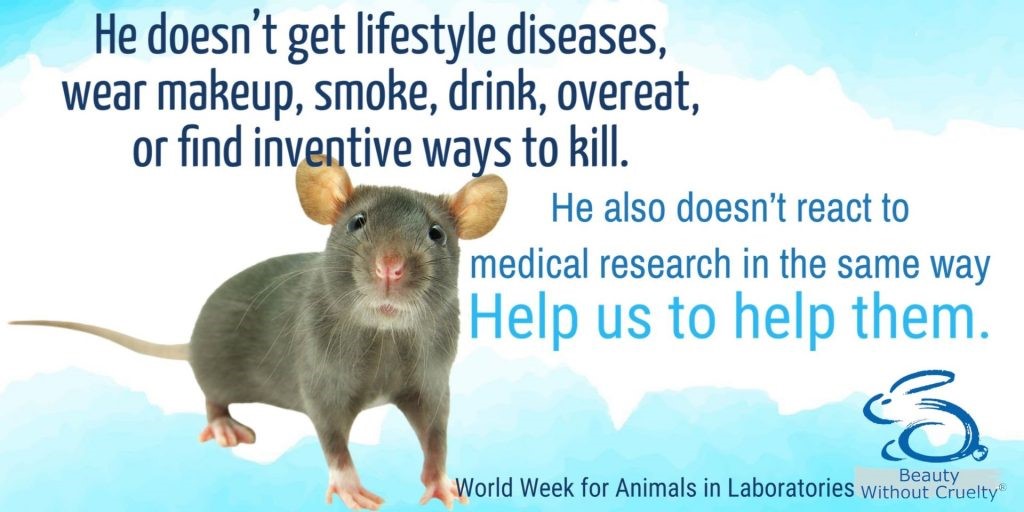
Here are just a few examples of how animal-based testing retard medical progress or how animals respond differently to humans as shared by Beauty without Cruelty SA:
The introduction of blood transfusion was delayed for over 200 years because of the misleading results of animal experiments.
Corneal transplants were delayed nearly 90 years by misleading animal tests.
Morphine drugs are a depressant in rats, dogs, hamsters, and other species, but produce tremors and convulsions at comparable doses in mice and cats. Morphine sedates people and dogs but causes maniacal excitement in cats and mice.
Tests on animals have led to around 100 drugs being thought potentially useful for stroke; not one has proved effective in humans.
Penicillin kills guinea pigs but can be a lifesaver for humans.
Aspirin and Streptomycin can produce allergic reactions in lab animals.
Paracetamol kills cats.
Did you know that more than 90% of experimental drugs that are safe and effective in animals fail in human clinical trials because they are too dangerous?
Animal studies do not predict with any certainty what will happen in humans! Dr. Sabin Albert also said that giving cancer to laboratory animals has not and will not help us to understand the disease or to treat those persons suffering from it.
Three major conditions explain why animal experimentation, regardless of the disease category studied, fails to reliably inform human health:
The effects of the laboratory environment and other variables on study outcomes.
Disparities between animal models of disease and human diseases.
Species differences in physiology and genetics.
I agree with Beauty without Cruelty when they say that you don’t need to be a balaclava-wearing animal rights activist to question the value of animal studies in this area of medical research. Animal testing is INHUMANE, UNNECESSARY & INEFFECTIVE! There are safe, modern, effective, accurate, reliable, and repeatable methods available that require no living beings. What’s missing is the will. Why are governments not legislating an end to all animal use and insisting that all future research and testing options must be modern, as these are the ones that benefit humans in the short, medium, and long term?
Image by Beauty Without Cruelty
We also support the development of the 4 R’s guiding principles, namely Replacement, Reduction, Refinement, and Responsibility, when using animals for scientific purposes. The more we push for better welfare standards, higher prioritization of animal life, and further questioning the scientific validity of animal experiments, the more we can make a difference.
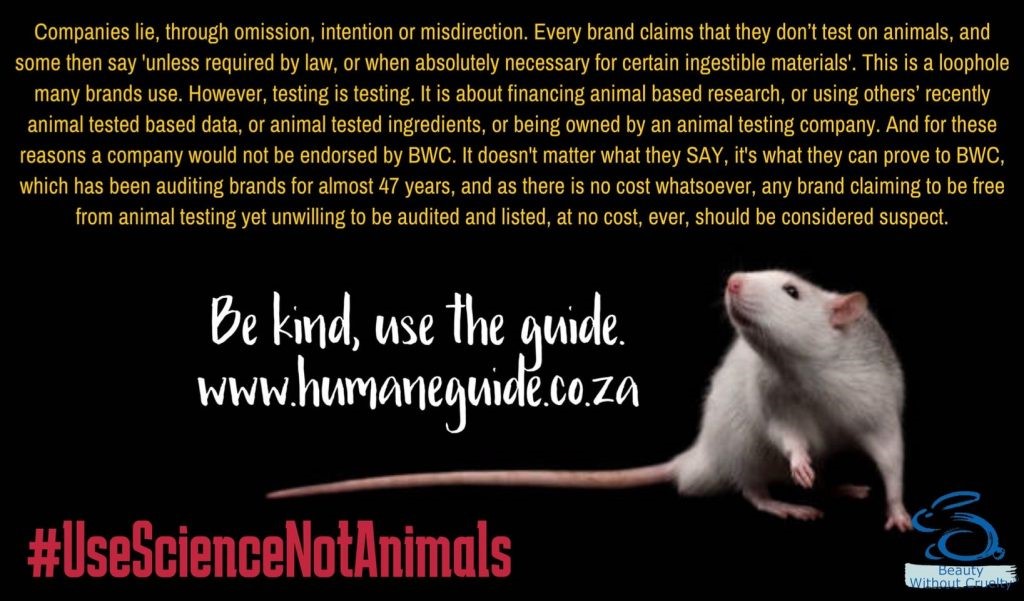
The term “cruelty-free” is unregulated. This means that brands aren’t breaking the law by calling themselves cruelty-free, even if they test on animals. Companies lie through omission, intention, or misdirection. Many beauty brands try to mislead us this way, even some sold by your friends and family! It is not what they claim, but what they can prove!
The CRUELTY-FREE 5 QUESTIONS cover the stages at which animal testing can occur. If a brand can confirm that they pass these stages without animal testing, we can consider them cruelty-free. Brands that are truly transparent and cruelty-free will respond with clear answers to these questions. If they skip questions or follow up with a short animal testing policy or smart marketing slogans, watch out because you might not be dealing with a cruelty-free company.
Contact the brand and ask them the CRUELTY-FREE 5 QUESTIONS.
Does your brand test on animals, for either finished products or ingredients?
Do your suppliers test on animals? How do you ensure this?
Do any third parties test on animals on your behalf?
Do you test on animals where required by law?
In which countries are your products sold?
One way you can distinguish these types of products from others is the rabbit logo on the product. It does not cost anything to be able to use the rabbit logo, so when the brand can answer “no” to the 5 questions, with proof, they may be allowed to use the logos. So, the only reason why a brand would not do it is either that they are testing on animals, or they don’t care enough. PLEASE NOTE, there are different rabbit logos, and not all rabbit logos mean the same. Some add a bunny that just says, “We love animals”. That doesn’t mean they are cruelty-free. I trust the Beauty without Cruelty logo.
The day you make this decision to change the brands you love or products that work for you to cruelty-free brands, it can be quite overwhelming, and it certainly was for me! There are just so many products that are tested on animals worldwide. Be kind and use the humane guide endorsed by Beauty without Cruelty (South Africa). They have already done the hard work, and this comprehensive list of beauty products, not tested on animals, can and should be your go-to. Keep in mind that there are companies listed that don’t use the logo, which also means the guide is essential. You can also contact BWC via social media to confirm.
If your brand is not listed there, you can contact your brand and ask the 5 cruelty-free questions, or encourage them to apply for the use of the logo if they claim they are cruelty-free. I first asked a brand if they are cruelty-free and got a smart marketing slogan reply back. I then asked the 5 questions with no reply, so I changed my brand. For another brand, I asked about the rabbit logo they do use, which I know doesn’t mean they are cruelty-free, and got no reply.
Next, you can start by changing out your beauty products one by one as your current ones are finished. I have used Oh So Heavenly, The Good Stuff, Be Bare Life (shampoo and conditioner bars), and the W-beauty brand from Woolworths. (None are paid endorsements.)
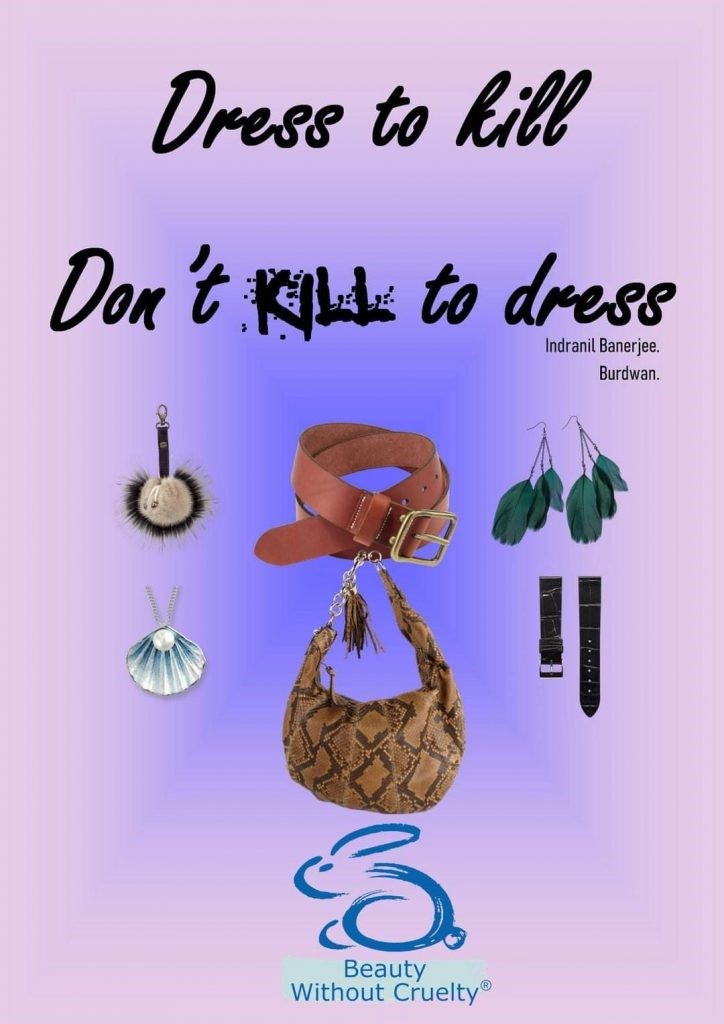
Then, you can move to more environmentally friendly packaging products. Also, think about the clothes you wear. Do you dress to kill, or kill to dress? I now choose not to buy any more fur, feathers (including feather duvets), or leather products.
Image by Beauty Without Cruelty
CHINA – As of May 2021, according to the Chinese National Medical Products Administration (NMPA), imported cosmetic products that fall into the ‘general’ category will no longer require mandatory animal testing to enter the Chinese beauty market. This means that shampoo, body wash, lotions, and make-up no longer require mandatory animal testing for products sold IN China. While animal use remains standard for hair dyes, perming products, blemish pigment-removing products, sunscreens, and others, including cosmetics claiming new efficacy, this is still a significant step forward. There is no mandatory animal use requirement for products manufactured in China for export purposes.
Watch this 4-minute animated short film on #SaveRalph. It is directed by Spencer Susser and stars Zac Efron, Ricky Gervais, and others.
The least we can do is remember the animals, be thankful, and acknowledge them for any breakthroughs in medical sciences they have helped towards, but continue to protest all unjust harm to them, and for animal-free research to be our future. Make ethical choices when you buy products, and please help create awareness for the many millions of animals who suffer and die in labs around the world for useless research every year!
Next week, we will look at the final part of this year’s animal cruelty awareness articles and how you might unknowingly be supporting animal cruelty through industries or practices.
Adv. Pule Baloyi , a member of the Pan African Bar Association of South Africa (“PABASA“) from the PABASA Tshwane Chambers has on behalf of MDM Attorneys, Bloemfontein, issued the following statement that:
The Bethlehem SPCA and Tshwane SPCA have as joint applicants, instructed MDM Attorneys Bloemfontein, to approach the High Court Pretoria for the court to consider the following relief:
Adv. Baloyi confirms that the application has been issued and is being served on the Respondents, this application requests the High Court in Pretoria to order the Minister of Agriculture fulfil his statutory duty of oversight in respect of the NSPCA Board, and to order an investigation and a forensic audit into the NSPCA Board due to the closure of various societies countrywide.
The Court is also requested to order the provisional suspension of certain key role players on the Board of the NSPCA, for their possible actions which led to the closure of numerous societies countrywide. If the application is successful, The Minister of Agriculture will report back to the Court when the investigation and forensic audit has been done, this investigation is to ascertain if it possible that the Board of the NSPCA is capable of fulfilling its function, if not various remedies have been suggested to enable the proper function of the NSPCA, which will benefit societies and animals countrywide.
The proper functioning of the NSPCA Board is vital to the success of all societies and in the best interests of all animals.
The Court has also been requested amongst other aspects to reinstate the removed Chairperson of the Bethlehem SPCA, Corlene Van der Merwe, which was unfairly removed as the chairperson and member of the Bethlehem SPCA, by the Board on 29 October 2024.
The Court has also been requested to look into the constitutionality of certain sections of the SPCA Act, the Boards Constitution, and rules as well as the Societies constitution which the Applicants view as unconstitutional and detrimental to societies and the welfare of animals countrywide.
The Applicants, being the Bethlehem and Tshwane SPCA, believe that the rights of animals are of paramount importance, and that the wellbeing of all animals is at the core of their application to court, they will argue that the existence of Societies for the Prevention of Cruelty to Animals (SPCA’s) countrywide is fundamental to the protection of all animals against animal cruelty and promotion of animal welfare.
The closures of Societies is a cause of grave concern, as when societies close down, animal welfare and the prevention of animal cruelty is negatively affected. The Bethlehem and Tshwane SPCA have undertaken to fight for animals, and approaching court is the only means that animals will get the protection needed.
This matter has far reaching consequences for the Applicants, for animals and for societies countrywide, and has been launched in the interests of animals and the public.
We request the public, to gather all the information about why the matter has been taken to the High Court to intervene, and why we submit that all societies survival hang in the balance, which must be protected by the Court, which has been requested to order intervention from the Minister of Agriculture.
There is no way forward with the NSPCA under the current Board and Directors, which according to the Applicants have lost sight of the objects and aims of the SPCA Act, and are incapable of fulfilling their statutory mandate in the interests of societies, which protect animals and prevent animal cruelty. The NSPCA was approached on numerous occasions by the Applicant’s legal Representatives and other Societies to have introspection and to self-correct, the NSPCA has despite such pleas, refused to do so.
Because of this, we request the public to support these brave societies and to support all societies countrywide.
The recent Sasol Highveld Photography Club (SHCP) meeting covered a range of important topics and updates for members. Here’s a summary of the key points discussed:
Welcome and Introductions
The meeting welcomed members, guests, and guest judge Peter Cavanagh.
Special recognition was given to the previous month’s winners: Senior Winner, Louis van der Walt, and Junior Winner, Yolandi Geyser.
Entries Summary
A total of 67 photographs were submitted across various categories:
Nature: 9
Photojournalism: 5
Monochrome: 9
Pictorial: 19
Scapes: 10
Nature – Birds Only: 4
Set Subject: 11
Agenda Highlights
Birthdays among members were acknowledged.
Discussed club member promotions and PSSA (Photographic Society of South Africa) news.
Reviewed results of senior and junior competitions, as well as updates on web competitions and photography events.
Membership and Fees
Membership fees will be collected in May 2025:
Ordinary members: R200 per year
Pensioners: R100 per year
Sasol Club Fees: R420 for non-Sasol employees (deducted from salary for Sasol employees).
Notable Birthdays
Members celebrating birthdays included:
Jackie Minnie (27 March)
Louis van der Walt (7 April)
Marius Krige (22 April)
PSSA News
Highlighted results from the Best Club Junior/Senior Competition:
Senior Winner: Louis van der Walt with “Dragon Fly Wing Motion” (score: 37/45).
Junior Winner: Yolandi Geyser with “Drinking Some Water” (score: 31/45).
Results from the Web Competition also included:
Sussa Pelser: “Gaboon Adder” (score: 33/45)
Leon Pelser: “Serious Business” (score: 32/45)
Louis van der Walt: “Dragon Fly Flower” (score: 35/45)
Photography Events
An update was provided on upcoming photography events, as well as results from past salons, such as the Amber Camera Club’s 3rd Digital Salon.
Other News
Congratulations were extended to the 2024 Honours Recipients, including Hanno De Beer for APSSA Colour.
Acknowledged members who contributed photos at the Cosmos 3 in 1 MTB 2025 event.
Judging and Meeting Calendar
Details regarding judging criteria were discussed, along with the calendar and set subjects for future meetings.
This comprehensive overview reflects the active participation and achievements of members within the club, encouraging ongoing engagement and excellence in photography. If you need any more specific information or insights, feel free to ask!
If you have any questions, contact Louis van der Walt at +27 (72) 755-2767. The Sasol Highveld Photography Club is passionate about photography and the quality of its images. It wants its members to enjoy their photography.
Members are also graded by their skill levels and receive points to progress to a higher level. The aim is for photographers to improve by having their photos judged and critiqued. By taking note of the guest’s commentaries, they should be able to improve.
Club Competition
Different “certificates” are awarded to the photographs. These are Bronze, Silver, Gold and Certificate of Merit (COM). If the author (photographer) does everything wrong in a photo, for his/her skill level, such as out of focus he/she will receive a bronze. Doing everything right will result in gold or even a COM.
The Best Photograph in the Junior Division was “St Helena Lighthouse” by John Mullineux.
St Helena lighthouse by John Mullineux
The Best Set Subject was “Light Painting” by Sussa Pelser
Light Painting by Sussa Pelser
The following is a collection of the photographs that received a Certificate of Merit
Category – Set Subject
Romantic by Lorraine BothaPainting with a Rose by Yolandi Geyser
Category – Photojournalism
Voerbale op land by Edmund HattinghSite visit by Anzette Snyders
Catergory – Pictorial
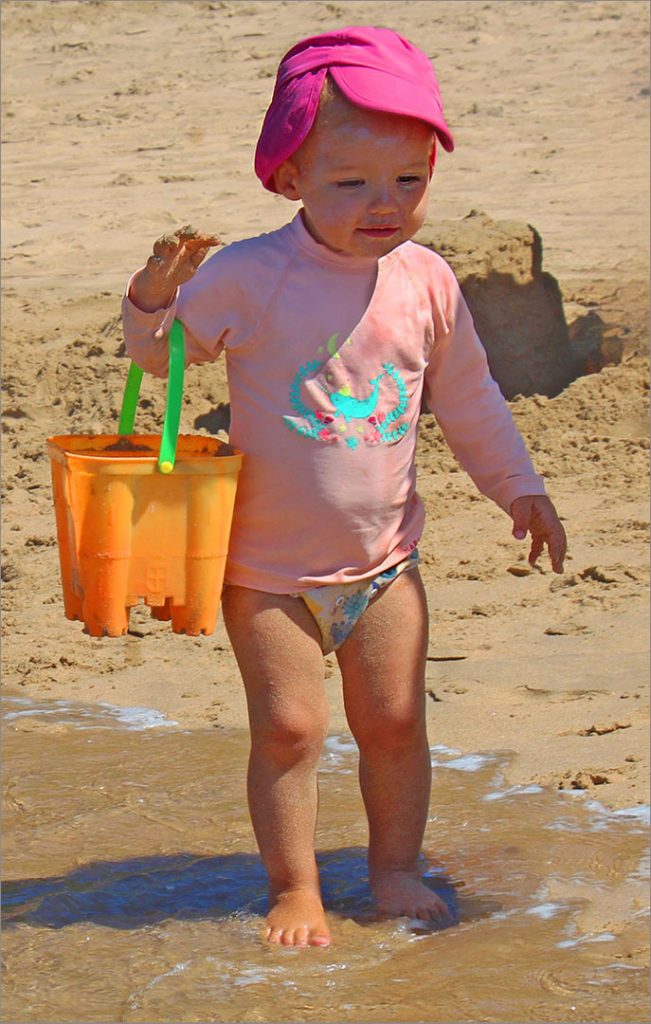
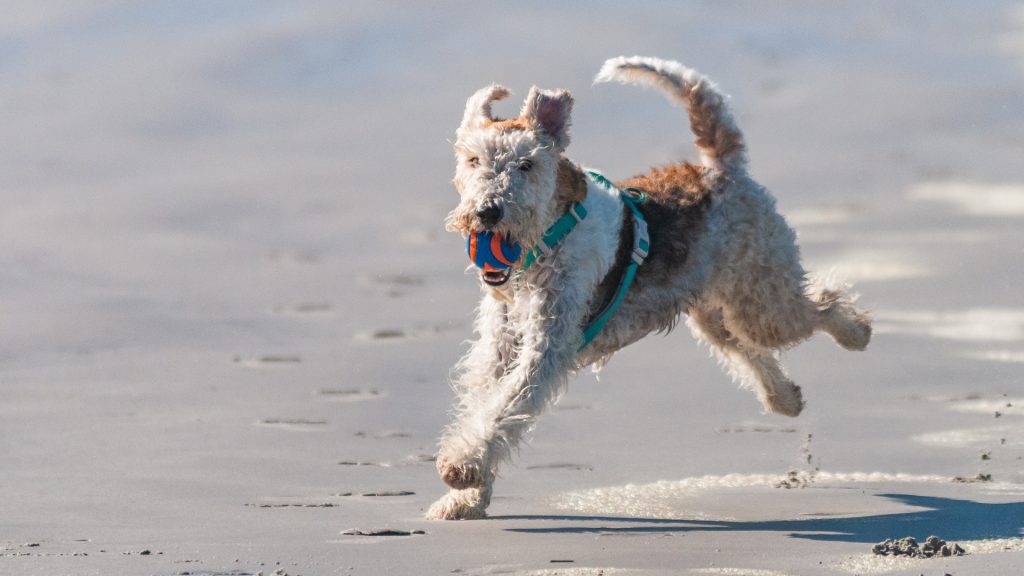
Saving a life by Leon PelserBaby at beach by Lorraine BothaSun sand and fetch by Marius KrigeAre we lost by Piet PotgieterThe last pose, natures silent end by Marius Krige
Harvard display by Leon PelserIn the heat of the game by Marius Krige
Category – Nature
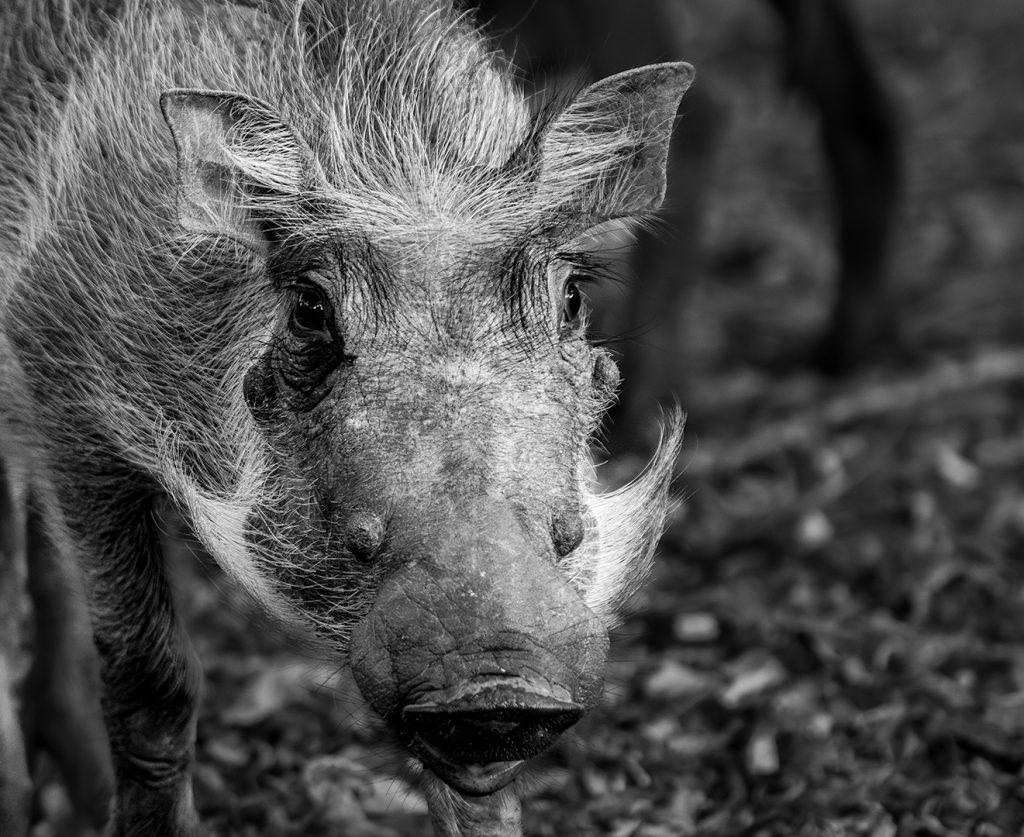
Busy worker by Yolandi GeyserCape fo style love by John MullineuxSmall wonder by Yolandi Geyser
Category – Monocrome
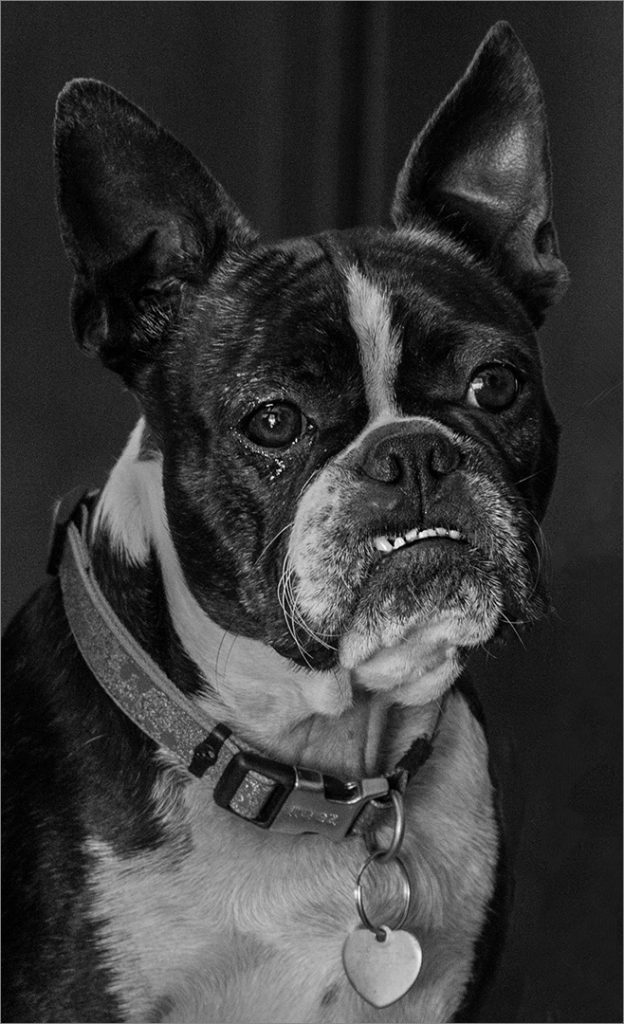
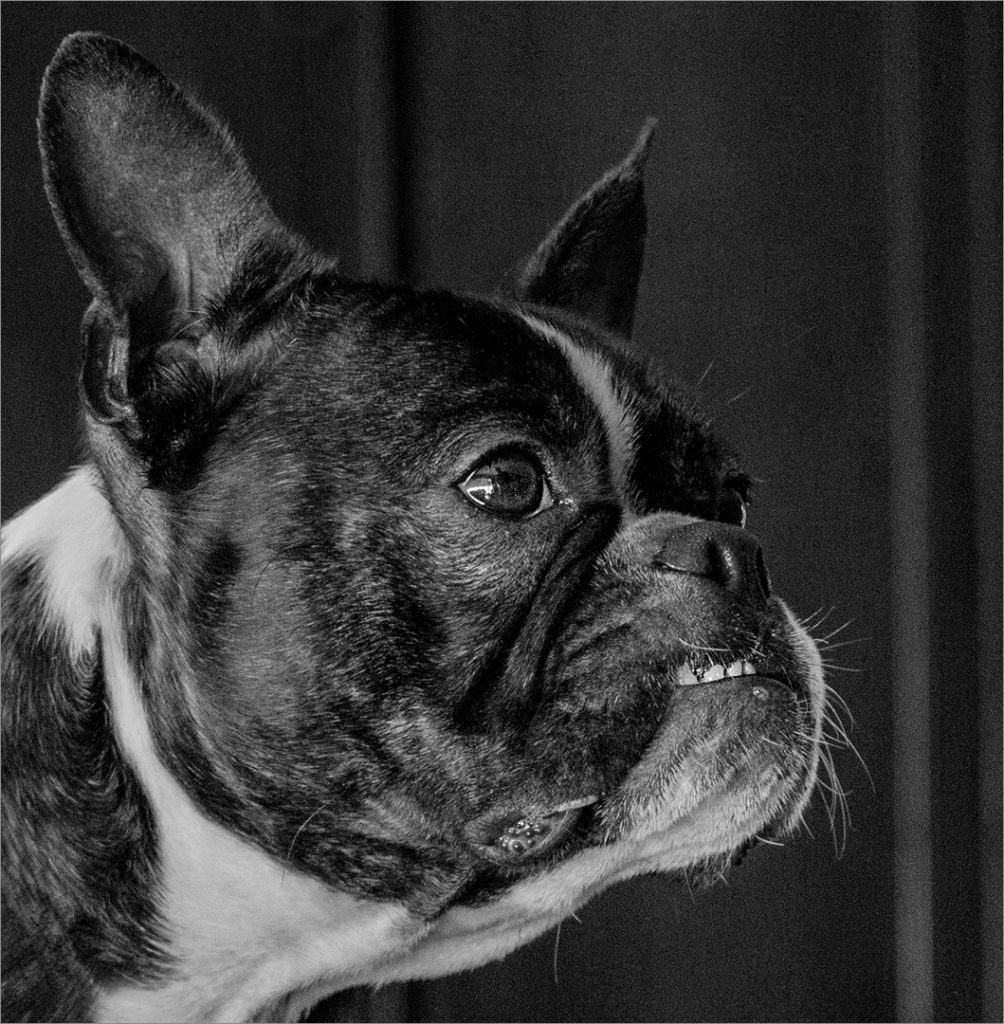
A prayer to his Lord by Marius KrigeMy sister is also smiling by Lorraine BothaAre you looking at me? by Yolandi GeyserThis is my best smile by Lorraine Botha
Category – Scapes
Clouds over canolas by Leon PelserLots of sand by Piet PotgieterBlue Bird test track at Verneukpan by John Mullineux
Category – Nature, Birds only
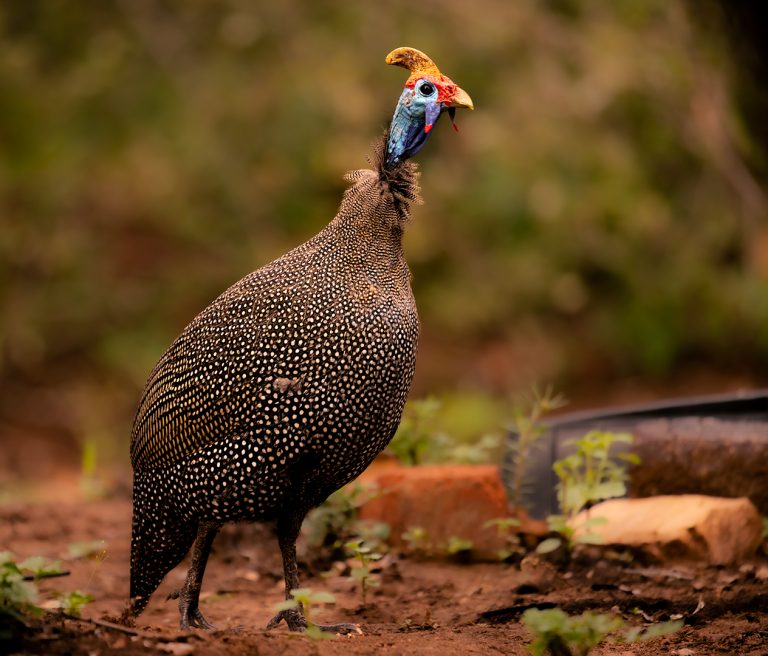
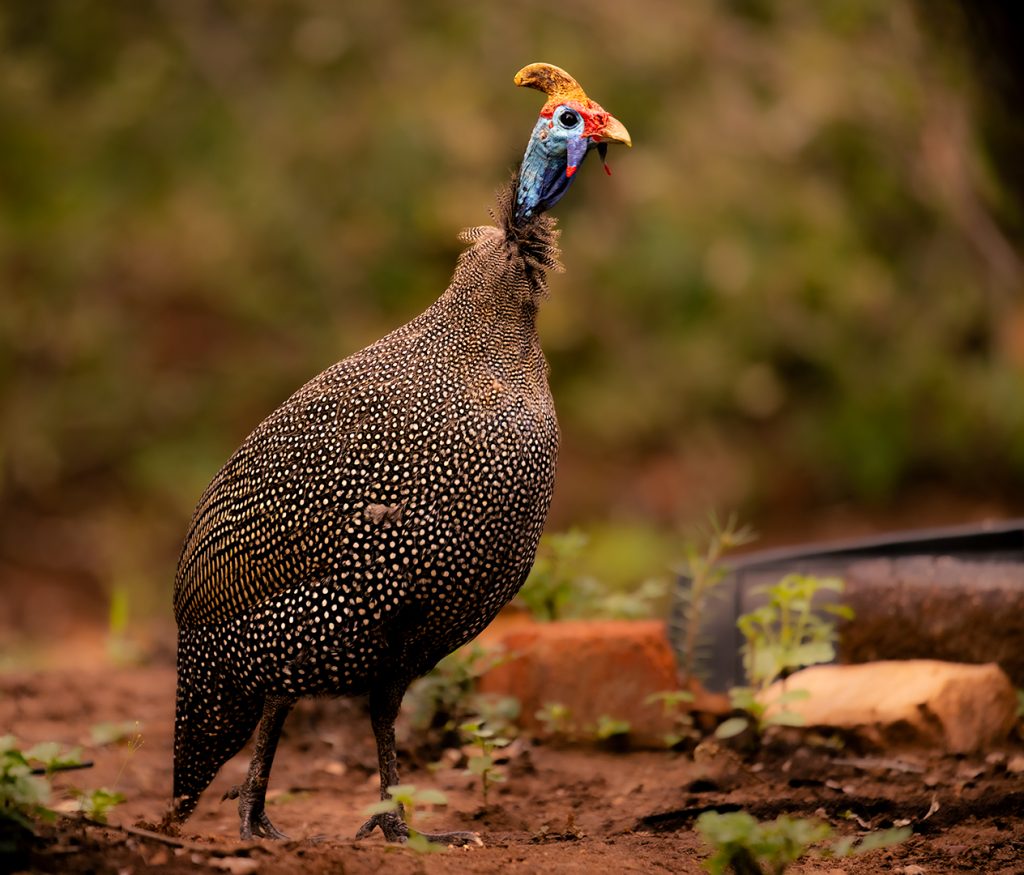
Excuse me by Yolandi GeyserNou bad ek darem lekker by Edmund Hattingh
A WEEK AFTER EASTER, THE CANDY WILL BE FORGOTTEN, BUT SADLY SO WILL THE RABBIT.
Easter is around the corner, and with Easter comes family gatherings, chocolate, Easter egg hunts, and gifts. Please don’t use this occasion to give your children chicks and rabbits just because they asked for them and think that they look “cute.” Pet ownership is a huge commitment and responsibility, and it’s not something that should be done on impulse.
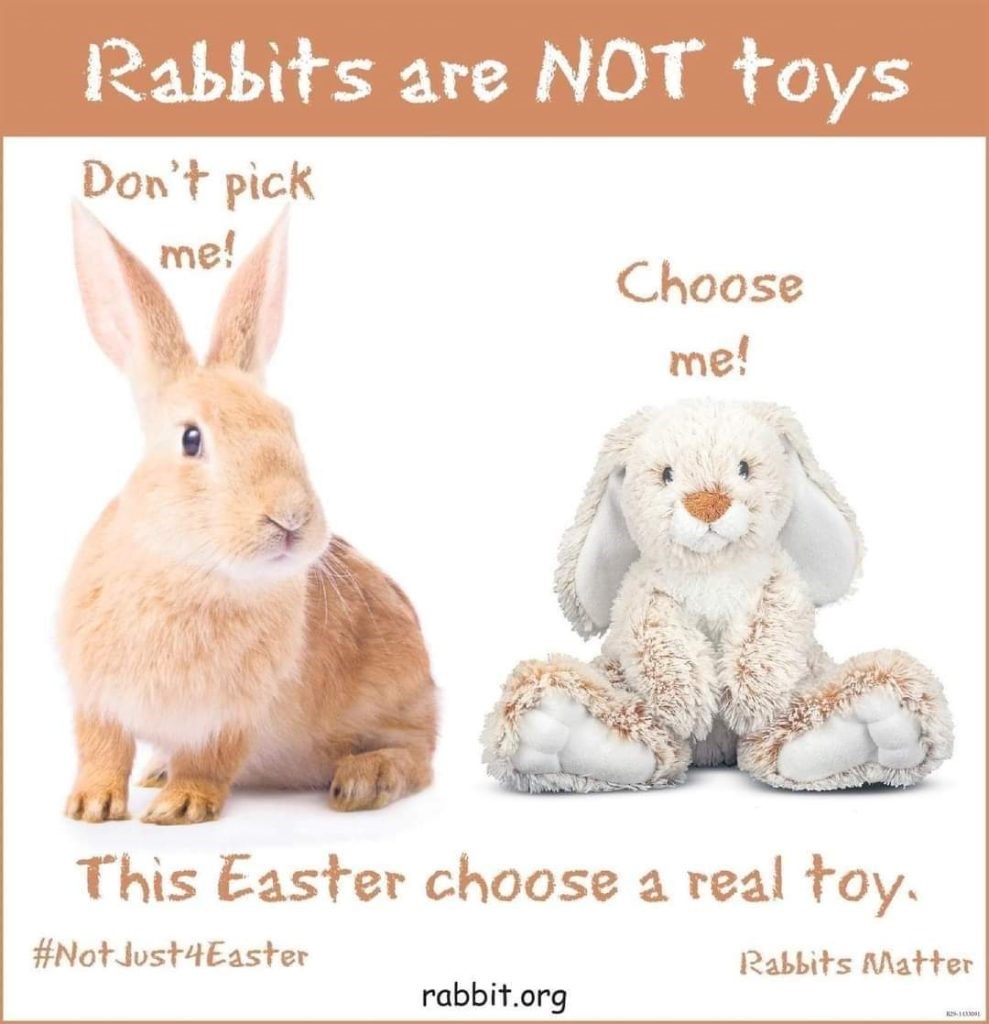
Did you know that rabbits are some of the most popular pets after cats and dogs, but also one of the highest abandoned animals? 95% of rabbits gifted as an Easter gift don’t make it to their first birthday. Stuffed toys or a chocolate bunny are a way more ethical and safe option.
A rabbit that seems cute can quickly turn into a mixture between a toddler going through their terrible twos and a puppy that is into everything. Now add the mood swings and hormones of a teenager, and soon you will have something that is hard work and not so fun because you can’t meet their needs.
In addition, Easter, like every holiday, involves potential hazards for your pets that every pet parent should be aware of, so make sure your pets avoid Easter goodies and decorations to avoid unexpected heartaches.
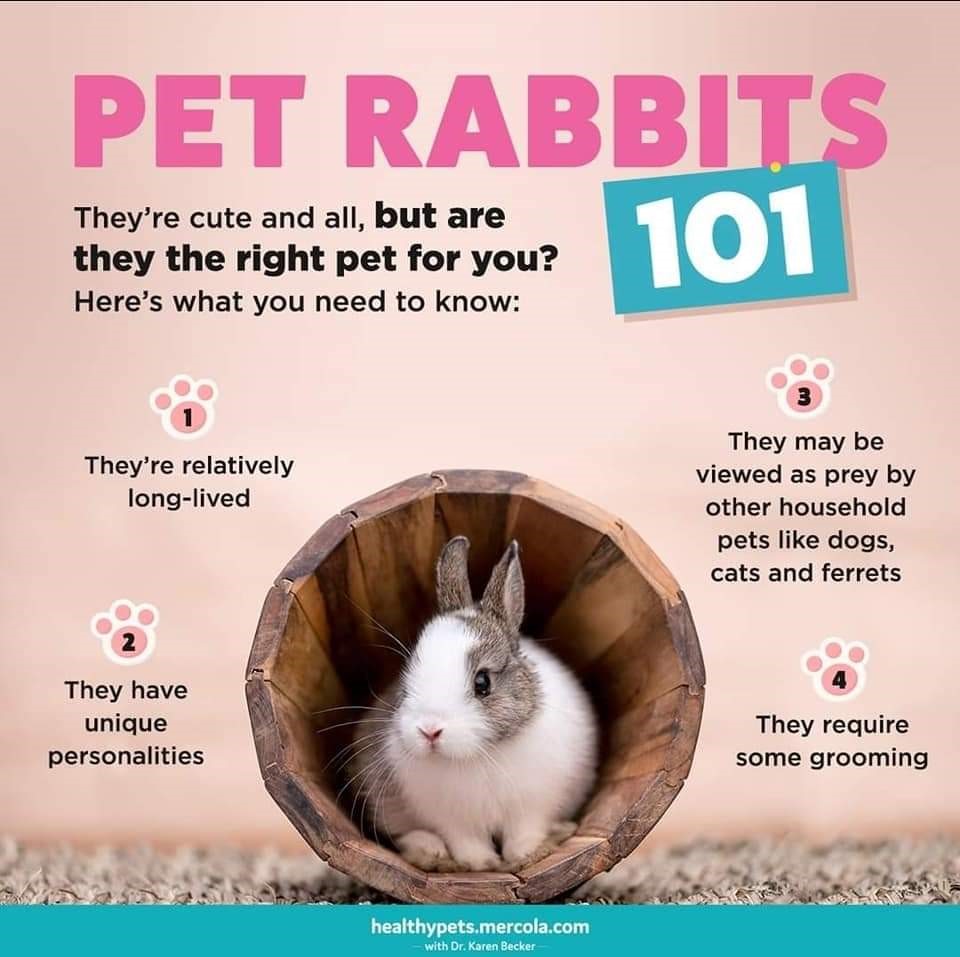
1) Rabbits can live more than 10 years, so this is a long commitment. They need food, water, hay, and regular medical care, including spaying, neutering, and enrichment.
2) They’re not ideal pets for children – the curiosity and high energy of children are terrifying to most bunnies, and because rabbits are prey animals, they may take a long time before they tolerate being picked up.
3) When your children tire of the bunny, they cannot live “in the wild”. Domesticated rabbits usually last 1-2 days if left in a park or the woods before they suffer a terrible death from a predator or nearby traffic.
4) Rabbits’ teeth never stop growing, so they are always looking for something to chew on. Electrical cords look like roots. They will gnaw on furniture, shoes, rugs, drywall, skirtings, and anything they can reach.
5) As prey animals, they are genetically programmed to maintain a normal appearance, even if they are very sick. They don’t whine like a dog or meow like a cat. They can become critically ill without you realizing it. You need to spend time observing and getting to know your bunny and their body language to detect the least deviation from “normal” and get him or her to a vet quickly!
6) Rabbits’ gestation period is 31 to 33 days, and they can fall pregnant within a few days after giving birth – they can reproduce hundreds of offspring within just a few years.
7) A balanced diet is imperative, and the illusion that bunnies require only carrots is misleading – a variety of vegetables, hay, and even herbs is vital to a healthy diet.
If you have a rabbit already, please make sure that you choose your veterinarian carefully because not all vets are qualified to treat them. You need an exotic pet vet, and even better, one that specializes in rabbits.
Easter – Image by Rabbit.org
WHY GIVING A BUNNY (OR ANY ANIMAL) AS A GIFTIS A TERRIBLE IDEA!
Animals are not and should never be seen as commodities. They are sentient beings and not disposable toys. Giving them as gifts sends the wrong message and is usually an impulse buy.
Animals are not gifts; they are many years of commitment.
Children’s attention span will fit better with a stuffed toy than with a sentient being whose needs should be a priority. Children lose interest quickly.
Tragically, many of the rabbits are abandoned in the weeks after Easter, once families begin to realize that caring for a rabbit is a major commitment. Many end up dead, abandoned, dumped on already overwhelmed shelters, or end up confined in outdoor hutches, before their first birthday.
Caring properly for a rabbit is complex. In general, rabbits need appropriate housing, exercise, socialization, and a specific diet for good welfare. Rabbits are high-maintenance pets with many specific physical and emotional needs. It is not an ideal pet for kids! Rabbits may suffer from boredom and depression if they are kept in cages, so they need many hours of free-roaming time and mental stimulation every day in a spacious, rabbit-proof area. Rabbits also require a diet rich in hay and fresh vegetables. Some breeds of rabbits, particularly the longer-haired rabbits, may require daily grooming. You must understand their physical, dietary, and social requirements, including the fact that most bunnies need friends, before getting them!
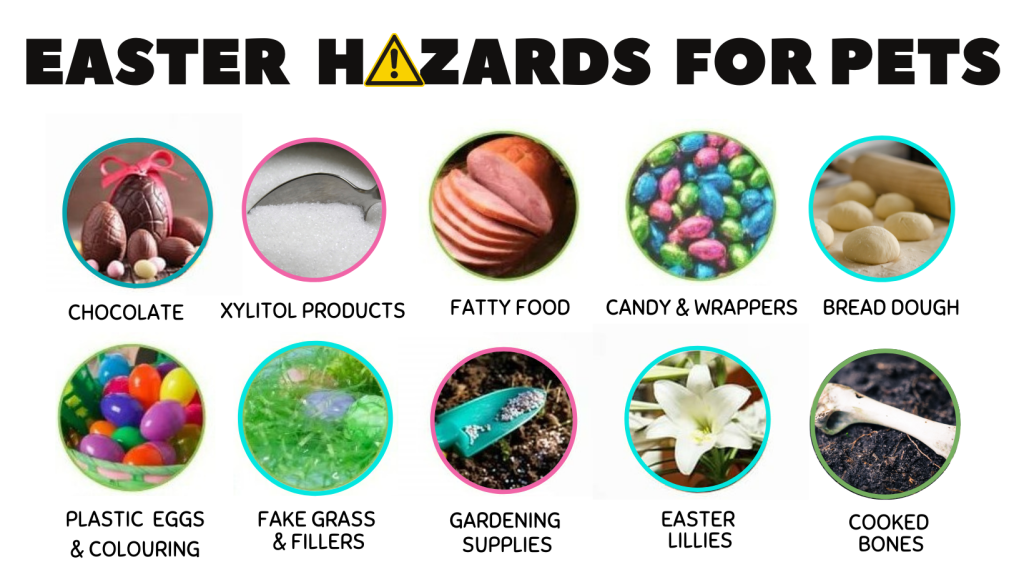
Dogs are much more often the victims of chocolate poisoning than cats because dogs like sweet-tasting things, and they’re indiscriminate eaters. Both theobromine and caffeine stimulate the central nervous system and heart muscles. They also relax smooth muscles, especially the bronchial muscles, and increase the production of urine by the kidneys. Even small amounts of chocolate can cause adverse reactions in pets, and the darker the chocolate, the more theobromine it contains.
Easter candy, baked goods, and other products containing xylitol
Sadly, xylitol poisoning in dogs is reaching epidemic proportions. Just a few years ago, xylitol could be found in less than a hundred products, but today it can be found in a wide range of products. Xylitol is a sweetener that is highly toxic to dogs. Xylitol is used to sweeten a wide range of products, including sugar-free gum and mints, nicotine gum, chewable vitamins, certain prescription drugs, dental hygiene products, and baked goods. It can also be purchased in granulated form as a sugar replacement to sweeten beverages, cereals, and other foods.
Easter basket grass and other fillers
The plastic grass used in Easter baskets can look tasty to pets, but it can’t be absorbed into their bodies. This means it can become lodged at any point along the gastrointestinal (GI) tract and create serious problems. If the grass is a staple in your Easter baskets, consider substituting paper grass or tissue paper.
Plastic eggs, foil wrappings, and Easter toys can also be attractive to pets, so be sure to keep Easter baskets and their contents well out of the reach of your dog or cat.
If you hide hard-boiled eggs in your house or yard for the kiddos to find, be sure to keep track of how many you hide and how many are found. You don’t want your pet to discover a rotten egg in a few weeks or months and eat it.
Also, keep in mind that plastic eggs can easily be cracked and produce small, sharp shards that can cause injury if your pet swallows them.
If you dye your Easter eggs, make sure to use non-toxic food colouring.
Easter lilies
A variety of lilies can potentially be toxic/deadly to pets, especially cats, but dogs too. Nontoxic varieties of lilies include the Calla, Peace, and Peruvian. If a kitty swallows even a tiny amount of any portion of these plants, including the pollen, kidney failure can result.
Easter dinner
Most types of traditional holiday feasts for humans are entirely too fatty and otherwise problematic for dogs and cats. Easter dinners are no exception, especially when they include things like honey-glazed ham, scalloped potatoes, macaroni and cheese, bread, buns, and desserts. Additional human foods to keep away from your pet due to their potential toxicity include onions, garlic, leeks, and chives; grapes, raisins, sultanas, and currants; and macadamia nuts. Cooked bones are also a no-no, along with alcohol.
Easter gardening supplies
If you plan any yard work, be sure to avoid exposing your pet to chemical fertilizers, herbicides, and pesticides. If you know or suspect your pet has eaten a potentially toxic substance, immediately contact your veterinarian!
Read last week’s article on holiday safety for your pets.
Do yourself, your bank account, and the rescues who are all overwhelmed with unwanted pets a favour and ADOPT! Critter Rescue SA adopts out their rabbits out sterilized, after performing a property check as well as supporting your family with sufficient information regarding housing and dietary requirements. Please do your homework before getting any pets!
If you can’t commit to their whole life, then please do not get them. Keep your pet’s safety in mind this Easter and have a blessed one with loved ones.
Join us again next week as we look at how our actions and decisions affect animals.
Sasol Gas Pipeline Safety | Act responsibly around gas installations
Sasol operates a network of gas pipeline infrastructure. Where there is a gas pipeline, you will see an orange-capped concrete pillar erected above ground.
The gas in these pipes is highly flammable. In the event of a gas leak, there will be a persistent “rotten egg-like” odour. Should you pick up this odour, do not ignite any fires or switch on a car engine. For your safety, contact Sasol before working near a gas pipeline.
Report any emergencies or suspicious activities on our toll-free number: 0800 212 260
The industry often says that animals are voiceless, but they do have a voice; they are just unheard. They can’t dial 911. They aren’t able to alert authorities to abuse, and they can’t quietly discuss their pain and injuries with a veterinarian. You have to be the eyes and ears for the animals you encounter to ensure that if there is any abuse, it can be stopped in time or prevented. If you do not report cruelty, then you are complicit.
As we mentioned last week, neglect may require an educational visit from an animal welfare inspector, and abuse may require the removal of the animal from the home and prosecuting the offenders. Either way, your call will guarantee a better life for that animal.
In the past, only the SPCA handled cruelties, but luckily, we now have more inspectors from other organizations, authorized by local Magistrates across South Africa. Still, save your local SPCA office and emergency numbers on your phone as the SPCA may not refuse an animal. Also, include the numbers of the areas where your friends or family stay or where you visit frequently. Find your nearest SPCA via the NSPCA website if you do not have another local authority.
HOW TO REPORT CRUELTY
Please understand that the SPCA or animal welfare organizations can’t always just take the animal. There is a legal process to follow!
Inspector Marius (Secunda) shares the following tips for reporting cruelty:
ENSURE PERSONAL SAFETY FIRST
• Do not confront the suspect if you feel unsafe.
• Do not trespass on private property to gather evidence.
BE THE ORIGINAL COMPLAINANT
• You must be willing to make the report yourself.
• Reports made via hearsay (e.g., “my friend saw…”) cannot be used in court.
GATHER CLEAR EVIDENCE
• Take photos or videos if it is safe and legal to do so.
• Write down:
o Date and time of the incident
o Location (provide a pin when possible)
o Description of what happened
o Number and type of animals involved
PROVIDE A WRITTEN STATEMENT
• Prepare a written, signed statement with your full name, ID number, and contact details.
• Describe the incident in your own words.
• This statement is essential for legal prosecution.
CONTACT THE RIGHT AUTHORITY
• Report directly to the Animal Welfare Inspector or your local animal welfare organisation.
KEEP RECORDS
• Keep copies of all evidence, reports, and correspondence.
• Note the name of the officer or inspector handling your case and follow up!
The new Animal Welfare Inspector in town (Secunda) is Marius van Reeuwyk, from SAAWIA. He has been taking a lot off our plate and can do more than we can legally, which will help the animals immensely. He can do wellness checks (when you suspect cruelty/neglect) and deal with cruelty or animal emergencies. We won’t have to run around between the SPCA and the NSPCA anymore, either. Please know that he does not get paid by anyone, so for us to help the animals locally, we need the community to help him, too. Please consider donating to his work on a regular basis.
If you have a problem with the way an Inspector conducts themselves, then please contact The Paw Company
Inspector Marius – Image by SAAWIAImage by SAAWIA Secunda
ALWAYS REPORT SUSPECTED CRUELTY!
If you notice an animal that appears to be suffering, call your local animal welfare agency immediately! Do not send a message or email, or do this through social media, as we lose precious time! Call until they answer! It can be done anonymously (to a point) and even if you are unsure, rather report so the SPCA or other authority can investigate. You can find an SPCA near your location or contact the NSPCA directly. You can also report it to your local SAPS, but I would rather do it through other local animal welfare organizations willing to assist.
If you are unsure whether it is cruelty or not, report it anyway! Please remember that no inspector can just take an animal away on the first visit. They need proof of the cruelty/neglect, and there is a process to follow, including writing a notice to comply or warnings before a warrant can be obtained for the removal of the animal in question. In clear-cut cases, it can happen faster.
When you call them and they go out, and you feel nothing has happened, follow up and contact the NSPCA (nspca@nspca.co.za) if it was reported to the local SPCA. When it happens again, please contact them again and provide affidavits where possible. This will help with the process. If you report cruelty to an SPCA and they claim it is not their area, by law, they still need to make sure that the case is attended to and provide feedback.
Be a responsible pet owner. Know about and fulfill the needs of your pet. Don’t just concern yourself with basic needs – give your pet positive experiences that really enhance their well-being. It is a lifetime commitment, not just when it suits you.
Be an example of kindness to other pets. Foster a pet that has suffered abandonment. Sadly, many pets are relinquished to shelters for various reasons. Foster homes help these animals recover and prepare them to move on to a new, permanent, loving home. If you can, ADOPT!
Intervene if you witness animal cruelty, abuse, or neglect. Do what you can to stop someone from mistreating an animal. However, be sensible and if necessary, seek help from other witnesses or authorities. An animal that has been mistreated needs support, sometimes immediately. You can make a real difference by taking an animal out of a harmful situation.
You can keep food, water, a leash, and a blanket in your car. If you see an animal in need or roaming around, you can help. Approach only if it is safe for both you and the animal, as we do not want them to run away into danger. If the animal is hurt, stay with them or follow them at a safe distance while you wait for your local animal welfare organizations to come and assist you. If you can pick up the animal, take them to your Vet, the SPCA, or into your yard until the owners are found.
Teach your children to have respect for animals. Set a good example by being respectful towards animals. Show children how to interact with and treat animals with love and consideration. Even if your pet allows it, kids should not be sitting on or pulling on the ears or tails, etc., of pets. Help them grow up to become the next generation of advocates for animals. Children who are cruel to animals often grow up to be cruel to people as well. Nip animal cruelty in the butt early on, even better, prevent it!
Know the legislation & support legislation that promotes kindness to animals. Stronger animal welfare laws and harsher penalties for abusers will lead to fewer cruelty cases. Support the campaigns and advocate for animal rights! Ask what animal welfare policies the political party you support has. You can read the Prevention of Cruelty to Animals Act, 1993 (Act 169).
Animal and social welfare link – Consider that neglect of animals can be closely linked to domestic violence. Animal abuse usually precedes or is concurrent with other abuse. By reporting your suspicions, you may also be helping both the animal in need and the family members concerned.
Educate people around you about the issue. Help people to understand that they can intervene in situations where animals are being neglected or even tormented. Animals have a right to live without fear or pain, and we have a responsibility to step in if their rights aren’t respected. Promote programs at schools! You can read more on specific educational animal welfare topics on the NSPCA website.
Offer help to people who seem overwhelmed with their animals. Animals aren’t necessarily neglected out of a lack of love. An owner may not have the psychological resources to provide an animal with the appropriate care. Whatever the reasons may be, an affected pet must be removed from a place of neglect and given the care it needs to live and thrive. Any help you give to an animal may help a human, too.
Volunteer in animal welfare, whether it is by fostering, helping at kennels, sharing posts, or donating to those who do the work. Take care of those animal welfare workers in the trenches, so they can continue this sad and tough job. Whether it is words of encouragement, a gift, treatment, or just a coffee.
Using cruelty-free products like skin/body/hair/make-up, and clothes. The www.humaneguide.co.za products are endorsed by Beauty without Cruelty (South Africa), where the manufacturers/companies do not test on or pay for testing on animals. Don’t be fooled by companies’ smart and sly slogans. It is never what the company claims, but what they can prove! Be informed!
Don’t support “free to good home” ads and report the selling of animals on social media. Facebook, Instagram, and WhatsApp do not allow for the selling of live animals! Don’t support breeders, pet shops, animal dealers/brokers, the circus, aquariums, petting farms, animal rides, animal sports, unethical hunting practices, or any industry that exploits animals for money or entertainment.
Go orange in April against Animal Cruelty
Their paws can’t call 911! Report suspected cruelty and help us prevent cruelty!
Join us again next week as we look at some safety tips for Easter.
WHEN YOU UNDERSTAND CRUELTY TO ANIMALS BETTER, YOU CAN HELP US ADDRESS THE PROBLEM MORE EFFECTIVELY.
Animals have voices, but only a few hear them! When was the last time you heard of anyone tuning in for animal abuse? It just doesn’t happen often, if at all. I mean the tuning in. Preventing animal cruelty is in all of our best interests. Animal cruelty is not only despicable in its own right, but it is often a gateway crime to violence against adults and children. Studies show that children who witness animal abuse are at a greater risk of becoming animal abusers themselves.
We follow the 5 (6) freedoms of animal welfare:
FREEDOM FROM HUNGER & THIRST
FREEDOM FROM PAIN, INJURY, DISEASE
FREEDOM FROM DISCOMFORT
FREEDOM FROM FEAR & DISTRESS
FREEDOM TO EXPRESS NATURAL BEHAVIOURS
…….AND THEN OUR HOPE FOR ALL WILDLIFE, TO BE FREE!
We are committed to breaking the cycle, and to help us stop animal cruelty, you need to understand the problem or how you might be contributing, recognize the signs, report it, and help educate others to prevent it.
Animal Cruelty – Image by The Paw Company
UNDERSTANDING THE PROBLEM
If you do not work in animal welfare or know someone who does, you probably know little about what is happening. What you might see on Facebook and social media is not even the tip of the iceberg. Our hearts break every day for the hurt that is out there. It is preventable!
A few facts about animal abuse:
The abuse of pets and animal companions is a daily occurrence.
Many animals suffer multiple forms of abuse, with the most common type of abuse being neglect and abandonment.
Cases of animal abuse include neglect, shooting, stabbing, fighting, beating, mutilation, torture, strangulation, rape, cannibalism, burning and poisoning.
Most animal abuse is never reported.
Dogs and cats are the most common victims, but abuse happens among other animal species, including domestic, farm animals, wild animals, small pets, birds, etc.
Although there are bad people, ANIMAL OVERPOPULATION is a massive problem, especially with cats and dogs. If there were fewer animals, with enough “good homes”, fewer animals could land in the wrong hands and be abused.
Why is there an OVERPOPULATION CRISIS? Because people don’t sterilize their pets, they support breeders and give or sell them to anyone. When animals end up in the wrong hands, they pay the ultimate price. There are animal dealers who easily fool the untrained individual. Do you want to take that risk with the life of a sentient being?
This needs to be addressed through education, sterilization campaigns and stricter breeding regulations. We would rather see a breed go extinct than let them endure suffering.
RECOGNIZE THE SIGNS
Once you learn to recognize the signs of animal abuse and neglect, you will be better equipped to report it. The Humane Society divides cruelty into two kinds: direct violence and neglect. Some call it active vs. passive cruelty.
Direct violence. Signs include open wounds, multiple scars, limping, or difficulty walking. Many dogs that suffer direct violence will also display behaviours such as hiding, walking with their head down and tail between their legs, or cringing when people approach. Since those can also occur for other reasons, these behavioural signs alone shouldn’t be taken as definitive proof that a dog is being hurt.
Neglect. Most people don’t go so far as to actually lay hands on their pet to hurt them, but what happens with far too many owners is just as bad: they neglect the needs of their dog/pet. I believe animals in the street should also be charged under neglect, and we will fight for that as much as we can.
CRUELTY CASES
All animal cruelty cases can be separated into three basic categories:
It may be hard to believe, but many people don’t even know that the harm they are inflicting on their pets is, in fact, abuse. This type of abuse is known as unintentional, and it’s caused through neglect, animal hoarding, or failure to meet an animal’s basic needs.
Intentional animal abuse and cruel intent both refer to abuse that is performed with the knowledge that an animal is being harmed and possibly injured.
Cruel intent is often recurring, and abusers in this category feel a sense of power, control, or enjoyment when inflicting pain on these animals.
Animal Cruelty
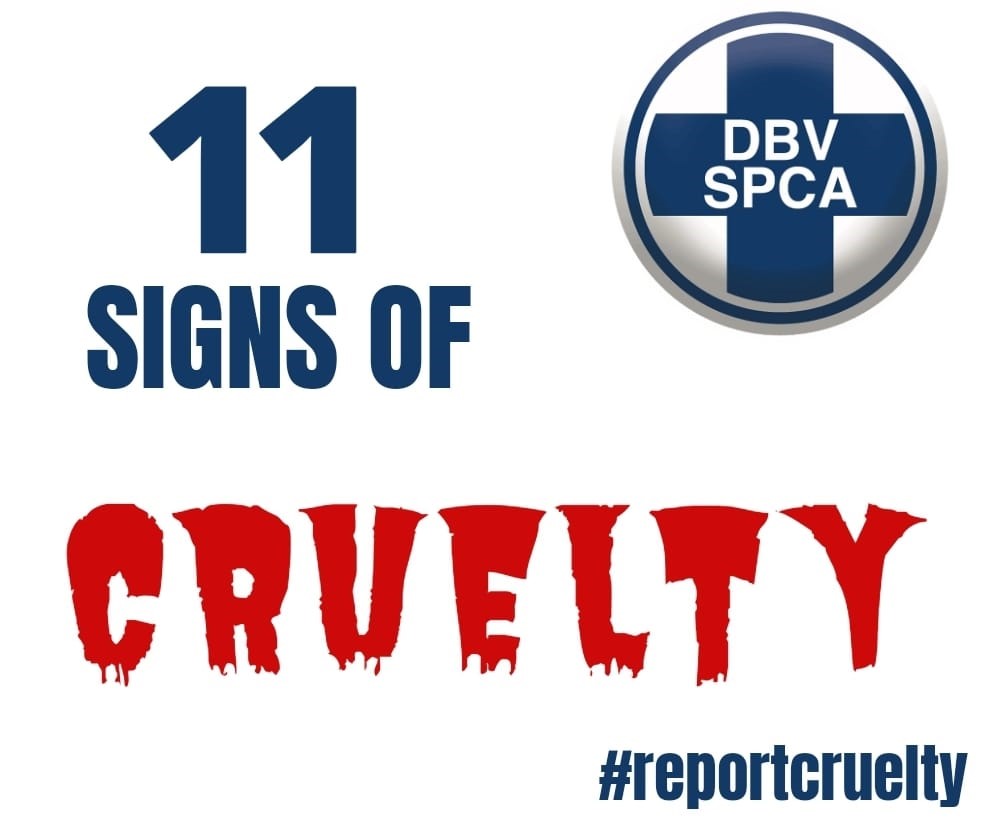
11 SIGNS OF CRUELTY (Bulawayo SPCA)
1 – POOR BODY CONDITION AND NOTICEABLE TRAUMA
The animal has severe matting and a filthy coat, hair loss, lesions, scabs, or other skin conditions that have not been treated. Open sores or obvious wounds. They appear to be flea or tick-infested. They are underweight with bones clearly visible or dehydrated. They might be limping or unable to walk at all, or have congested eyes or ears. They are in obvious physical distress, have no signs of medical care like bandages, etc., and require veterinary care. Withholding/denial of medical care, whether sick or injured, is also considered cruel.
2 – LACK OF FOOD OR WATER
Every time you see this animal, you notice that they have no obvious sources of food and/or freshwater. They may be aggressive due to starvation and thirst, and perhaps very lethargic.
3 – LACK OF SHELTER
The animal is contained in an area that is largely or fully exposed to inclement weather or constant sun.
4 – LACK OF SANITATION
Faeces and/or debris cover the animal’s living area. Offensive odours coming from a home or yard, such as the constant smell of ammonia or faeces.
5 – ABANDONED
The animal is left in a house, yard, or other areas that appear empty or devoid of normal human activity. Reports of companion animals abandoned and left to die inside vacant buildings are alarmingly common. It is a crime under SA law to abandon an animal.
6 – THE ANIMAL IS TIED OR CAGED
They have little or no room to move and are unable to stand or turn. Animals are kept confined inside a car, garage, basement, attic, or other enclosed areas.
7 – CHAINS, ROPES, WIRE, OR PADLOCKS AROUND THE ANIMAL’S NECK
Be on the lookout for anything around an animal’s neck that may have become embedded and/or infected, including regular collars. If an animal is tied there are chaining or tethering regulations that need to be followed!
8 – SIGNS OF AN ANIMAL BEING TRAINED TO OR HAVING BEEN USED TO FIGHT
This is especially common with power-breed dogs and even roosters. You may see training implements, treadmills, spring poles, etc. More likely, you will notice obvious signs of trauma, including scars, open wounds, infections, and even missing body parts, such as ears or tails.
9 – THE ANIMAL’S BEHAVIOR IS ABNORMAL
They may be very aggressive, hostile, ill, distressed, or severely shy, e.g., cowering, hiding, fear-biting, even with or especially with the owner.
10 – TOO MANY ANIMALS LIVING ON ONE PROPERTY
This can be a sign of animal hoarding, which makes the conditions no less cruel. An estimated hundreds of thousands of animals are being hoarded as victims each year. An individual who has a large number of animals in his/her care, who may not even know the total number when questioned. Animals are kept in overcrowded, deteriorated areas. Your local municipal bylaws state how many animals may be kept.
11 – OVERT ACTS OF VIOLENCE
An owner or any person who is being overtly violent against the animal, striking or throwing objects at them, or otherwise physically abusing them.
There is no violence against an animal that is justified, and a person who would abuse an animal in public or plain sight is likely doing far worse outside of view. The death of one or more animals under suspicious conditions should also be reported and investigated.
The above is there to help you understand cruelty better and know what to look for. Some of the above signs by themselves do not necessarily mean that an animal is being abused. It’s important to examine the entire situation before jumping to conclusions, but rather report it if you are unsure, so it can be investigated.
For EXAMPLE, you might notice that your neighbour’s three cats are infested with fleas and are physically uncomfortable. After a short conversation with your neighbour, you learn that all three cats are being treated, and they appear healthy and socially adjusted. You conclude that these cats are probably not being abused. On the other hand, you notice another neighbourhood dog with an obvious flea infestation who also looks emaciated, has open sores on its body and acts aggressively when approached. In this case, you may have reason to suspect abuse.
Download this cover photo above and add it to your profile.
Add a frame to your profile picture.
Tie an orange ribbon outside your home.
Share posts to educate about animal cruelty.
Wear an orange ribbon or clothing.
and more………
Preventing animal cruelty is not an easy task, but with your help, we CAN DO THIS! Next week, we will look into how you can report cruelty and help us fight cruelty!