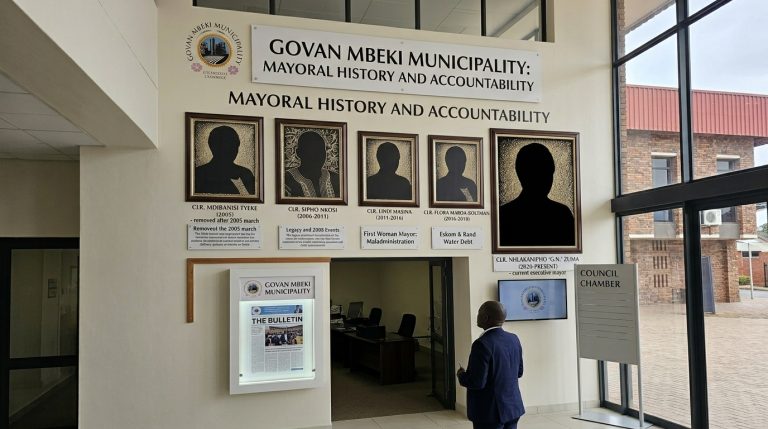
By the Bulletin Editorial Team
The Bulletin has received a letter from Sibusiso King Hlolweni, a resident of eMbalenhle, raising serious questions about the political and administrative history of Govan Mbeki Local Municipality.
Hlolweni’s letter is not merely a criticism of the current municipal leadership. It is an attempt to trace how political decisions, leadership changes, financial mismanagement and service-delivery failures have shaped the municipality over nearly two decades.
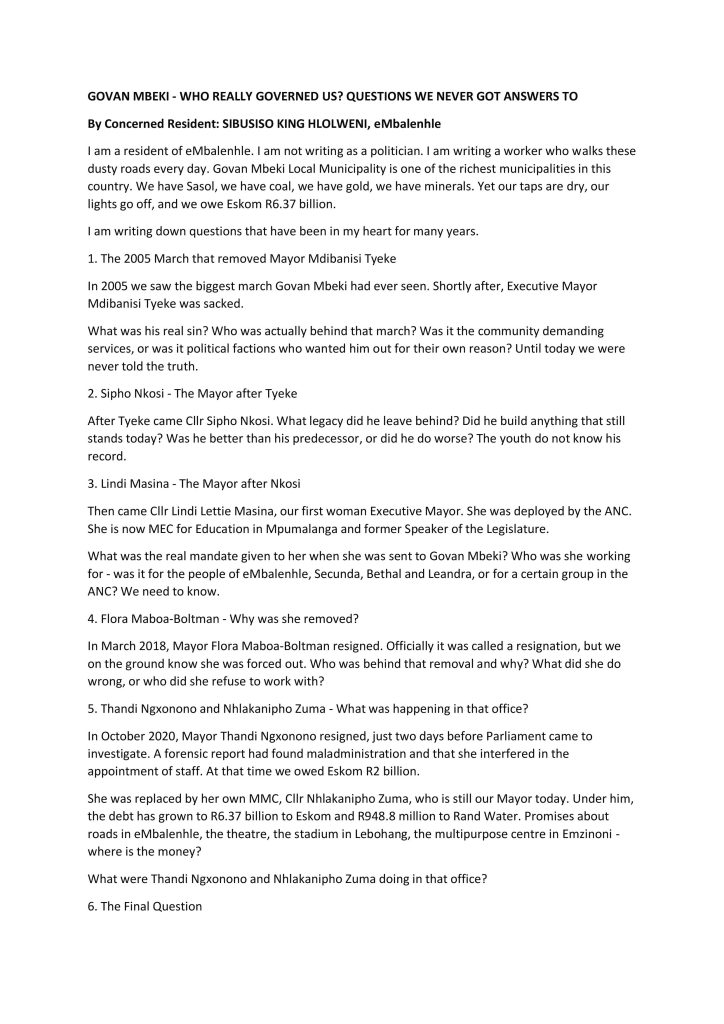
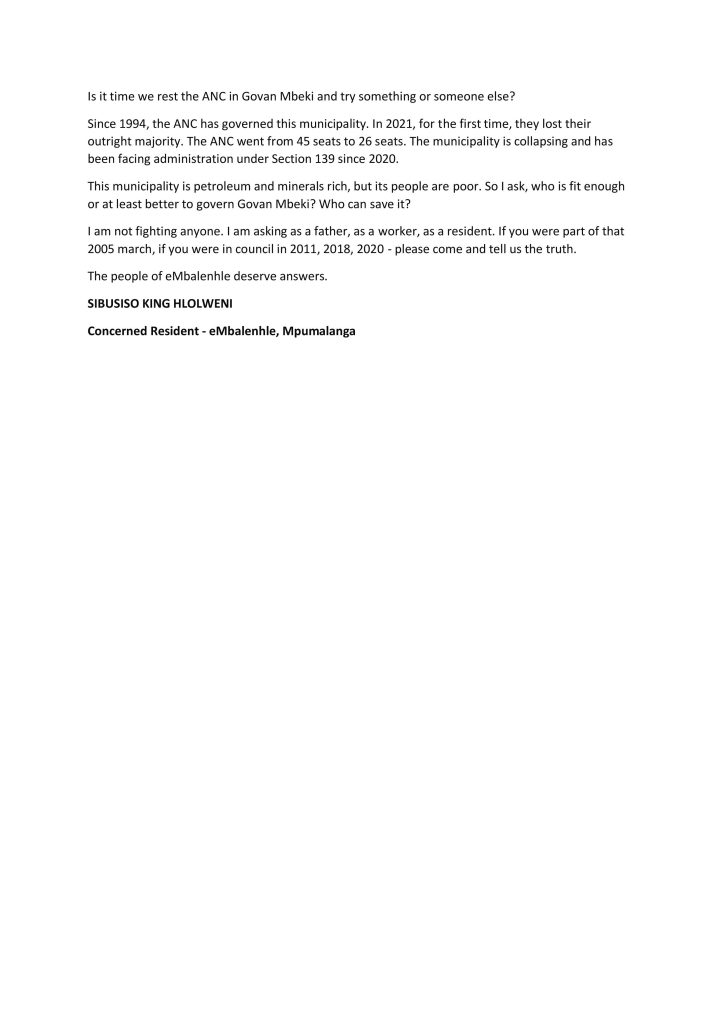
Govan Mbeki is one of Mpumalanga’s economically significant municipalities. It benefits from major industrial, energy, mining and commercial activity. Yet many residents continue to experience unreliable electricity, water interruptions, deteriorating roads, incomplete projects and limited economic opportunities.
The municipality’s financial position has also deteriorated severely. Reports have referred to billions of rand owed to Eskom, together with substantial debt to Rand Water and other service providers. The municipality has also faced repeated concerns about financial management, governance and possible intervention under Section 139 of the Constitution.
Hlolweni’s central question is therefore direct: Who has really governed Govan Mbeki, and in whose interests?
The 2005 march and the removal of Mayor Mdibanisi Tyeke
One of the questions raised concerns the major march held in 2005, after which Executive Mayor Mdibanisi Tyeke was removed from office.
Residents deserve a clear public account of what happened. Was the march driven primarily by genuine service-delivery grievances? Was it connected to internal political divisions? Or was it a combination of both?
Community protests can reflect real hardship, but they can also become linked to political contests within governing parties. Without access to official records, it would be irresponsible to state conclusively who organised the march or what the decisive reason for the mayor’s removal was.
However, the matter should not simply disappear into local political history.
The public has a right to know whether the removal was based on administrative performance, political accountability, internal party decisions or a combination of factors.
What was the legacy of Sipho Nkosi?
Following Mayor Tyeke, Cllr Sipho Nkosi became mayor. Hlolweni asks what concrete legacy was left by that administration.
This is a reasonable question, but it should be answered through evidence rather than political memory alone. A proper assessment would examine the municipality’s integrated development plans, annual reports, audited financial statements and capital budgets during that period.
Nkosi served as the executive mayor of Govan Mbeki Municipality from 2006 to 2011. During his tenure, his deputy mayor, Thandi Mtsweni, was murdered.
Mtsweni was gunned down in front of her husband and son at her home in Leandra on 27 June 2007. At the time of her death, she was reportedly investigating alleged tender irregularities within the municipality.
In 2008, while attending proceedings at the Evander Magistrate’s Court against those accused of killing Mtsweni, Nkosi was arrested by police inside the courtroom. He was implicated in connection with her assassination but was later released because of insufficient evidence.
Following his arrest, Nkosi was suspended as mayor, although he was subsequently reinstated
A mayor’s legacy cannot be measured only by speeches or political popularity. It must be measured by functioning infrastructure, sound finances, credible procurement and improved services.
Lindi Masina and the question of political deployment
Cllr Lindi Lettie Masina later became the municipality’s first woman Executive Mayor. She subsequently served in the Mpumalanga Legislature and as MEC for Education.

Hlolweni asks what mandate she received when she was deployed to Govan Mbeki and whether her primary accountability was to residents or to the ANC.
This question touches on a broader issue in South African local government: the relationship between elected public representatives and political-party structures.
Mayors are elected through council, but many are selected or recommended through party processes. That can create tension between:
- accountability to residents;
- accountability to council;
- accountability to a political party; and
- accountability to provincial and national government structures.
There is nothing inherently unlawful about political parties selecting candidates or recommending office-bearers. The concern arises when party loyalty appears to take precedence over constitutional obligations, council oversight and the public interest.
The proper test is not speculation about a mayor’s personal loyalties. The proper test is whether the administration complied with the Constitution, municipal legislation, council decisions, procurement rules and its service-delivery commitments.
Flora Maboa-Boltman’s 2018 departure
In March 2018, Flora Maboa-Boltman left the position of Executive Mayor. Although her departure was publicly described as a resignation, reports at the time indicated that the ANC had recalled her and cited instability within the municipality.

This distinction matters. A resignation resulting from a political recall is not the same as a completely voluntary departure.
The issue is not whether a political party may change its representatives. It may do so within the law and its own rules. The issue is whether residents are informed about the reasons for major leadership changes in a municipality whose finances and services affect hundreds of thousands of people.
The Thandi Ngxonono administration and the 2020 crisis
Hlolweni also raises questions about the administration of Mayor Thandi Ngxonono, who resigned in October 2020, reportedly shortly before a parliamentary investigation or oversight process.
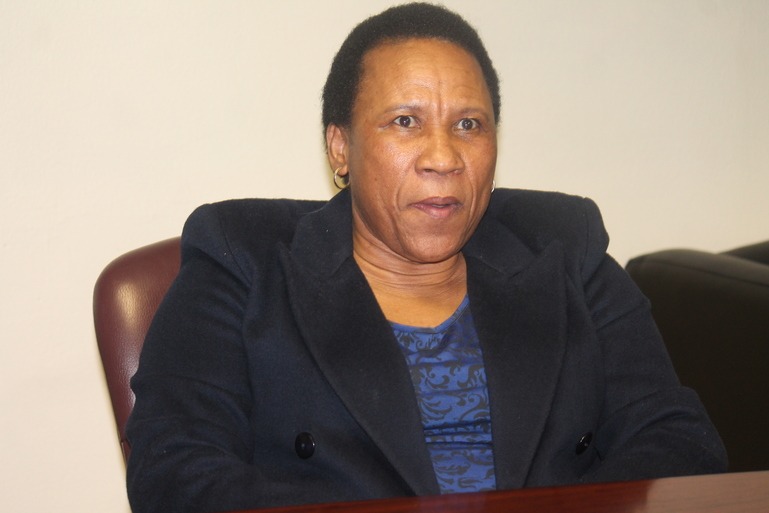
Reports from that period referred to allegations of maladministration and concerns about interference in the appointment of municipal staff. These are serious allegations and should not be treated as proof of wrongdoing unless established through a properly adopted report, disciplinary finding, court judgment or other authoritative process.
What requires closer examination is the documentary record:
Section 106 report: findings that demand follow-through
The Section 106 report supplied to The Bulletin is a 150-page final report prepared for the Mpumalanga Department of Co-operative Governance and Traditional Affairs by Motlatsi Seleke Incorporated. It records that the investigation was instituted under Section 106(1)(b) of the Local Government: Municipal Systems Act 32 of 2000 to examine allegations of maladministration, fraud, corruption, serious malpractice and non-compliance with legislation at Govan Mbeki Local Municipality.
- The report examined several areas, including recruitment and acting appointments, the appointment of the chief financial officer, non-implementation of council resolutions, irregular contract extensions, municipal infrastructure and water-services grants, and supply-chain management.
Its findings are particularly significant because they identify weaknesses not only in individual decisions, but also in the municipality’s internal systems.
According to the report’s executive summary, the municipality made 19 employee appointments during the 2017/18 and 2018/19 financial periods that were found to contravene its Recruitment and Selection Policy. It also recorded 12 acting appointments made without compliance with the municipality’s Acting Policy. The investigators stated that recruitment and selection had been “greatly influenced by certain political office bearers”.
The report recommended that the recruitment policy be reviewed and updated. It further recommended disciplinary action against officials responsible for recruitment failures and that the council invoke the councillors’ Code of Conduct in relation to allegations of political interference involving then Executive Mayor Thandiwe Yvonne Ngxonono and councillor N.E. Nkosi. Those findings should not be presented as criminal convictions; they are findings and recommendations contained in an investigation report.
The report also describes a municipality in which oversight decisions were not consistently implemented. Investigators found that there was no proper process to monitor the implementation of council resolutions and that some departmental heads were not held accountable when resolutions remained outstanding. The recommended remedy was a formal tracking system, monthly reporting by responsible officials and the inclusion of implementation progress as a standing item on council agendas.
The CFO appointment and financial accountability
The report devotes a separate section to the appointment of Bongumusa Benedict Sithole as chief financial officer.
It states that the advertised position required, among other things, a tertiary qualification at NQF Level 7 in accounting, finance, economics or chartered accountancy, at least seven years’ relevant management experience, including two years at senior-management level, and the relevant municipal finance competency requirements.
The investigators concluded that Sithole’s Bachelor of Commerce degree was in Insurance rather than one of the fields specified in the advertisement. They also recorded that he had received an overall “basic” result in a competency assessment conducted for another municipality. The report stated that no competency assessment had been conducted for Govan Mbeki before his appointment and that the municipality had not applied to the minister for a waiver of the prescribed requirements.
On that basis, the investigators concluded that the appointment was invalid and recommended that the MEC take appropriate steps to enforce compliance, including possible court proceedings to determine the validity of the appointment.
The report raises a second, separate issue concerning the employment documentation. It records that the municipality could not locate a signed employment contract concluded before Sithole began working as CFO. It further records that a performance agreement was signed only on 9 October 2018, outside the statutory 60-day period referred to in the report.
The report says the municipality later adopted a council resolution authorising the conclusion of a new employment contract. However, the investigators questioned whether the council could retrospectively remedy an appointment that had allegedly contravened the Municipal Systems Act.
The document also records that disciplinary proceedings were instituted against Sithole but that, at the time covered by the investigation, no disciplinary hearing had been held and no disciplinary ruling had been issued. The report recommended that the appointment’s validity be addressed and that the findings of the Integrity Management Unit be implemented.
Supply-chain failures and contracts
The report characterises contract management as a major problem within the municipality. It identifies service providers allegedly operating without contracts, contracts extended from month to month without adequate justification, reliance on expired contracts and contracts terminated without proper consideration of contractual obligations.
The investigators warned that the absence of contracts made it difficult to hold service providers to defined obligations, monitor their performance or establish whether services had actually been delivered. They also stated that incomplete or misplaced records limited the investigation.
The report’s summary records alleged irregularities involving transactions with Sinothile Transport & Projects CC and Vuma Konke Transport & Projects CC. It states that certain deviations were irregular and did not comply with the Municipal Finance Management Act and the municipality’s Supply Chain Management Policy. It also records that invoices involving several suppliers amounted to irregular expenditure.
In another section, the report refers to an Integrity Management Unit investigation into alleged irregular expenditure and fraudulent payments for services that were not rendered. It says the IMU found that payments had been made to three suppliers without the necessary documentation or proof of services rendered. The report records that the IMU recommended criminal charges against implicated officials and suppliers, as well as internal disciplinary action.
Those recommendations require verification from the municipality, the provincial government and law-enforcement agencies.
The report itself does not establish that criminal convictions followed, and The Bulletin does not imply that they did.
Infrastructure, grants and service delivery
The report links administrative weakness to the municipality’s ability to deliver services. Its scope included underspending of the Municipal Infrastructure Grant and Water Services Infrastructure Grant, as well as the failure to complete initiated projects.
The investigators reported that several projects had not been completed because of delays and alleged underperformance by appointed service providers. They recommended that the Project Management Unit operate independently, monitor projects regularly and prepare progress reports to ensure that spending complied with approved implementation plans.
The report also records concerns about the municipality’s skills-development funding. It states that R14 million was allocated through the Municipal Skills Development Grant for 2017 and R23 million for 2018. It records that the LGSETA allocation for 2017 was not spent and was transferred to the 2018 budget. The investigators said that documentation did not explain what happened to the R37 million allocated through the Municipal Skills Development Grant for the two years.
The report did not find maladministration in every area examined. For example, in its assessment of the skills-development levy funds, it stated that there was no maladministration based on the documents and interviews reviewed. But it also identified a lack of compliance with legislation and inadequate investment in employee skills development, and recommended a skills audit and a formal skills-development plan.
A report about implementation as much as misconduct
Perhaps the most important finding is that the report repeatedly returns to the question of implementation.
The investigators recorded that some council resolutions had been implemented, but that no proper process existed to monitor progress. They also stated that a tracking system was available but was not being used. Their recommendations included:
- regular updating of the council-resolution register;
- quarterly reporting to council;
- monthly monitoring by the municipal manager and departmental heads;
- implementation of the Integrity Management Unit’s findings;
- disciplinary action where officials failed to implement or report on resolutions; and
- progress reports to the MEC for Co-operative Governance and Traditional Affairs.
This gives the Section 106 report a direct bearing on the questions raised by resident Sibusiso King Hlolweni. The central issue is no longer simply whether allegations were made or whether investigations were conducted. It is whether the municipality and provincial authorities implemented the report’s findings, pursued consequence management and corrected the systems that the investigators found to be defective.
The municipality, the provincial department, councillors and officials named in the report should be asked to provide an updated implementation schedule. That schedule should identify each recommendation, the official or institution responsible, the action taken, the date of implementation and any outstanding legal or disciplinary process.
Until that information is made public, the existence of the report will not by itself resolve the accountability crisis. It will instead raise a further question: what happened after the findings were delivered?
At the time, the municipality’s Eskom debt was already a major concern. The subsequent growth of the debt suggests that the crisis was not resolved by changes in political leadership.
Nhlakanipho Zuma and the continuing debt crisis
Cllr Nhlakanipho Zuma subsequently became mayor. Hlolweni asks what happened in the mayoral office during this period and why the municipality’s debt continued to grow.
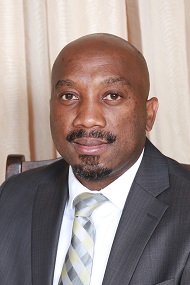
It is important to distinguish between political responsibility and personal culpability. A mayor may carry political responsibility for the performance of an administration without personally causing every debt, contract or failure. Establishing individual wrongdoing requires evidence.
At the same time, political leaders cannot avoid accountability indefinitely by blaming only previous administrations.
If a municipality inherits a financial crisis, the public should expect to see:
- a credible financial-recovery plan;
- transparent reporting on Eskom and Rand Water arrangements;
- monthly expenditure and revenue monitoring;
- action against illegal electricity connections and non-payment;
- improved billing and revenue collection;
- consequences for irregular expenditure;
- progress reports on stalled infrastructure projects; and
- regular public meetings explaining what is being done.
The projects mentioned by Hlolweni—roads in eMbalenhle, the theatre, the Lebohang stadium and the Emzinoni multipurpose centre—should each be investigated individually. Residents need to know whether these projects were cancelled, delayed, abandoned, redesigned or affected by funding and contractual disputes.
Who is responsible for the municipality’s decline?
The evidence available in the public domain points to a problem that is larger than any one mayor.
The municipality’s decline appears to involve several overlapping factors:
- frequent political leadership changes;
- internal party contestation;
- weak council oversight;
- poor financial controls;
- inadequate revenue collection;
- electricity and water debt;
- procurement and contract-management concerns;
- insufficient consequences for poor performance; and
- failures by different spheres of government to intervene effectively.
This does not remove the responsibility of individual office-bearers. Every administration must account for its own decisions. But residents should also be cautious of explanations that blame the entire crisis on one mayor or one political faction.
A proper investigation should examine the full period since 1994 and identify which decisions created the municipality’s current financial position.
Should residents consider a change of government?
Hlolweni asks whether it is time for residents to rest the ANC and try another party or governing arrangement.
That is ultimately a democratic choice for voters. No party should be presumed entitled to govern indefinitely. Equally, replacing one party with another will not automatically solve the municipality’s problems.
Any party or coalition seeking residents’ support should be required to present a detailed and measurable recovery programme addressing:
- the Eskom and Rand Water debts;
- revenue collection and billing;
- electricity and water reliability;
- road maintenance;
- completion of stalled projects;
- professional municipal appointments;
- transparent procurement;
- consequence management; and
- public reporting and community participation.
The real question is not only which party can replace the ANC. It is whether any party, coalition or independent leadership group can demonstrate the competence, integrity and discipline required to rebuild the municipality.
The answers residents deserve
Hlolweni’s letter should not be dismissed as political provocation. It raises questions that many residents are asking privately.
The Bulletin believes the following information should be made publicly accessible:
- a complete chronology of mayors and acting mayors since 1994;
- the reasons and procedures for each leadership change;
- all major forensic and investigative reports;
- the municipality’s annual audit outcomes;
- records of irregular, fruitless and wasteful expenditure;
- Eskom and Rand Water debt statements;
- Section 139 intervention documents;
- the status of major infrastructure projects; and
- records of disciplinary, civil or criminal action arising from municipal investigations.
These documents would allow residents to move from rumour and political accusation to evidence-based accountability.
The people of eMbalenhle, Secunda, Bethal, Leandra, Emzinoni and Lebohang do not need more political slogans. They need facts, explanations and consequences.
The municipality’s resources belong to the public. Its council is accountable to the public. Its political leaders are entrusted with public power.
The time has come for a full and independent account of how Govan Mbeki was governed—and why a municipality with such a strong economic base has left so many of its residents feeling abandoned