A new report by the Centre for Research on Energy and Clean Air (CREA) has raised concerns about the health and economic effects of air pollution linked to Sasol’s Secunda coal-to-liquids operations in South Africa’s Highveld Priority Area.
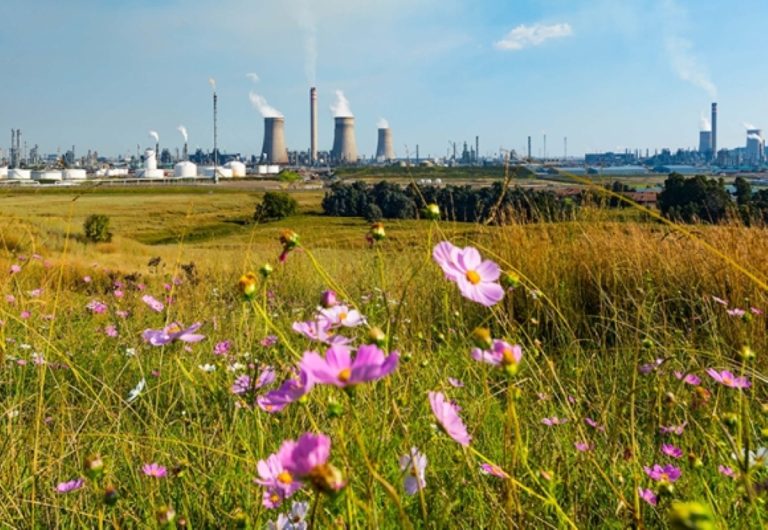
Published on the International Day of Clean Air for Blue Skies 2026, CREA’s health impact assessment examines emissions from what it describes as the world’s largest point-source greenhouse-gas emitter. The Secunda facility has operated in the Highveld for approximately 50 years, with local residents frequently reporting a strong “rotten egg” odour associated with industrial emissions. CREA says pollution from the facility can, under certain weather conditions, travel as far as Johannesburg and Pretoria—approximately 150 kilometres away.
According to the report, Sasol Secunda emitted an estimated 112 kilotonnes of sulphur dioxide (SO₂) in 2024, in addition to significant quantities of hydrogen sulphide (H₂S).
CREA estimates that emissions of particulate matter (PM2.5) and nitrogen dioxide (NO₂) from the facility contributed to approximately 1,000 premature deaths in 2024. The organisation estimates that these deaths represent a combined 23,800 years of life lost among the affected population.
The assessment also highlights potential impacts on children and future generations. CREA estimates that emissions from Sasol Secunda contributed to approximately 1,100 preterm births in 2024, as well as increased risks of low birthweight, other adverse birth outcomes and childhood asthma.
While acknowledging Sasol’s role as a major industrial employer and contributor to the South African economy, CREA estimates that the health impacts associated with the facility’s air pollution cost the economy approximately US$1 billion—or R19 billion—annually.
CREA has called on the Minister of Forestry, Fisheries and the Environment to review Sasol Secunda’s alternative sulphur dioxide limits, taking into account their potential effects on air quality, population exposure and public health. It has also recommended binding annual reductions in SO₂, nitrogen oxides, particulate matter and hydrogen sulphide emissions; stronger emissions reporting and independent monitoring; improved air-quality regulations; and greater involvement of affected communities in enforcement and Highveld air-quality planning.
Sasol, however, has questioned the report’s methodology and said its findings require further scrutiny before being treated as fact.
In a response dated 21 September 2026, the company said complex air-quality and health-impact assessments can be influenced by assumptions, input data, source-attribution methods, modelling choices and the way uncertainty is treated.
Sasol’s preliminary review, the company said, identified issues requiring further examination, including the use of historical emissions data for certain pollutants, the application of meteorological data from a different period than the reporting year, source-allocation assumptions and the treatment of uncertainty.
The company said it intends to commission an independent third-party review of the CREA report. The review is expected to assess the emissions inventory, modelling assumptions, source-attribution methodology, health-impact calculations, baseline data and uncertainty ranges. Sasol also said it plans to engage with CREA during the process.
Sasol referred to an earlier independent review conducted during its appeal to the minister for a load-based sulphur dioxide limit for boilers at its Secunda steam plants. According to the company, that review identified significant differences in methodology, assumptions and calculations that materially influenced CREA’s conclusions at the time. Sasol said the findings were considered by an independent advisory panel appointed by the Minister and contributed to the granting of the requested alternative dispensation.
The company maintains that it remains committed to improving ambient air quality and managing related health impacts. Sasol said it has invested more than R9.5 billion in emissions-abatement initiatives since 2015, including particulate-matter controls on boilers, low-nitrogen-oxide burners, the decommissioning of certain incinerators, volatile-organic-compound reduction projects and boiler turndown initiatives.
Sasol further stated that these investments have enabled compliance with applicable minimum emission standards for particulate matter, nitrogen oxides and most regulated emission sources. The company said it continues to comply with the requirements of its atmospheric emission licences, including the integrated emissions-reduction measures associated with its Clause 12A application and appeal.
The competing positions highlight the continuing debate over the scale, causes and consequences of industrial air pollution in the Highveld. CREA’s report presents estimates of substantial health and economic impacts, while Sasol says the findings must be independently verified and assessed against transparent, robust scientific methods.
Sasol’s latest disclosures are available in its 2026 annual reporting suite.
#TheBulletinSA #Sasol #Secunda #AirPollution #Highveld #PublicHealth #CleanAir #EnvironmentalJustice #ClimateHealth #SouthAfrica