RAND WATER DEEPLY CONCERNED BY ESCALATING DEBT FROM MUNICIPALITIES.
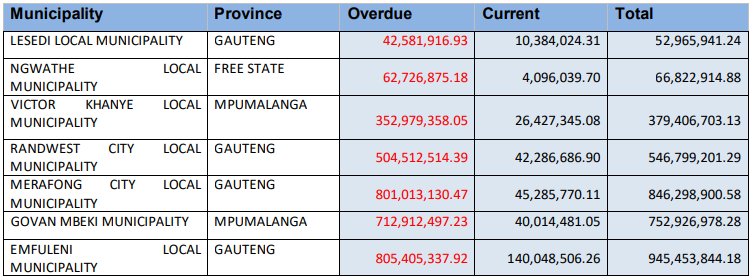
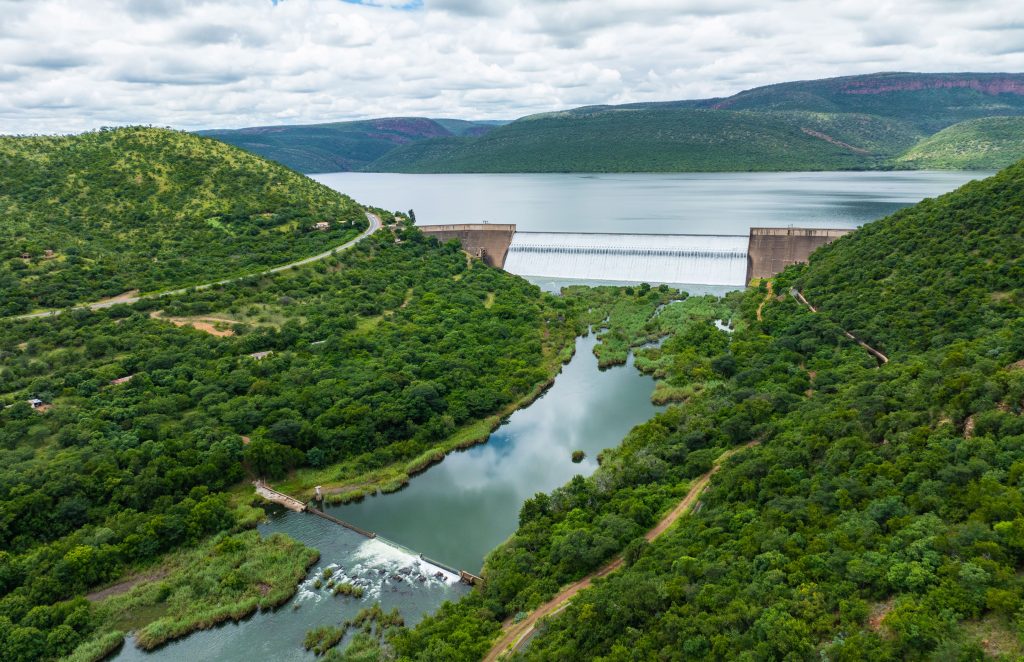
Rand Water is deeply concerned over the escalating debts caused by municipalities’ failure to honor their bulk water purchase agreements and debt settlement arrangements with Rand Water. This situation highly destabilizes Rand Water’s financial position and poses a direct threat to its medium and long-term sustainability. Rand Water operates without any form of allocation from the national fiscus thus relies solely on funds collected from its customers, primarily municipalities to fulfil its obligations. To date, Municipalities owe Rand Water a cumulative overdue amount of R3 billion, with R2 billion relating to Gauteng municipalities, R1 billion from Mpumalanga municipalities, and at least R63 million from Free State municipalities.
These non-performing municipalities are contributing to this long overdue debt.
The payment patterns of municipalities have deteriorated to concerning levels that threaten the liquidity, financial performance, and sustainability of Rand Water. Despite our relentless efforts to accommodate this ongoing pattern of non-payment through bilateral engagements and participation in Intergovernmental Relations forums, we have regrettably reached a stalemate.
Several agreements and engagements were held with the aforementioned non-paying municipalities, and it’s evident that these municipalities have taken advantage of these avenues and use them to cause endless and fruitless negotiations when it is clear that they have no intention to pay or enter into amicable arrangements that will afford them an opportunity to pay their account with ease. Some of these municipal customers take an inordinately long period of time to sign the agreements.
The magnitude of the outstanding debt from municipalities has reached a critical level, thus requires urgent attention. Rand Water has invoked the provisions of Section 41(1) of IRFA and declare an intergovernmental financial dispute and seek intervention of National Treasury and Co-operative Governance and Traditional Affairs.
In terms of Promotion of Administrative Justice Act 3 of 2000, Rand Water also would like to sensitize the residents and communities of the aforementioned municipalities of its intention to exercise its right and invoke the provisions of Section 4 of the Water Services Act and initiate the curtailment of water flow due to non-payment of water services. Rand Water therefore advise the communities of Ngwathe Local Municipality and Merafong City Local Municipality that on the 26th February 2024 it has reduced the water flow by 20%, should these municipalities fail to pay the overdue amount or enter in to amicable payment arrangement, Rand Water will further implement another 20% on the 25th March 2024.
Rand Water is also in the process of employing the same credit control measure for the other owing municipalities who is failing to honor their Debt Settlement Agreement.
It is important to note that should Rand Water be placed under further on-going financial risk; the entity will be plunged into a debt crisis which will impact all municipalities currently serviced by Rand Water and curtail the ability of Rand Water to finance the construction and augmentation of bulk water infrastructure and to undertake adequate maintenance of its extensive network. This would have dire consequences on the entire network, particularly Gauteng Province and other parts of the country that are serviced by Rand Water
Rand Water remains committed to serving its customers and ensuring long-term security of supply of potable bulk water. We implore the owing municipal customers to treat this matter with the utmost urgency.
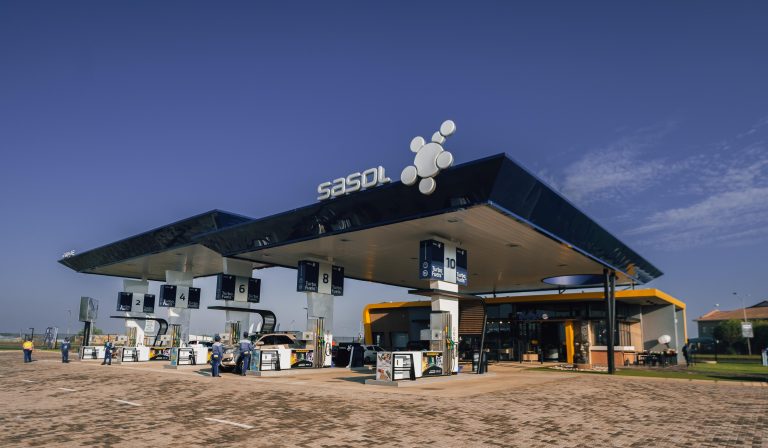
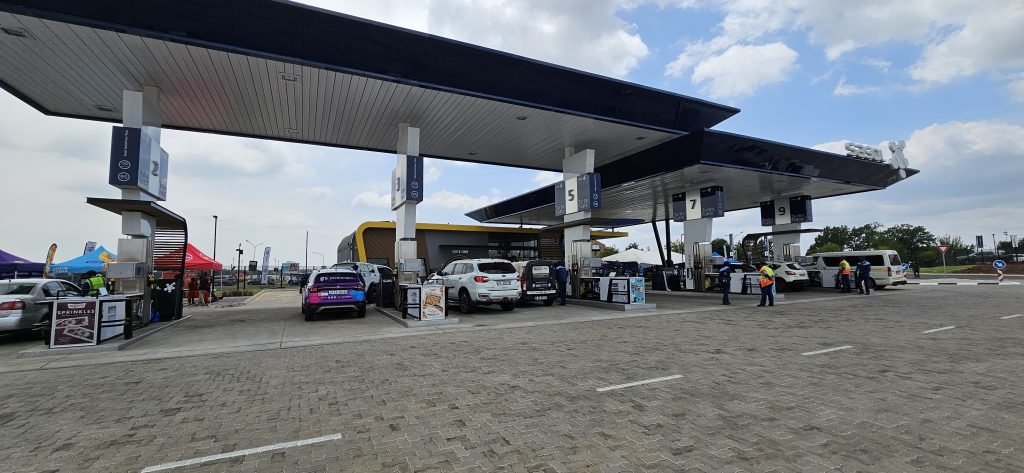
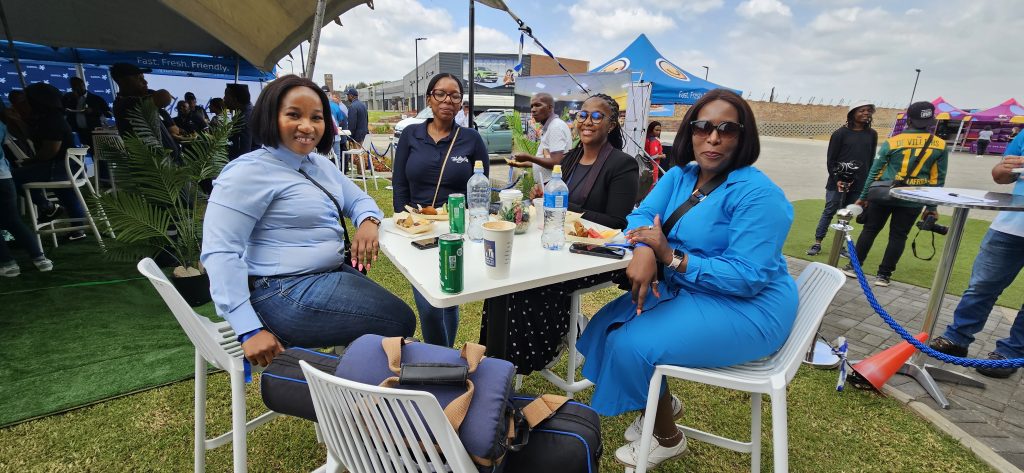
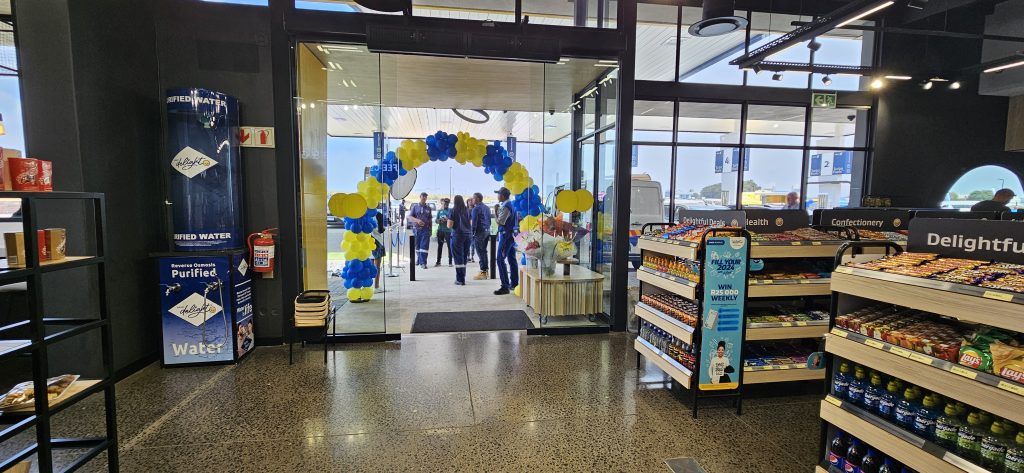
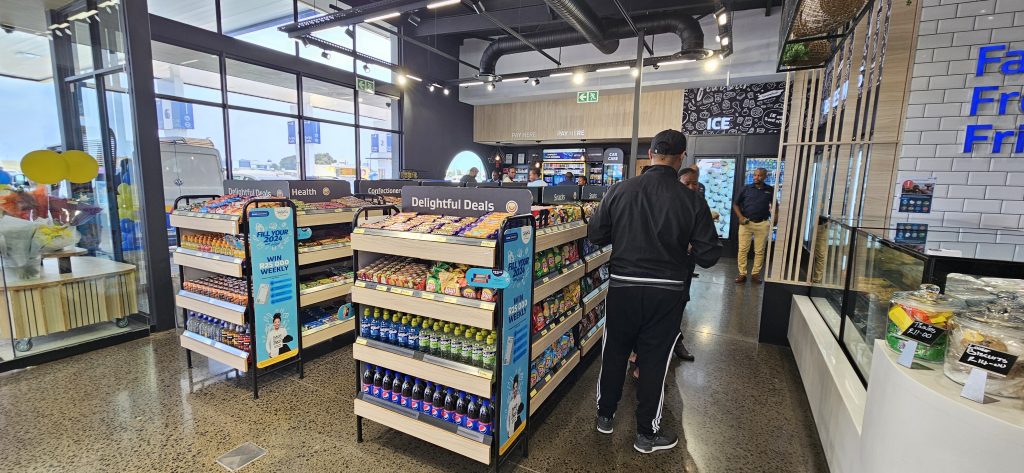
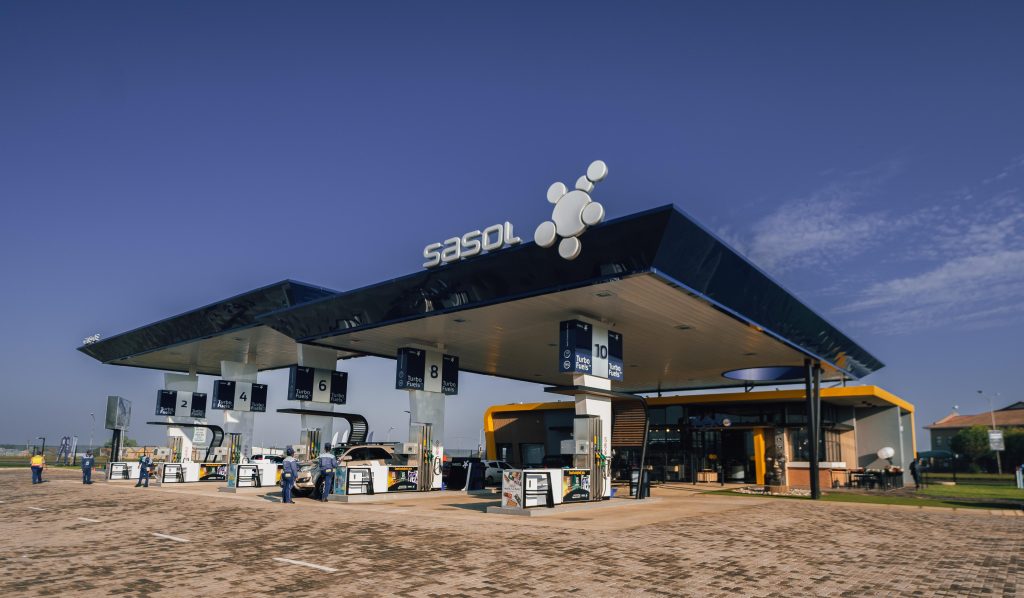
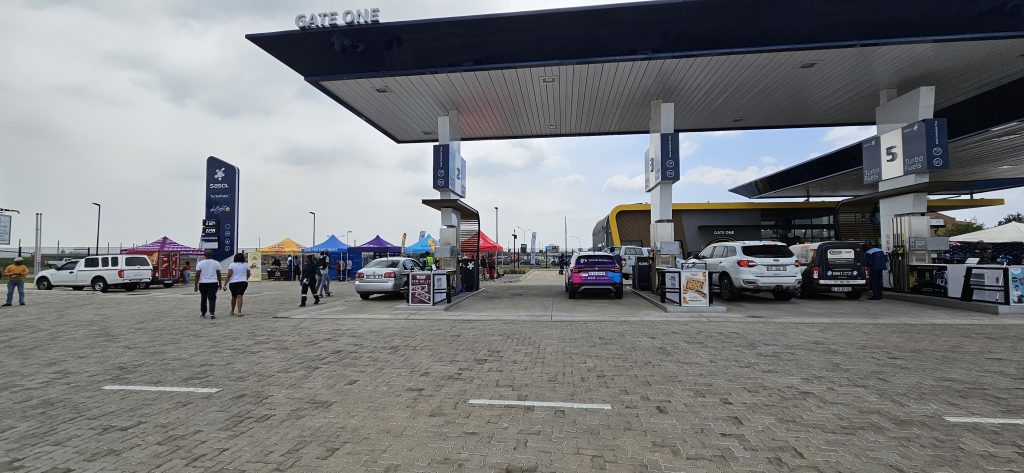
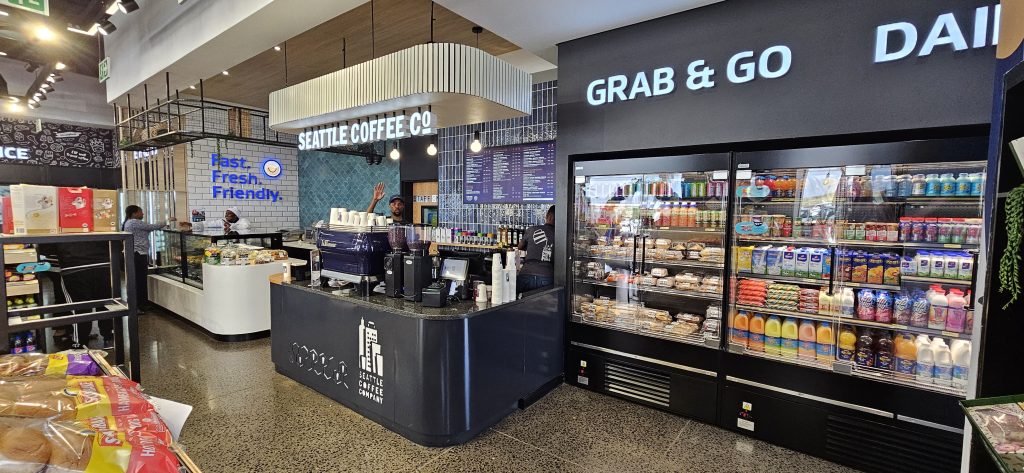
Secunda – The Sasol Energy Business on Wednesday launched its new forecourt design to industry referred to as Mark – V design. The new Retail forecourt and convenience store design in Secunda, Mpumalanga reflects the future of Sasol forecourts build and design. The newly designed forecourt is located in Secunda less than a kilometre from its world-renowned petrochemical complex that it is the technological innovation hub that has driven the growth of the organisation globally over the past 70 years ago.
The Mark – V design marks a significant milestone in the businesses commitment to deliver increased value to the motoring public and consumers across its fuel retail network and to ensure that the Sasol brand remains a highly recognisable leading brand in South Africa, known for delivering innovation and customer excellence to all.
Photo Supplied
“We are a “proudly South African born and bred fuel brand” that is seen to be progressive, is eco-conscious and customer centric towards meeting the changing fuel and convenience shop landscape in South Africa; this is consistent with Sasol’s high investment into green research and our commitment to delivering the next-level customer experience to the public and consumers alike; the Mark-V, through its design, represents our commitment to achieving these objectives and we are very pleased to be having this launch here in Secunda, the heartland of Sasol’s birth as an organisation, said Dumisani Bengu, SVP for the Mobility Customer Experience Business and Acting Executive Vice President for the Energy Business to the Bulletin.
The adopted design, which embraces the need to understand changing customer needs and exceed their expectations in a fast-changing market landscape, is adaptable to fit the requirements of individual sites throughout the Sasol retail network and therefore, more and more of the South African public will be able to experience the exceptional improvements made to fuel products and convenience purchases at these newly designed sites as the rollout program progresses.
Reggie Sibiya, Chief Executive Officer (CEO) of The Fuel Retailers Association of South Africa said: “this is a significant achievement for Sasol and the industry. Sasol has continued to invest in its retail network and has over the years demonstrated its commitment not only to the development of the retail fuel industry but to ensuring that the industry remains relevant in a technologically advancing and competitive market landscape through such innovations as brought about by the Mark-V design launched today”.
Sasol (JSE: SOL, NYSE: SSL) and Transnet Freight Rail (TFR), an operating division of Transnet SOC Ltd. (Transnet) and owner of South Africa’s railway, ports and pipeline infrastructure, today announced a first-of-its-kind public-private partnership to improve rail transport reliability in South Africa.
Under the five-year agreement, Transnet will deliver ammonia from Sasol’s Secunda and Sasolburg facilities to the company’s customers through a dedicated fleet of 128 ammonia tankers. In turn, Sasol will fund Transnet’s maintenance and repair programme for the fleet.
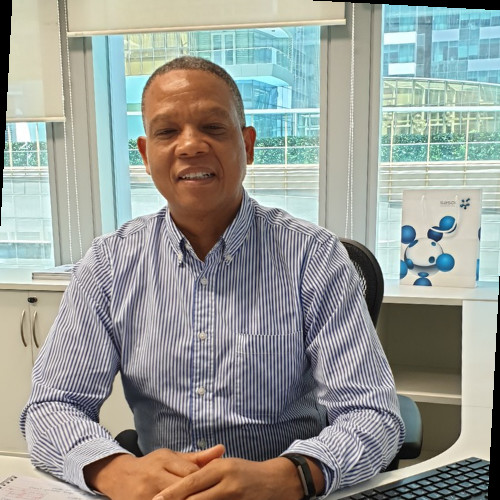
“Sasol’s partnership with Transnet is an investment in South Africa’s rail infrastructure network, a critical economic driver for the country and a key business enabler for Sasol,” said Sasol Vice President for Base Chemicals, David Mokomela. “The result will improve service to our customers and give us the transport capacity and reliability we need to respond to growing market demand. As one of South Africa’s largest companies, we are proud of this public-private partnership, which signals progress in advancing the country’s growth objectives.”
Sasol Vice President for Base Chemicals, David Mokomela
“This strategic partnership with Sasol demonstrates what is possible through collaboration and partnership—a foundational element of TFR’s Response Strategy,” said Acting TFR Chief Executive Russell Baatjies. “We appreciate Sasol’s support of this deal. It is a significant step toward addressing the industry’s current capacity challenges and protecting the ammonia rail supply—a critical material used in South Africa’s agriculture, mining and chemical markets,” he added.
TFR and Transnet Engineering (TE), who will execute the Sasol ammonia fleet’s maintenance and repair work, expect additional revenue generation from anticipated increased haul volume and the Sasol-funded maintenance and repair work.
TFR, which is Transnet’s largest Operating Division, provides the rail network infrastructure and operates rail services across major corridors to transport a broad range of bulk and general freight commodities, including mining, agricultural, manufacturing goods, bulk liquids, containerised freight and automotive units and components for export, regional and domestic markets. Freight Rail is recognised as a heavy haul rail operator for coal and iron ore on export lines and recently extended this capability to export manganese on the iron ore and Gqeberha lines. The Freight Rail network and rail services provide strategic links between ports, freight terminals and production hubs.
Sasol Chemicals produces and sells more than 540 000 tonnes of ammonia annually. It is used to make a variety of fertilisers and industrial chemicals for the agriculture, mining, textile, and metalworking industries.
Sasol is a global chemicals and energy company. It harnesses its knowledge and expertise to integrate sophisticated technologies and processes into world-scale operating facilities. It safely and sustainably sources, produces and markets a range of high-quality products in 22 countries, creating value for stakeholders.
FIND OUT WHAT TO DO IF YOU LOST OR FIND AN ANIMALS
Many animals are roaming the streets and reported as lost! This happens all year round, but we see especially high volumes during and after the holidays or fireworks displays. There are always good Samaritans who take them in and keep them safe, but many people do not know how to proceed, so here are our guidelines.
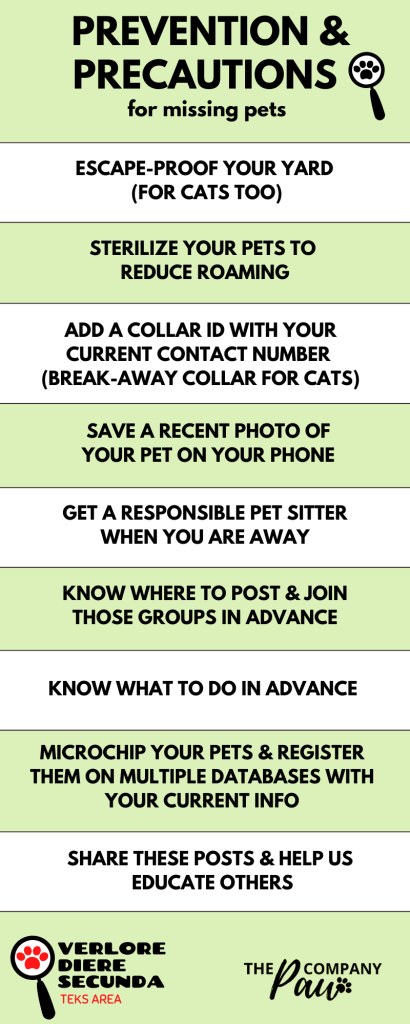
Add a collar ID with your number on it (we don’t add the animal’s name for safety reasons)
For cats a break-away collar with ID.
Have a recent photo available.
Get a responsible pet sitter when you are away.
Know how and where to post.
JOIN YOUR LOCAL SOCIAL MEDIA GROUPS IN ADVANCE
Join the local WhatsApp group for lost and found pets as well as the VERLORE DIERE SECUNDA (TEKS)group on Facebook, and your neighbourhood watch groups.
If you are not on the local WhatsApp group, contact us for the link. If you know someone who is not on social media and you can’t post on their behalf, they can also contact us to post.
We try very hard to centralize this to more effectively reunite animals, but there are so many people, inexperienced in animal welfare or spiteful, who do their own groups. This is not beneficial for an effective reunion of pets.
POST ON SOCIAL MEDIA PLATFORMS
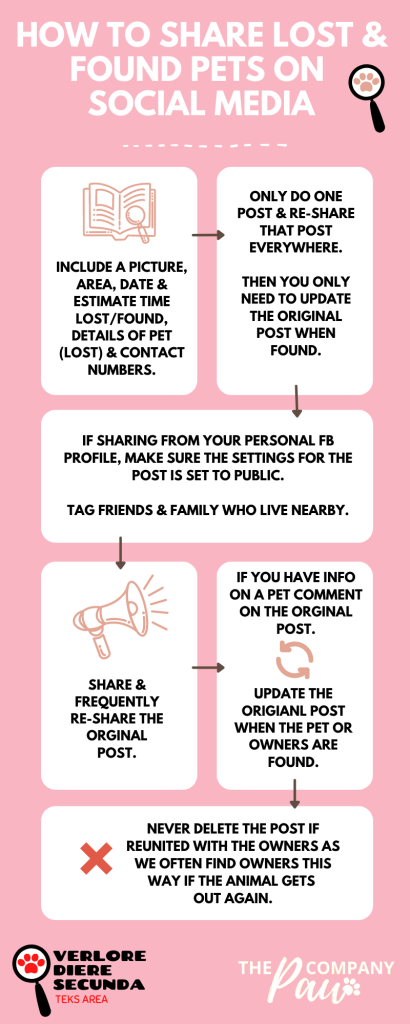
Posting correctly is important to more effectively reunite pets and save time. Your post should include:
Whether you found a pet or lost a pet.
A photo (not multiple due to how group timelines work)
The area (street, near e.g., Spar & town).
The date (lost or found).
Estimate time if possible.
Contact person & number. (Facebook Messenger is ineffective if you aren’t friends)
We don’t recommend adding too much info about the animal as that info can be used to “test” the owners who claim them.
Please COMMENT on and SHARE the original post only and always! Don’t create many different posts nor add details like a contact number in the comment section, as few people read it.
If you share it from your personal profile, make sure the setting is public, otherwise only your friends can see the post. Do one post on our group or on your personal profile and share that one everywhere. This way it can be shared even out of closed groups.
Frequently reshare the original post again.
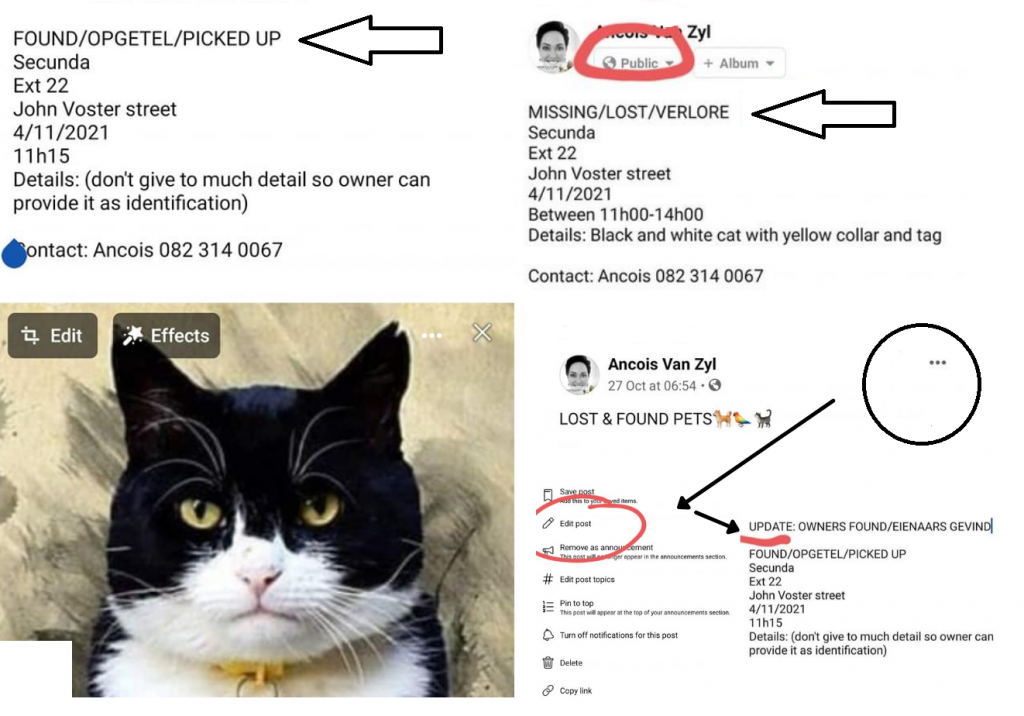
UPDATE the original post as soon as the pet is found, so those who shared the post can see the outcome and people can rather share other lost/found posts instead of an already found one. How: click on the 3 dots in the top right corner of your original post. Choose “edit post” and then add above the original writing in capital letters UPDATE: OWNERS FOUND or BACKHOME, AT VET, AT SPCA etc.
DON’T DELETE THE POSTS as it has helped us many times before to find owners again. You can also send us the address or details of the owner so we can save it for our records.
EXAMPLE BELOW
How to structure your post and how to update it afterward.
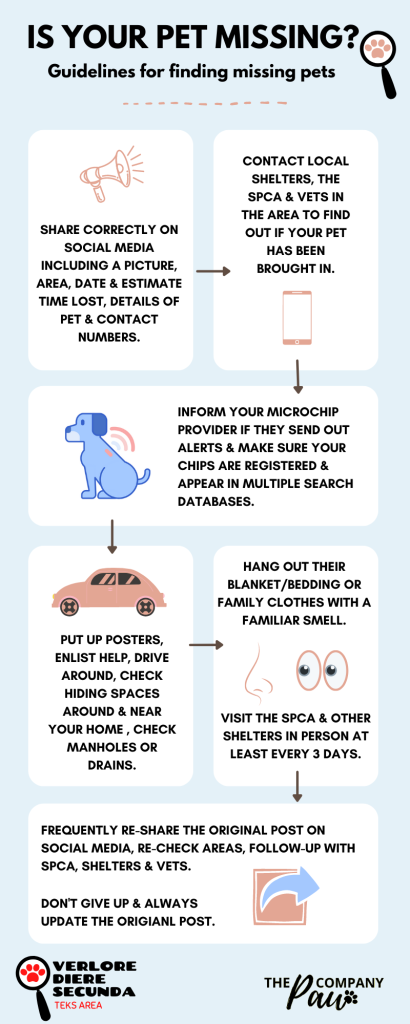
YOUR PET IS MISSING
Phone your local SPCA and send them an email with a picture & detailed description of your pet.
Visit the SPCA frequently IN PERSON. Remember they have many animals coming in daily.
Search your own yard thoroughly.
Drive around in your area and call the pet’s name.
Put up posters (good idea to have one in advance with a more recent photo).
Search manholes or other hiding spaces in your area. Also, report open manholes to your local counselor.
Contact your local Vets to see if an animal has been brought in.
Share on your local social media pages or groups as per social media guide above.
Contact other local welfare organisations.
Continue to follow up with the SPCA and other organisations.
Try and call for pets at night as sound travels further.
Some suggest putting out cats’s litter-box or pet’s blankets, as a familiar scent could help them find their way home. (Controversy about litter-box exists)
Sometimes stolen animals are sold or dumped in nearby towns, so widen your search.
If they have a microchip, immediately double-check if it is registered. Type in the microchip number on both ChipNDoodle and AMLA. If it does not appear on both, you can stilldo it immediately and it can help if they are found.
Re-check areas previously searched.
Don’t give up as some reunions even happen weeks, months, or years later.
For many reasons we do not recommend offering rewards for missing pets.
This is not an endorsement of any of the above organisations or businesses by me or The Bulletin.
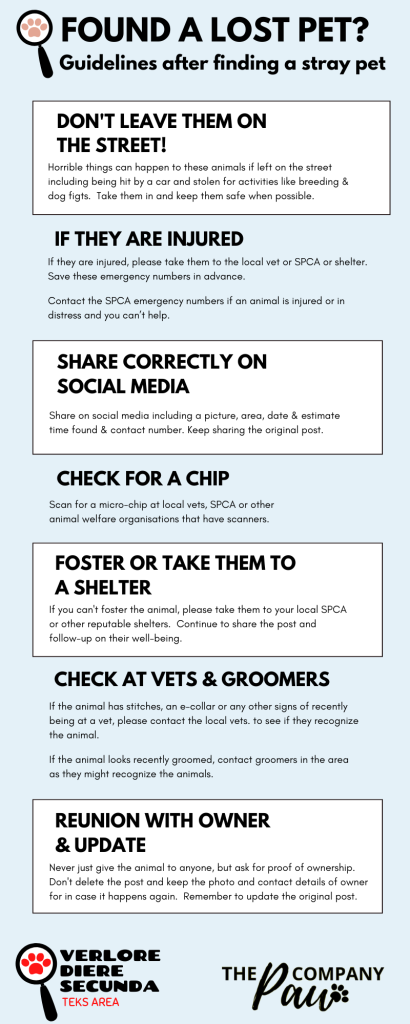
YOU FOUND OR SEE A STRAY ANIMAL
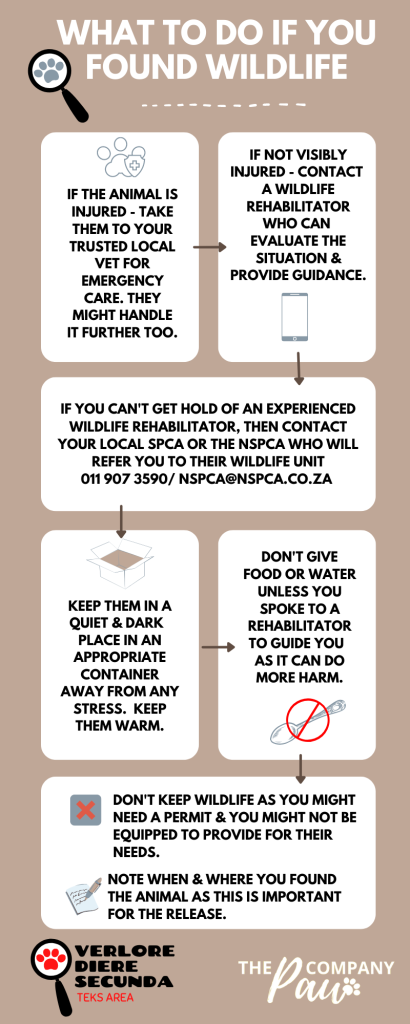
If they are hurt, please take them to the local Vet or SPCA.
Contact the SPCA emergency numbers if an animal is injured or in distress and you can’t help.
Provide water, but be careful so that they don’t over-drink as well as be cautious with giving food if they are in shock or injured.
Scan for a microchip at local vets, SPCA, or animal welfare organisations (Feral Watch & TNR or Because Dogs & Co).
Check with groomers if it seems like a recently groomed pet.
If it appears that the animal has recently been to the vet (stitches, healing wound or vet-shaved areas), please check with all local Vets.
Post on local social media groups/pages.
Take care of the animal (foster) until you find the owner.
Find a foster home if you can’t foster and after 5 days organise adoption through one of the responsible welfare organisations.
Take the animal to the SPCA if you can’t foster or find a foster. The SPCA has a 5-day pound period, after which the animal becomes their property and can go up for adoption or be euthanized. The owner who claims the animal will be responsible for costs incurred and will have to abide by certain procedures. By law, no SPCA may refuse any animal.
When you reunite them with the possible owners, ask them to provide info like sex, specific markings, sterilisation as well as other proof of ownership (photos, microchip number etc.). Watch the animals’ reaction when a person claims the pet. If you are unsure, rather contact a local animal welfare organisation to assist.
No animal is safe in the streets, however, it is even more dangerous for puppies and power breeds. In such cases, we advise to take them to the SPCA. They are currently the only ones with legal authority to do something about the situation. We also suggest that with “repeat offenders” who are out often. The SPCA may however not advertise the animal during the pound period, so continue to share the post that you updated with “at the SPCA”.
If they are injured, you should take them to a veterinarian. They should be able to address the emergency and if they are not equipped to treat the wildlife, they will have the right contacts to provide guidance.
Locally, contact Shy at 083 653 9755 or Stefan at 079 771 7125 for further guidance. If you can’t get hold of them because they are at work then contact Judy from SA Wildlife and Rehabilitation to guide you. Both Shy and Stefan work with her – 073 112 1131. Don’t feed the animal until you speak to a rehabilitator. Keep safe in a warm, quiet, and dark place until you reach the right people.
You can also contact the NSPCA (011 907 3590/ nspca@nspca.co.za) directly. They will either contact the Wildlife unit or the local SPCA. If the animal was not injured, we may also refer them to the SPCA. They have protocols in place for this.
NEVER KEEP THE WILD ANIMAL if you found them, as you might not be equipped to meet their needs and you might require a permit, even if you plan to release them later. Keep the environment where you keep them as stress-free as possible.
YOU CAN’T JUST KEEP THE ANIMAL
You cannot just keep an animal you found as they are not legally yours. If the owner has not been found after five days of advertising, we can arrange for a responsible adoption through a reputable organisation. This is for the animal’s safety and for legal reasons. Through this process, we also make sure that the yard is safe and that sterilisation happens to prevent further breeding. We have people who microchip and register them on their name or put them on their insurance and claim it is their animal, when by law, it is not. How would you feel if someone does that with your animal that got out?
The SPCA and other organisation rarely have the resources to drive up and down to pick up or search for strays and therefore need the community to assist with this. If you choose to take in an animal, please do not just dump them on any already overwhelmed organisation, when you can help.
Thank you to each of the heroes who take in these lost pets and help us effectively reunite animals with their owners!
Next week we will revisit how to escape-proof your yard so your pets do not outsmart you.
On Friday, Thungela celebrated an innovative fish breeding facility at the Loskop Dam Nature Reserve in Mpumalanga, commissioned to restore aquatic life in the Wilge-Olifants river catchment following the unfortunate uncontrolled release of mine-impacted water from Khwezela Colliery’s Kromdraai site on 14 February 2022.
Thungela committed to rehabilitating the areas affected by this overflow and took full accountability to do what was necessary to restore the ecosystem. Through partnerships with the relevant stakeholders, Thungela developed a rehabilitation plan approved by the Department of Water and Sanitation, which included various activities aimed at restoring the environment, with particular emphasis on enhancing biodiversity to levels beyond those prior to the incident.
Through close collaboration with the Mpumalanga Tourism and Parks Agency (MTPA) and leading aquatic scientists in South Africa, Thungela embarked on a path to execute the plan successfully. Amongst the activities contained in the plan was to speed up the recovery of the fish population to restore biodiversity in the Wilge-Olifants River catchment, which resulted in the commissioning of the fish breeding facility they unveiled on Friday.
July Ndlovu, CEO of Thungela, said, “I am proud to witness the fulfilment of the commitment that we, as a responsible coal miner, made in 2022. To be able to implement all aspects of the rehabilitation plan, which has led to the restoration of the environment to even better conditions than we found it – is the legacy we want to leave. We hold ourselves to the highest standards as set out in our Environmental, Social and Governance (ESG) Framework.”
July Ndlovu, CEO of Thungela
“Our dedication to this initiative has helped us achieve our objective of minimising impact on the environment to achieve sustainable outcomes where we operate, and we are thrilled that the partnerships we have formed with the MTPA will extend well beyond the river system’s ultimate revival. We anticipate that this facility will become a hub for research in endemic species into the future and that the MTPA will run the facility to benefit other river systems,” said Ndlovu.
With water quality having returned to pre-incident levels and a resurgence in macro invertebrate activity observed, the time is right to replenish fish stocks. Through the fish breeding project, up to sixteen native fish species will be re-introduced to the river system. These will be released as part of the launch celebration, and we will continue to breed and release fish until monitoring indicates that fish diversity and population density have returned to pre-incident levels.
In addition, Thungela has forged partnerships with other authorities, the farming community and members of society, embodying a shared vision for environmental stewardship and the well-being of neighbouring communities. This initiative not only contributes to the improvement of biodiversity in the area but also highlights Thungela’s dedication to environmental restoration and sustainability – demonstrating the Company’s accountability and commitment to being a responsible steward of the environment.
Mduduzi Vilakazi, CEO of Mpumalanga Tourism and Parks Agency, commends the collaboration: “Our partnership with Thungela showcases the significance of united efforts in conserving our region’s valuable natural resources and enhancing community livelihoods. This partnership sets a precedence that ensures sustainable use of resources to benefit our communities. The best way to conserve nature is through such strategic collaborations with established economic entities that invest in environmental appreciation.”
Mduduzi Vilakazi, CEO of Mpumalanga Tourism and Parks Agency
The fish breeding facility is among several of Thungela’s conservation endeavours, including the introduction of renewable energy solutions and advanced water treatment systems to protect the environment, particularly during periods of low rainfall in the area.
We are committed to continuously share updates on the rehabilitation measures to rectify the environmental impact and averting future occurrence, with an end goal of achieving full ecological revival that reflects a return to pre-incident biodiversity and water quality levels.
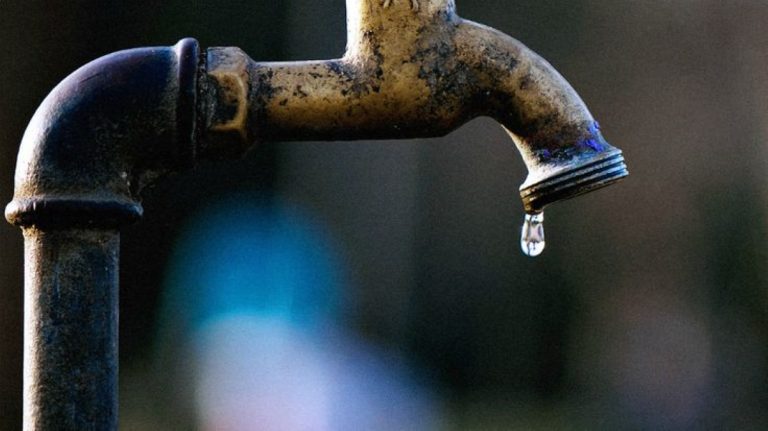
It is several months now that Govan Mbeki Residents have been facing water shortages at the end of each month. Or so it seems.
Social pages are flooded with complaints and speculations as to the origin of the water shortages. The only certain thing is that water disappears regularly without any clear indication as to the reason.
The Municipality also lacks the will or ability to keep the community informed regarding the crises and when they do give information it is not always credible.
“The DA in Govan Mbeki is taken aback by the municipality’s failure to keep residents abreast of water scarcity across the municipality,” said DA Cllr James Masango in a statement today.
DA Cllr James Masango
“The residents keep on getting low-pressure water and in some parts of the municipality, no water” continued James, “It is concerning that the municipality is not forthcoming with information while residents are deprived of a basic service.”
The DA reached out to Rand Water for clarity on the matter according to the statement. “The water utility company informed us that their technicians are still assessing the situation and that feedback will be given, said James.
Considering that the municipality owes more than R763 million to Rand Water, the DA is concerned that residents might be subject to throttling due to the municipality’s failure to settle their outstanding debt read the statement.
Last year, Rand Water communicated that Govan Mbeki was one of the municipalities that were threatening its financial position. They also listed Govan Mbeki as a direct threat to its medium- and long-term sustainability.
Bethal and Secunda are the most affected areas. Secunda is the economic backbone of Govan Mbeki. With the devastating unemployment rate, it is appalling to note the municipality’s lack of substantial efforts to reignite the local economy.
“The DA reiterates that the municipality must ensure that there is long-term viability of the water management system,” concluded James, “It is high time for the ANC administration to take accountability and make sure that services are provided to the residents.”
The Bulletin learned from someone within the municipality that the possibility of throttling the water supply is very high.
Rand Water and GMM reached an agreement a while ago that states, in layman’s terms, that GMM must pay their current account and then use some of their equitable share to pay on the old outstanding amounts. The Bulletin learned that GMM is not keeping to that agreement.
The Bulletin wrote to Rand Water and GMM but have received no response at time of publishing this article
Rand Water even stretched the billing period to 45 days to help the municipality (it is not clear how a longer billing period will help the payments) but that agreement is not adhered to according to our source. GMM paid just over R8m towards the RW accounts while the interest incurred for January was nearly R7m. The outstanding amount owing to Randwater at the end of January is just over R763m.
It is therefore Rand Water’s right to restrict the water to Govan Mbeki Municipality. Rand Water’s client is not the residents of GMM but the municipality itself.
The 2009 judgment by the Constitutional Court of South Africa in Mazibuko v City of Johannesburg is seen by many as a watershed in the interpretation of the fundamental constitutional right of access to water. The Constitutional Court ruled that the right of access to sufficient water does not require that the state provide every person upon demand and without more with sufficient water. Nor does the obligation confer on any person a right to claim “sufficient water” from the state immediately.
The following article isby Chantelle Gladwin-Wood and Maike Gohl, Partners at Schindlers Attorneys. Please read the original article HEREand visit their page for more info and help. The article was published in 2021
Know Your Rights: Illegal Electricity/Water Disconnections by Municipalities.
This article examines the legal issue of when a disconnection of electricity or water by a municipality will be lawful.
Dispelling the Myth
Many people think that a municipality is not entitled to disconnect one service if that service is fully paid up (but where another service is in arrears). This is not correct. A municipality is fully entitled to disconnect the supply of any service whatsoever supplied to a property, where there are undisputed arrears owing in connection with any other service billed in connection with that property.
Pre-Termination Notices
The law provides that a municipality must give the consumer (and the owner of the property, if the consumer of the services at the property is not the owner) a minimum of 14 days written notice of termination of the supply of electricity and water. If this notice is not given to the occupants of the property (and the owner, if the owner is not the same as the occupant) at all then the disconnection is illegal.
Furthermore if less than 14 days has elapsed between the date of delivery of the pre-termination notice and the date of disconnection, then similarly the disconnection is illegal.
The purpose of giving a person 14 days is to allow that person to respond to the municipality within that time and to raise any disputes about the charges that are purportedly owing, or alternatively to allow the responsible person to make payment of the arrears or make other payment arrangements with the municipality such as by entering into an instalment payment plan. If a consumer is denied this opportunity, then this is a violation of that person’s rights in terms of our administrative law and Constitution and the disconnection is accordingly unlawful.
Pending Queries
It is unlawful for a municipality to disconnect a consumer whilst there is a query pending in relation to that consumer’s account, provided that the quantum or value of the disputed charge equals or exceeds the amount of arrears on the account. For example, if you have lodged a query in relation to R50 000 of disputed water charges, but at present your bill is sitting at R100 000 (which include the R50 000 of disputed water charges and another R50 000 of other undisputed charges) then the query logged in relation to the disputed water charges will not protect you from disconnection because there are other arrears owing which are undisputed. You can legitimately be terminated for non-payment of undisputed arrears, even if you have raised a dispute in relation to other charges on the same account.
Payment of Current and Undisputed Charges
In terms of the bylaws of most municipalities, a query logged in relation to any municipal account will only remain valid for so long as the customer continues to pay the current and undisputed charges billed to it on a monthly basis. What this means is that if you fail to pay your current charges (or any portion of your current charges that are undisputed) you can be disconnected, even if you have an existing and unresolved query in relation to other disputed charges on your account.
In addition, some municipalities provide that where you dispute the charges billed on a monthly basis for any particular service (for example, electricity, perhaps because you are of the view that your meter is faulty or the charges are too high, being based on inflated estimated charges) you must then pay the average of the prior three month’s undisputed charges for that service (ie the last time that you did not dispute your electricity charges, you take the average of three months for that service, and make payment of that amount for electricity rather than the amount currently billed to you) in addition to all other undisputed charges. Failure to make payment of current and undisputed charges in terms of the relevant by-laws/policies will render you subject to credit control action, which could include disconnection or being summonsed to court to pay.
Prior Owners’ Debt
A recent case in the Gauteng Local Division of the High Court in Johannesburg offers persuasive authority (but does not create legal precedent) for the principal that a municipality may not terminate a purchaser’s electricity or water supply as a result of outstanding debts incurred by the prior owner of the property. This principle has yet to be tested in court and so at the moment there is no conclusive answer to this question in law, although until another judgment settles the issue, there is at least persuasive authority to support purchasers battling with this issue.
Allocation of Payments
Although the manner in which payment is allocated to a municipal account is not directly linked to the issue of when a municipality is lawfully entitled to disconnect or not, it does impact on the legality of the disconnection indirectly. This is because if a consumer is disputing any portion of his account, and that consumer does not before making payment of any undisputed charges on that same account, notify the municipality in writing that the payment made must be allocated only to the undisputed charges, a municipality will then have the right in law to allocate that payment in any manner that it wishes.
This may (or may not) result in the consumer’s payment (which he intended to be for undisputed charges) being allocated towards a portion of, and settling a portion, the disputed charges that the consumer was not intending to pay. When this happens a consumer will be very surprised by the advice given to him by the municipality that the dispute that he logged is no longer valid (it having been settled by his payment of the disputed charges), because he would be of the view that his dispute should be valid and pending seeing that he had continued to pay his current and undisputed charges on a monthly basis.
As a result, the consumer’s query will be closed (the disputed charges having been paid) and he would be liable to disconnection or other credit control action in respect of the unpaid current and undisputed charges which reflect as unpaid on the municipality’s systems.
Arranging Reconnection or going to Court to be reconnected
Where you have been unlawfully disconnected, you can ask the municipality to reconnect you, alternatively (if you do not come right with this) you can approach a court for an urgent court order that you be reconnected or that you are allowed to reconnect yourself. Schindlers can assist in bringing an application for reconnection, if needs be, as we have had to do this dozens of times in the past to assist our clients who have been unlawfully disconnected. If you are successful, the court will ordinarily order that the municipality make a contribution towards your legal costs for having to approach a court for relief. That being said, there are legal costs involved, and it is always better to try, before going to court, to arrange reconnection with the municipality first, and only to approach the court if you have no other option. Schindlers can assist in arranging reconnection with the municipality too if this is needed/appropriate.
Conclusion
It is imperative that consumers understand and know their rights in relation to disconnections and threats of disconnections made by the municipalities in respect of purported arrears in relation to municipal accounts. This simple knowledge may be sufficient to assist you in avoiding what could be a very pleasant, time-consuming, and costly exercise when having to deal with an illegal disconnection or your electricity or water supply.
THE CRUELTY OF GROUNDING THOSE WHO WERE MEANT TO FLY.
In a world where exotic and wild birds are often kept as pets, the harsh reality of their captivity remains a pressing concern. Birds, inherently designed for flight and freedom, find themselves confined to cages that restrict not only their fundamental physical movement but also compromise their overall well-being. The allure of owning a feathered friend, often misguided by well-intentioned pet enthusiasts, has led to an increase in inadequate living conditions for these avian creatures. This article aims to shed light on the inherent cruelty of keeping birds in cages, emphasizing the mismatch between their natural needs and the captivity they endure.
The allure of cute videos featuring talking birds has captivated the hearts of many, sparking a desire in individuals to bring these charismatic feathered friends into their homes. However, the adorable snippets on social media often present an idealized version of bird ownership, glossing over the intricate care and commitment these intelligent creatures require. Many individuals, enchanted by the charming antics of talking birds, embark on the journey of ownership without fully comprehending the responsibilities involved. The result is often a well-intentioned but ill-prepared pet owner, unaware of the extensive needs, from proper cages and veterinary care to social interaction and mental stimulation, that accompany the joy of sharing a home with these fascinating birds.
THE ILLUSION OF ADEQUATE CAGES
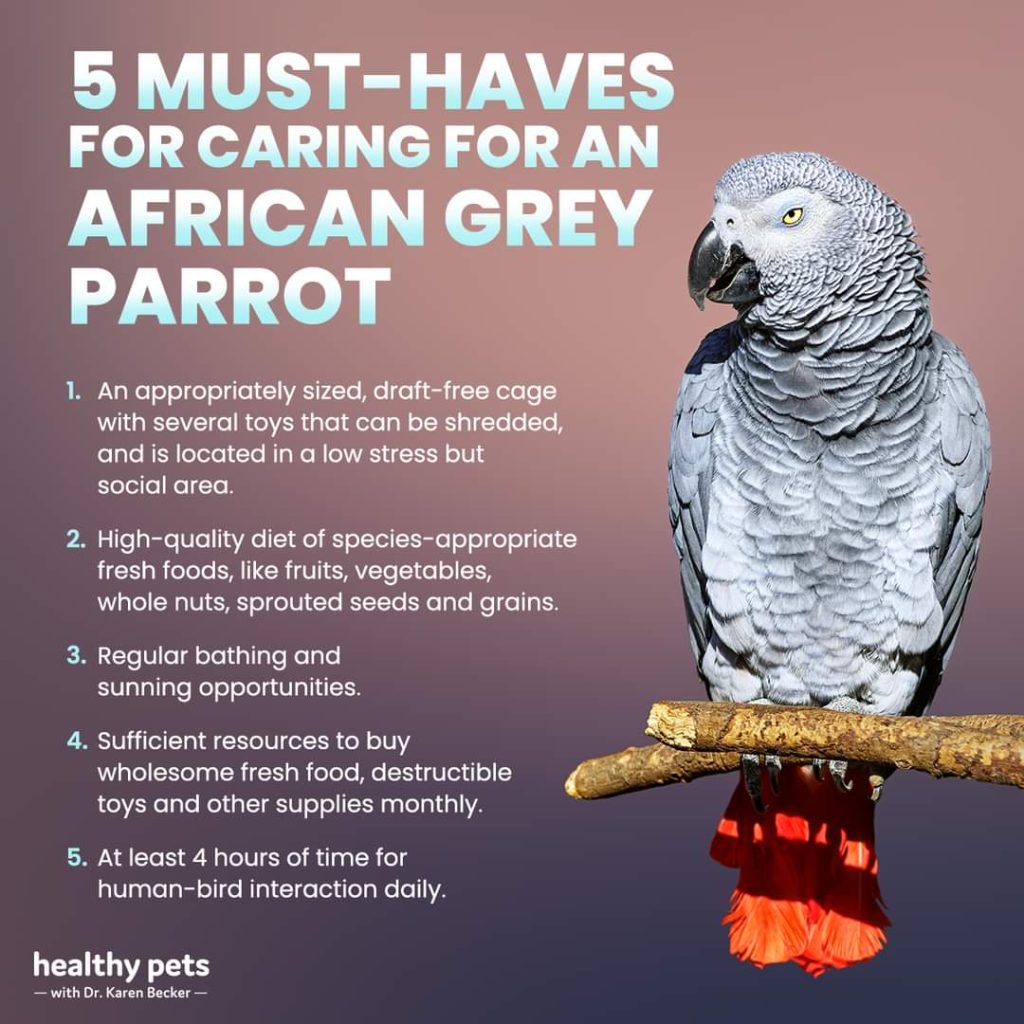
One glaring issue in the realm of bird ownership is the deceptive marketing of cages, such as the so-called “African Grey cage,” which often fails to meet the fundamental needs of the birds it has to house. Birds, especially larger species like African Greys, are meant to soar through the skies, exploring expansive territories and exercising their wings. Unfortunately, most commercial cages severely limit these natural behaviours, providing little room for flight and exercise.
Vertical cages, another popular choice among bird owners, contribute to the confinement dilemma. Birds predominantly fly horizontally in the wild, making vertical cages an impractical choice. With a horizontal cage, there is more room to fly across and more room to forage and play on the bottom. Many birds struggle even to flap their wings properly within the confined space, let alone experience the joy of flight. If a bird can’t expand their wings to full length without touching the sides nor be able to fly in their cage, then the cage is definitely not large enough! Round cages for example can pinch their feet where the cage bars become smaller, so it can be a safety issue.
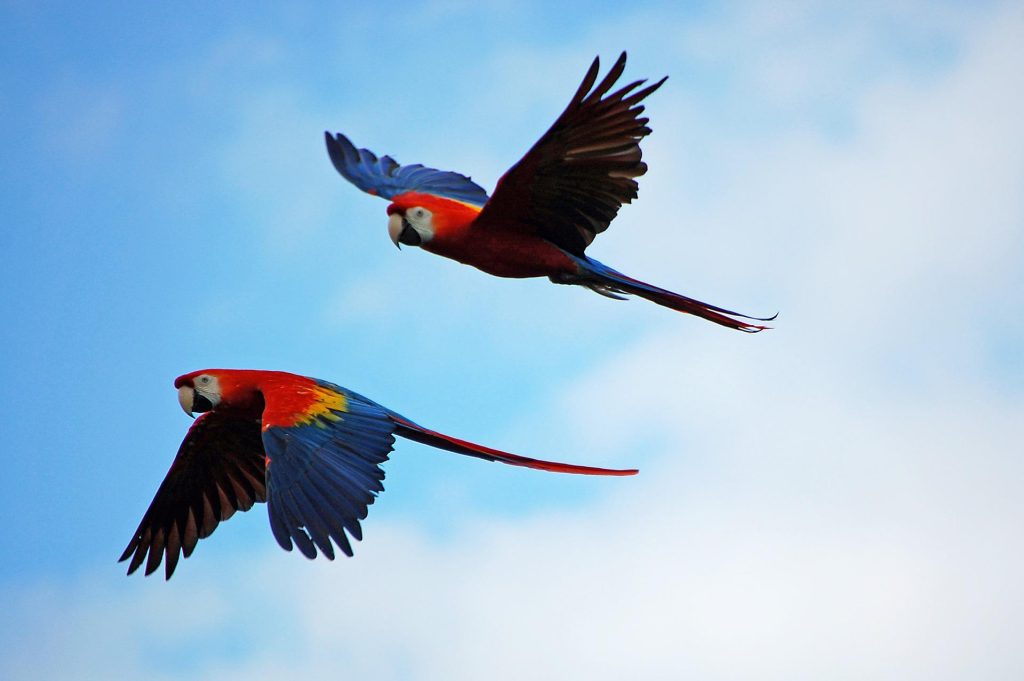
One of the five freedoms of animal welfare includes the opportunity to express natural behaviour. How much flight is your bird getting? This limitation results in physical and psychological distress for our feathered friends. Read more on enclosures for pets, including birds, here.
IGNORANCE AND INADEQUATE CARE
Beyond the physical constraints, the ignorance surrounding the proper care of birds exacerbates their suffering. Unlike cats and dogs, birds are not as domesticated (maybe tamed), making their needs distinct and often misunderstood. Many well-intentioned pet owners rely on advice from pet shops, assuming it to be comprehensive and in the best interest of the bird. Pet shops are in it for profit, not for improving the lives of animals, otherwise, they would not be selling them, fuelling the massive overpopulation crisis and encouraging impulse buying without proper homing! These sources rarely provide all the important information required for responsible bird ownership, if any.
Avian veterinary care is another aspect often overlooked. Many towns lack specialized avian veterinarians, leaving bird owners without access to crucial healthcare for their avian companions. Birds require regular check-ups, beak and nail trims, regular deworming and vitamins, and specialized diets to thrive. The absence of proper veterinary care further contributes to the cycle of neglect that captive birds endure.
Read here, why love for your pet, including parrots is not enough.
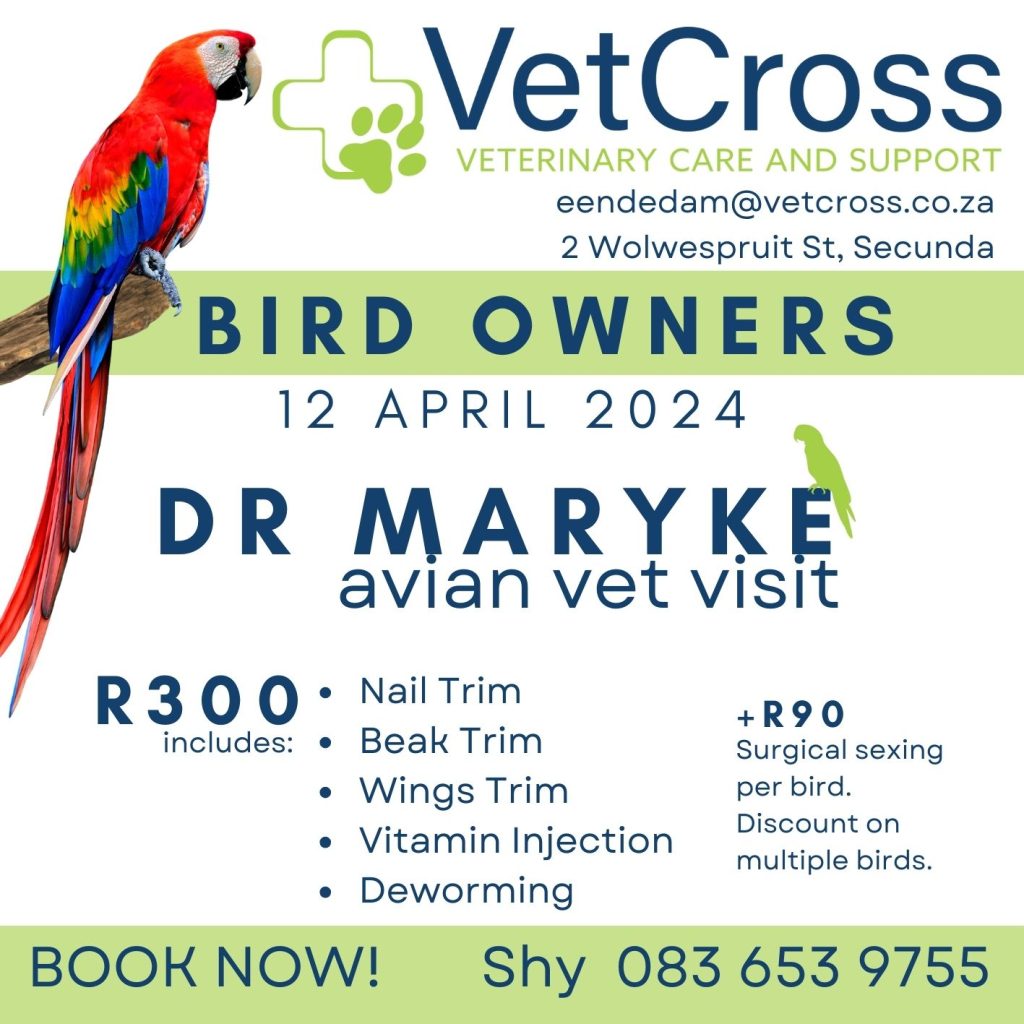
Our local bird educator is Shy and she can be contacted on 083 653 9755. She organizes and works closely with the Avian vet Dr. Maryke van Zyl who we bring to Secunda, hosted by Vetcross Eendedam Veterinary Clinic. The next visit is on 12 April so make sure you book with Shy.
SOCIAL ISOLATION AND LACK OF ENRICHMENT
Birds are highly social creatures, thriving on interaction with their own kind. Yet, many are kept in solitary confinement, deprived of the companionship they crave. This isolation can lead to behavioural issues, anxiety, and even depression in these intelligent and social animals.
Enrichment, both mental and physical, is crucial for a bird’s well-being. Inadequate stimulation in a cage leads to boredom, frustration, and stereotypical behaviours, such as incessant feather plucking. Owners must provide toys, puzzles, and activities that mimic the challenges birds face in the wild, fostering a more fulfilling and natural life for their avian companions.
For many reasons, birds are not good starter pets for kids.
HIDDEN DANGERS IN THE HOME
The hazards of everyday household items pose yet another threat to captive birds. Non-stick pans, scented candles, air purifiers, gas heaters, and various chemicals emit fumes that can be toxic to your pets. Many pet owners are unaware of these dangers, inadvertently exposing their feathered friends to harmful substances that compromise their respiratory systems and overall health.
A LONGER COMMITMENT
The longevity of parrots, often living several decades, poses a unique challenge in the realm of pet ownership. Many well-meaning individuals acquire these intelligent and sociable birds without considering the lifelong commitment required. As these feathered companions age, they frequently find themselves passed on from one home to another, becoming casualties of changing circumstances or unprepared owners. For some parrots, this happens 6 or 7 times in their lifetime! Sadly, a significant number of these birds are not even included in their owner’s wills, leaving them in a state of uncertainty. The fortunate ones find solace in rescues or with dedicated rescuers who open their hearts to provide a haven for these neglected souls. Despite the rescuers’ best efforts to offer a vastly improved life, the birds, who are human-imprinted, bear the lifelong scars of their past. While these rescues bring comfort and care, the shadow of a life spent in cages persists, a sad reminder of the challenges faced by parrots who, through no fault of their own, endure a journey of many homes.
If you find wild birds in the Secunda area you can contact Shy 083 653 9755 or Stefan 079 771 7125 for guidance. Please do not give these birds to well-intentioned people, who do not have the permits or proper knowledge to take care of them. Remember that Pronutro is a no-go to feed! Read more on how to find missing parrots here and how to help wild birds here.
If you did your homework and still want a bird, please adopt and don’t support any free birds or breeders who are causing this problem that rescues must try to fix. Read more here on what to consider before you get a bird. Brainy Bird – Parrot Rescue and Rehabilitation is an awesome bird rescue you can volunteer at in Gauteng or support in other ways.
It is time for a collective awakening to the inherent cruelty of keeping birds in cages. The soaring melodies and vibrant plumage of these creatures should not be confined to the bars of a cage. Responsible ownership demands a deeper understanding of avian needs, a commitment to proper care, and the acknowledgment that birds are not mere ornaments but sentient beings deserving of a life that mirrors their natural instincts and behaviours. Let us unite in advocating for the rights of our feathered companions, ensuring they are not sentenced to a life of captivity but instead afforded the freedom and dignity they were born to experience.
We will fight not until the cages are comfortable, but until they are empty! Join us by not supporting this industry!
Next week we will look at what to do when your pets go missing.
This article was first posted on Lake Umuzi’s website by Rolin Booysen. Read the origional HERE.
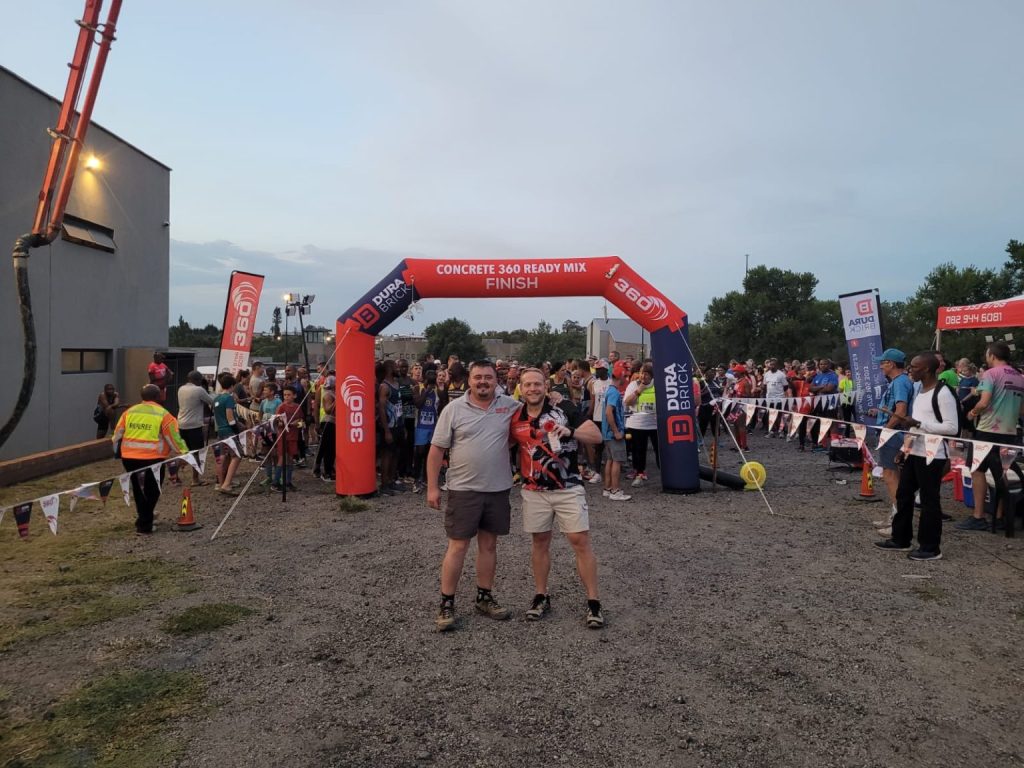
On the evening of February 14, 2024, theConcrete 360 Readymix Valentine’s Night Race unfolded, hosted by the Lake Umuzi Secunda Marathon Club. Against the backdrop of a warm summer night, 325 avid runners, along with their families, gathered to participate in this exciting event.
Stefan Roos & Louis Sauer from Concrete 360 Readymix
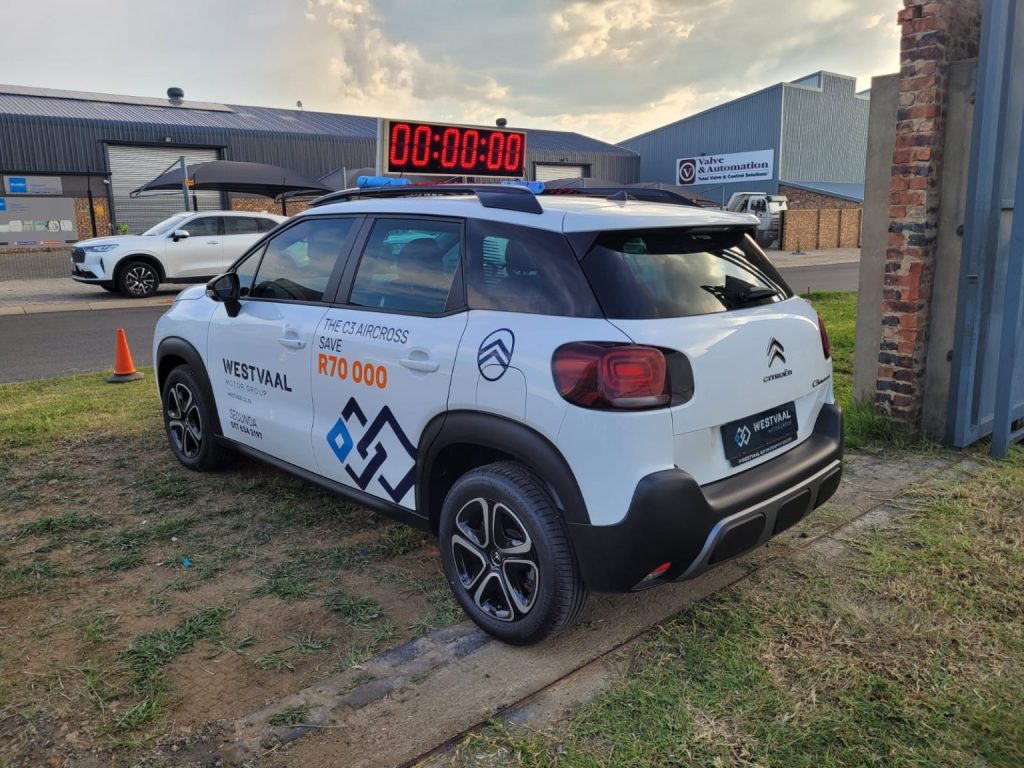
Under the banner of Concrete 360 Readymix, the 10km race commenced with a unique touch—a mixing truck that set the scene of a bustling city race. The support from neighboring marathon clubs, including Bethal, Standerton, Ermelo, and Sasol, was evident, as athletes from these communities joined in significant numbers. Leading the pack was the brand new Citroën C3 from Westvaal Secunda, guiding the front runners through the race. The unmistakable presence of Evander Athletics Club’s bus added an extra layer of enthusiasm, fueling the spirit of the race.
Westvaal Secunda’s Citroën C3
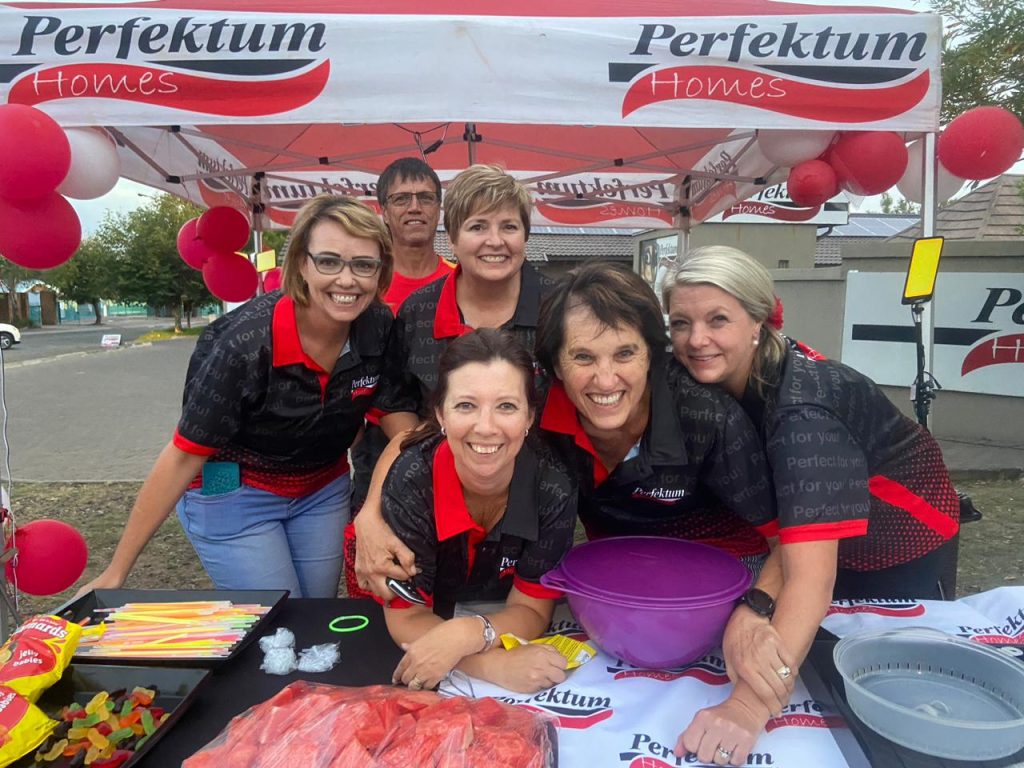
The waterpoints sponsored by Rawson Properties and Perfectum Homes played a crucial role in ensuring the runners remained hydrated and energized, maintaining their stamina throughout the race.
Perfectum Homes’ Waterpoint
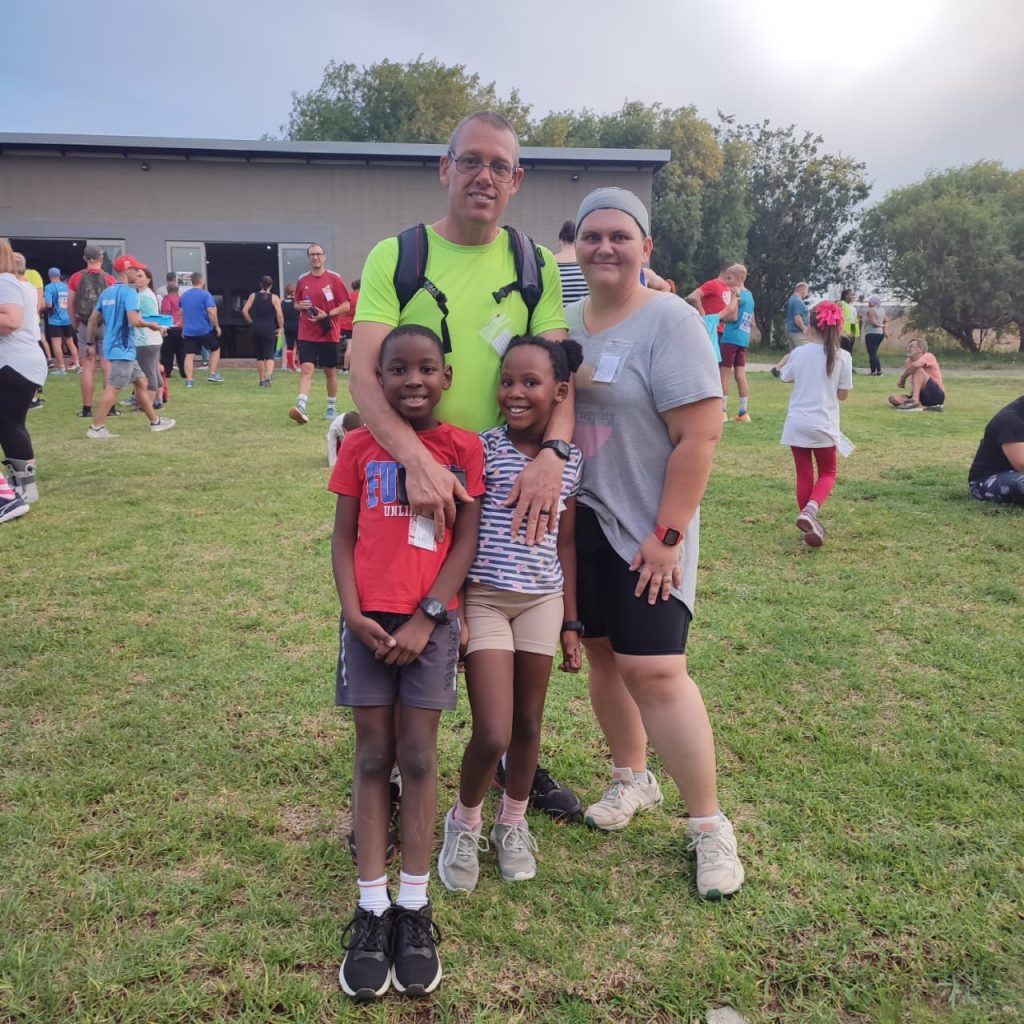
Not limited to the seasoned runners, the 2km fun run saw the participation of 210 individuals, providing an opportunity for families and couples to engage in a unique Valentine’s Day activity as the sun set over Secunda.
Campher Family ready for the Fun Run
The Lake Umuzi Secunda Marathon Club extends heartfelt appreciation to Concrete 360 Readymix. Their unwavering support not only made the Valentine’s Night Race possible but also included invaluable assistance at the entry points and the provision of a sweeper vehicle, ensuring the safety of all participants as they made their way back to Lake Umuzi Waterfront.
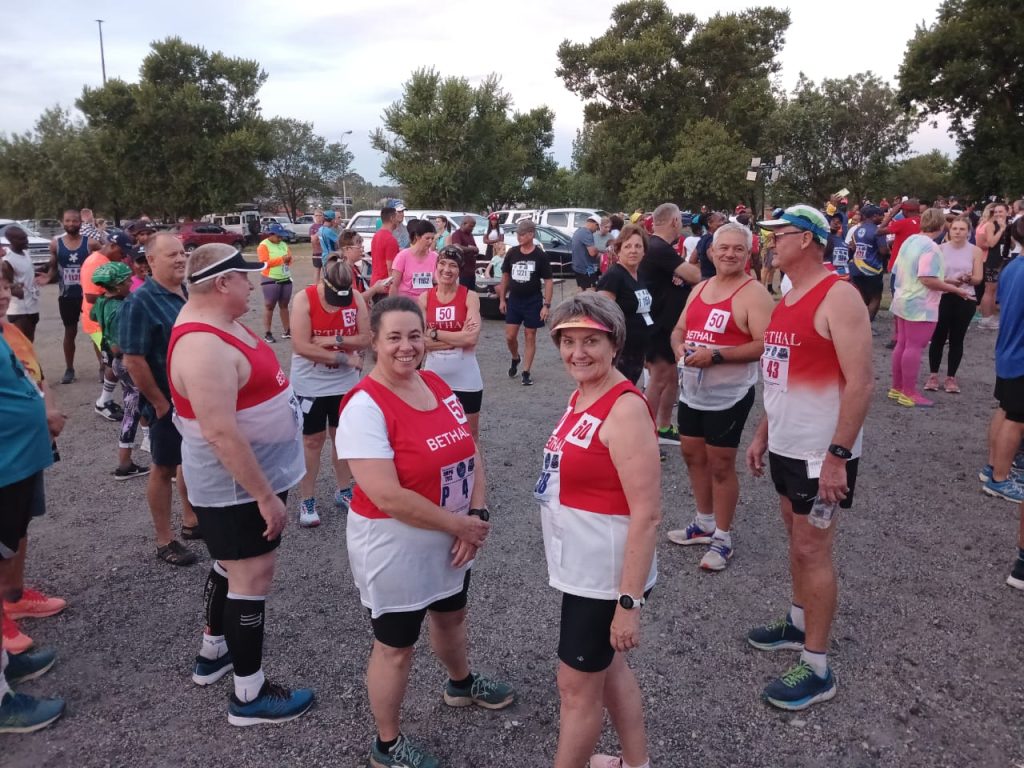
Bethal Marathon Clubs runners
As we bask in the success of the Valentine’s Night Race, our eyes are already set on the Kijima Kosmos 3 in 1, scheduled for March 9, 2024. To secure your camping spot, be sure to book your camp accommodation promptly, as other lodging options around Lake Umuzi are already fully booked.