Govan Mbeki Municipality has tabled a draft 2026/27 Medium-Term Revenue & Expenditure Framework that lays bare a municipality under acute financial stress. The document, prepared in line with MFMA and National Treasury guidance, shows rising costs, shrinking capital investment and a funding shortfall that threatens service delivery and legal compliance.
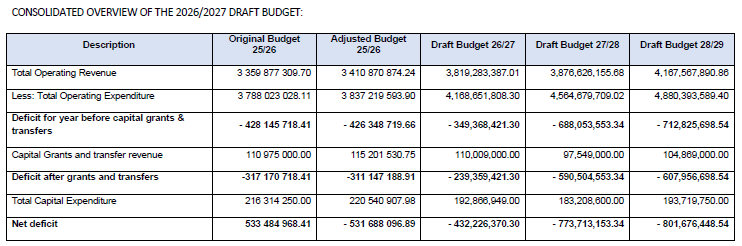
A stark funding gap The draft budget projects operating revenue of R3.819 billion against operating expenditure of R4.169 billion — an operating deficit of about R349 million. Including capital, the municipality faces an overall deficit of R432 million. These shortfalls come alongside a reduced capital programme of R192.9 million for 2026/27, down by R27.6 million from the adjusted 2025/26 budget, constraining investment in infrastructure at a time when maintenance and upgrades are critical.
Mounting liabilities and cash-flow risk The municipality’s creditors currently total R7.638 billion, with Eskom and Rand Water the largest outstanding accounts. At an assumed 66% payment rate, only R4.45 billion of debt is realistically collectible over time — well short of what is needed to meet obligations and sustain operations. The budget papers warn the municipality will be unable to pay obligations as they fall due, risking non-compliance with Subsection 99(2)(b) of the Municipal Finance Management Act and exposing the council to potential litigation, additional interest charges and escalating legal fees.
Drivers of the deterioration Operating expenditure has increased by R331.43 million relative to the current adjusted budget, driven mainly by salary increases (kept within the 35% regulation), higher bulk-purchase costs and general inflation. Revenue growth is constrained, and without decisive action collection rates, operating efficiency and cost control will not improve fast enough to close the gap.
Service delivery and personnel implications Cash-flow constraints could leave critical vacancies unfilled, undermining service delivery and limiting the municipality’s operational capacity. The papers call for an urgent, intensive review of the organizational structure to align staff to essential deliverables.
Policy response and recommended measures The draft reiterates the statutory requirement to adopt funded budgets and urges immediate interventions: expenditure reprioritization, strict cost containment, intensified revenue enhancement and improved credit control, and full implementation of mSCOA. Administratively, the municipality proposes tariff increases (water and sewerage up to 11%, provisional electricity 12.74%, assessment rates and other tariffs around 3.7%) and other policy measures aimed at stabilizing finances. The document also stresses that if an unfunded budget is adopted, Council must table a credible plan showing how the municipality will move to a funded position.
Political fallout: opposition to an unfunded budget The funding gap and the municipality’s precarious cash position drew political opposition. The Democratic Alliance (DA) and the Freedom Front Plus (FF+) voted against accepting an unfunded budget, signalling concern that the draft fails to provide a sustainable, lawful funding model and warning that continued acceptance of unfunded budgets will deepen financial instability and compromise core services.
Conclusion Govan Mbeki’s 2026/27 draft budget signals an urgent need for decisive, sustained fiscal action. The operating and overall deficits — R349 million and R432 million respectively — coupled with R7.638 billion in creditors and limited collectible debt, create an immediate liquidity crisis with legal and service-delivery consequences. While the administration has proposed revenue and cost measures, the rejection by DA and FF+ of an unfunded budget underscores the political and governance challenge: without a credible, fundable plan and disciplined implementation, the municipality risks further deterioration in financial health and service outcomes.
An unfunded budget cannot be supported