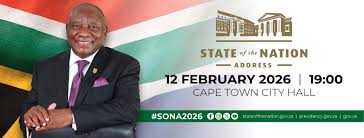
President Cyril Ramaphosa’s 2026 State of the Nation Address set a determined tone for a year of reform, recovery and renewal. Framing the moment with the memory of the 1956 women’s march and other milestones of the struggle, the President linked South Africa’s constitutional promise to a set of bold, practical priorities: drive inclusive growth and job creation; reduce poverty and the cost of living; and build a capable, ethical, developmental state.
A renewed focus on security and the rule of law dominated the agenda. Organised crime and gang violence were identified as the most immediate threats to democracy, public safety and economic progress. The government will pursue an intelligence-led, integrated enforcement strategy, consolidate national intelligence efforts, and deploy multidisciplinary teams to dismantle priority syndicates. The South African National Defence Force has been authorised to support police operations in hotspot provinces, and 5,500 new police recruits will join this year in addition to prior commitments. A criminal-justice reform initiative, modelled on Operation Vulindlela, aims to strengthen institutions — from the SIU and Hawks to the NPA — while a Whistle-Blower Protection Bill and procurement reforms are intended to reduce corruption and restore public trust.
Water insecurity and local government dysfunction are being elevated to the national scale. The President announced a National Water Crisis Committee to coordinate rapid responses and long-term investments. More than R156 billion in public funding has been committed for water and sanitation over three years, alongside a R54 billion incentive for metros that reform water, sanitation and electricity services. Legislative measures — including the Water Services Amendment Bill — will enable the government to hold providers accountable and intervene where municipalities fail. A revised White Paper on Local Government promises a differentiated, merit-based approach to municipal responsibilities, stronger accountability and faster national interventions when needed.
Economic recovery is central to the plan for inclusive growth. Four consecutive quarters of GDP growth, two primary budget surpluses, an improved credit rating and lower inflation signal positive momentum. To convert this momentum into enduring job creation, government has pledged over R1 trillion in public infrastructure investment over three years and launched an infrastructure bond that was heavily oversubscribed. Reforms to speed commercial dispute resolution (specialised courts), create a professional State Property Company, and expand Operation Vulindlela’s market-opening reforms aim to attract further private investment.
Energy and logistics reforms are key to long-term competitiveness. Load shedding has been ended and the country is accelerating a transition toward renewables, targeting more than 40% of energy from clean sources by 2030. Eskom is being restructured with an independent transmission entity and immediate steps to begin independent transmission projects. Rail and port turnarounds — including private concessions at major terminals and enabling private rail operators — are intended to reduce costs and connect producers to global markets. Preparations for high-speed rail and public-private partnerships in critical corridors were also announced.
Job creation and industrial transformation are priorities across sectors. The Presidential Employment Stimulus has created more than 2.5 million opportunities, and public employment programmes will be expanded and better coordinated to provide income, skills and pathways to long-term work, particularly for youth and women. Government set an ambitious R2 trillion investment target over five years and committed funding for small and medium enterprises — more than R2.5 billion for 180,000 firms plus R1 billion in guarantees — with special focus on women- and youth-led enterprises. Incentives for the green economy (including a 150% tax deduction for new electric vehicle investment) and measures to promote beneficiation of critical minerals are designed to position South Africa for global demand.
Agriculture and the response to disease received urgent attention: a national vaccination programme for 14 million cattle (28 million doses) was announced to combat a severe foot-and-mouth outbreak, with a task team reporting monthly. The agriculture sector’s export potential was underscored, and finance and extension services will be scaled up for emerging black producers.
Education and skills development are framed as pillars of the skills revolution. Early childhood development is being expanded — including compulsory Grade R and increased ECD subsidies — while the government pursues a dual training model linking classroom learning to workplace experience. The matric class of 2025 achieved an historic 88% pass rate, but the address stressed the need to reduce dropout rates and expand access to science, technology, engineering and mathematics. Reforms to SETAs, greater use of TVET colleges, and changes to skills-levy returns aim to better align training with employer needs.
Social protection, housing and child welfare were emphasized as essential to an inclusive recovery. The Social Relief of Distress Grant will continue but be redesigned to support livelihoods and pathways to sustainable employment. A new housing model will prioritize subsidies for ownership and rental in suitable areas, and the District Six restitution programme will continue with Phase 4 funding. A national mission to end child stunting by 2030 was launched, with targeted interventions for the first 1,000 days of life and allocations to be set out in the Medium Term Budget Policy Statement.
Health and gender-based violence drew urgent, actionable commitments. Investment in health infrastructure and academic hospitals will be prioritised, beginning with George Mukhari Hospital. A mass rollout of Lenacapavir — a six-monthly HIV prevention injection — and a nationwide push to vaccinate girls against HPV aim to reduce HIV transmission and cervical cancer. GBV and femicide, declared a national disaster, will be addressed through improved investigations, expanded sexual offences courts, survivor-centred services, and prevention campaigns.
On migration and borders, the address combined enforcement with human rights protections: funding for border infrastructure and technology, expanded Electronic Travel Authorisation systems, and prosecutions for employers who hire undocumented workers. Ten thousand new labour inspectors will strengthen enforcement of labour laws, while the government reiterated that foreign nationals must not be denied access to essential services.
Strengthening the state and digital transformation were central themes. Legislative reforms, including the Public Service Amendment Bill, will protect senior appointments from political interference and enforce lifestyle audits and a central registry for disciplinary cases. SOE governance will be tightened through clearer appointment standards and a phased move to centralised portfolio management. A Digital ID and the MyMzansi platform will digitise key services — driver’s licenses, matric certificates, police statements and SASSA eligibility checks — expanding access and reducing bureaucratic barriers.
Internationally, South Africa will continue to champion multilateralism, African integration and the interests of the Global South. The government affirmed its commitment to the AfCFTA, economic diplomacy to expand exports, and continued participation in peacekeeping and conflict-prevention efforts. The address reiterated South Africa’s principled stance on sovereignty and human rights across global conflicts.
The President framed 2026 as a turning point: the country is emerging from a period of decline and moving toward growth, with concrete actions to fix local government, fight crime and corruption, create jobs, and build a state that delivers. A National Dialogue process will deepen public participation and culminate in a national convention to define a national compact and inform the next phase of the National Development Plan beyond 2030. The address closed with a call to collective action: to ensure that growth lifts all South Africans, restores trust in public institutions, and secures a more equitable, resilient future.
Overall, the address combined immediate operational measures — security deployments, water crisis interventions, vaccination drives and recruitment targets — with long-term structural reforms in infrastructure, energy, local government, skills, and the public service designed to convert recent economic gains into inclusive, sustainable progress.